Intro
Agentic commerce is the point where your customer stops shopping and lets an AI do it for them. And most small businesses have no idea it is barreling toward them. The big retailers are already prepping. You are busy actually running the shop.
And it is moving faster than it feels. This is really the same story as showing up in AI search results, since the assistants answering questions are the ones learning to buy.
So here's the plan, hype stripped out. We will show you what agentic commerce actually means for a shop your size and why it won't wait. Then the strategies to get ready, and the mistakes to dodge.
What Agentic Commerce Means For A Small Business
Agentic commerce just means an AI agent does the shopping instead of the customer. They say what they want in plain words. The agent hunts down the options, weighs them, and buys. They only step in to approve it, if that.
You have already seen the baby version. Ask ChatGPT for a gift, and it comes back with products. The next move is it just buying one, no clicking through on your end.
For a small shop, that is a genuine shift. Your next buyer might be a bot with a budget and no patience at all for a website it can't figure out.
How Agentic Commerce Actually Works
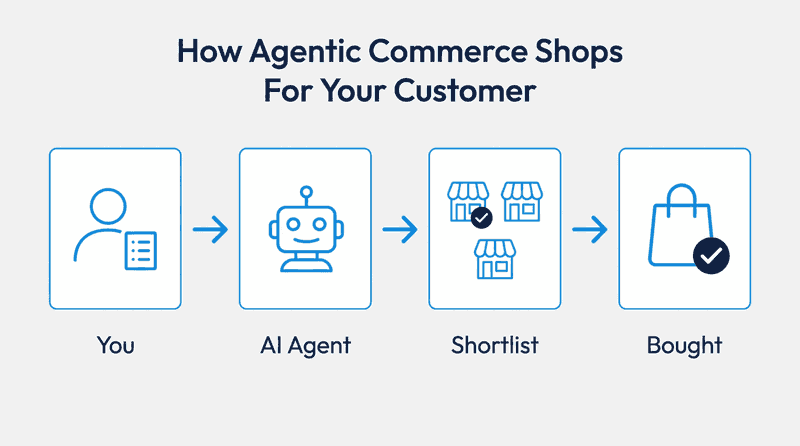
Look closely, and it is a short little chain. The agent reads the request. It goes looking across different places for a match. It checks the price and whether you have the thing in stock. Then it pays.
The All-in-One Platform for Effective SEO
Behind every successful business is a strong SEO campaign. But with countless optimization tools and techniques out there to choose from, it can be hard to know where to start. Well, fear no more, cause I've got just the thing to help. Presenting the Ranktracker all-in-one platform for effective SEO
We have finally opened registration to Ranktracker absolutely free!
Create a free accountOr Sign in using your credentials
That paying bit leans on new rules the big players are wiring up, usually called an agentic commerce protocol. They let an agent pay a real shop with real card details and leave a clean record behind. You don't build any of it. You just have to be there when an agent comes looking.
Why Agentic Commerce Is A Small-Business Problem, Not Just A Retail-Giant One
Easy to assume this is an Amazon problem. It really isn't. An agent doesn't care how big you are. It cares whether it can read your prices and trust your reviews and actually get through checkout.
Which is weirdly great for the little guy. A small shop with tidy, clear info can out-rank a sloppy giant in an agent's head. Easiest to deal with wins, not biggest.
Why Small Businesses Can't Wait On Agentic Commerce
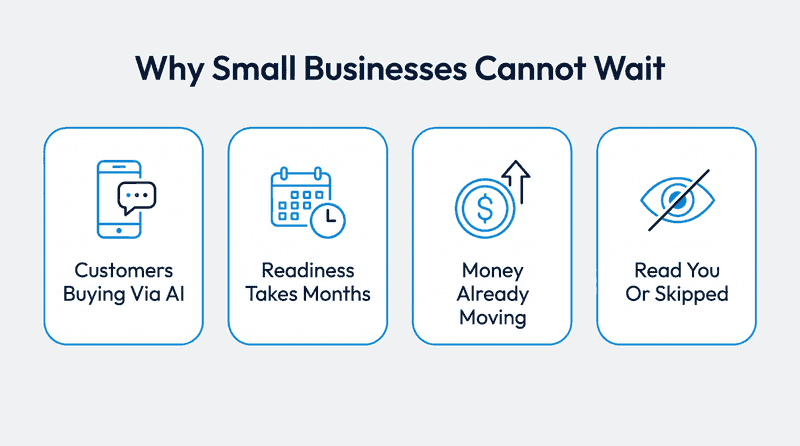
Sure, but does this need dealing with right now? It does. Four reasons it won't wait for a quieter month.
1. Your Customers Are Already Shopping Through AI
Not a future thing. People are already handing their shopping over to AI assistants and quite enjoying it.
Adobe went and counted. Out of more than 5000 US shoppers they surveyed, 39% had already used generative AI to shop. Another 53% said they plan to this year. That is a whole lot of people getting used to a conversational search experience rather than 10 blue links.
2. Getting Ready Takes Months, Not A Weekend
The tricky part is the timeline. The stuff that makes you legible to an agent grows slowly. Reviews. Clean listings. A site a machine can read. A track record. None of it shows up overnight.
So the shops starting today are already a year ahead by the time this goes mainstream. Leave it, and you are building from scratch while rivals are already on the shortlist.
3. The Dollars Are Already Moving Through Agents
This isn't play money either. Agents are closing real sales at real scale. They are not just browsing and bailing. One recent Cyber Week Salesforce clocked AI and agents swaying 20% of orders and driving $67 billion in sales. A fifth of a record-breaking week, already flowing through AI. That share isn't shrinking.
4. An Agent Either Reads You Or Skips You
A human cuts you slack. They will squint at a clumsy site and look for what they need. An agent won't lift a finger extra. It reads what it can and ignores the rest. No squinting. No second chance. No note telling you why you lost. So a hard-to-read shop isn't a minor ding. It is the sale vanishing, and you never even clock that it happened.
How To Get Your Small Business Ready For Agentic Commerce: 7 Proven Strategies
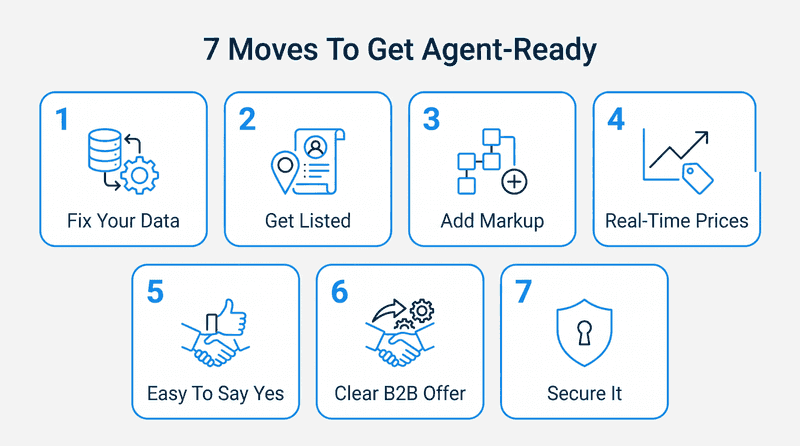
Right, the hands-on bit. Seven moves. Each one patches a different thing an agent needs from you. You won't knock out all seven this week. You can start one today.
1. Fix Your Product And Service Data First
This one holds up everything after it. An agent knows exactly what your data tells it and not a scrap more. Half-finished or self-contradicting listings leave it to guess, and it won't bother. It will pick the shop it can actually read.
The All-in-One Platform for Effective SEO
Behind every successful business is a strong SEO campaign. But with countless optimization tools and techniques out there to choose from, it can be hard to know where to start. Well, fear no more, cause I've got just the thing to help. Presenting the Ranktracker all-in-one platform for effective SEO
We have finally opened registration to Ranktracker absolutely free!
Create a free accountOr Sign in using your credentials
You can get a gorgeous design, but it counts for nothing here because the machine never sees it. It reads the facts and goes with whatever you wrote down. It also helps to keep those facts matching everywhere they show up, since agents cross-check.
Data quality bites hardest in categories where the specs decide the sale. Building materials are a good example. Nobody buys the wrong size or rating by accident. The attributes have to be exact or the order is useless. An agent matching one of those requests has to read real numbers.
This online insulation store is a clean example of doing this right. Their insulation catalog lists the things an agent actually needs to match a query. R-values like R-19. Dimensions like 4ft by 8ft. The material too, from fiberglass to mineral wool to rigid foam board. Unit pricing per board or per square foot.
An agent can act on data like that without hesitating. Someone asks for R-19 fiberglass batts for a wall, and the match is obvious. For your store, the same idea works, whatever you sell. Write down the attributes that actually decide the purchase. Be exact and consistent. An agent rewards the business whose facts leave nothing to interpret.
How To Do It:
- Write complete specs for every product, including the attributes buyers actually filter by
- Use the same product names and units across your site and every feed
- Fill in the brand, size, material, and price fields buyers expect
- Fix listings that disagree with each other before an agent ever reads them
2. Get Listed Where Agents Actually Pull From
Spotless data does nothing stuck on a page no agent visits. Agents don't roam the whole web hoping to stumble on you. They lean on a short list of sources they already trust. Product feeds. The big marketplaces. Google's shopping data. Review sites. Skip those, and you are simply not in the running, however lovely your own site is.
It pays to keep an eye on where you already turn up too. You can track your brand mentions across AI search and see which engines are putting you forward, and which leave you off entirely.
How To Do It:
- Submit a complete product feed to Google and every major marketplace you reach
- Claim and finish your profiles on the directories your buyers trust most
- Check which AI engines already show your business and which leave you out
- Keep every listing current so no agent ever pulls an outdated version
3. Add The Markup That Lets An Agent Read Your Site
People forgive a busy page and just read around it. A machine can't. It needs the facts labeled so it knows a price is a price and a review is a review.
That labeling has a name. It is called structured data. Without it, your page is a blob of text an agent has to squint at. Add it, and your site reads like a tidy little spreadsheet. It is the same groundwork behind answer engine optimization, where you format content so an AI can lift a clean answer straight off the page.
How To Do It:
- Add schema markup for your products, prices, and reviews on every page
- Label the key facts so a machine knows what each number actually means
- Put a direct answer in the first few lines under each heading
- Test your pages in an AI assistant to see what it extracts
4. Keep Your Prices And Stock True In Real Time
Getting picked means nothing if the agent then trips over a wrong price or a sold-out item. The second your listing and reality disagree, you read as unreliable. Down the ranking you go.
A person shrugs off a slightly-off price. An agent won't. It is deciding on the exact numbers in front of it. A wrong one turns into a bounced order or a refund you are eating later. Either way, it learns to stop trusting you.
How To Do It:
- Sync your stock levels across every channel in close to real time
- Update prices everywhere the moment they change, not just once a week
- Pull sold-out items quickly so no agent ever promises what you lack
- Connect your systems so a single update reaches every listing at once
5. Make A Considered Purchase Easy To Say Yes To
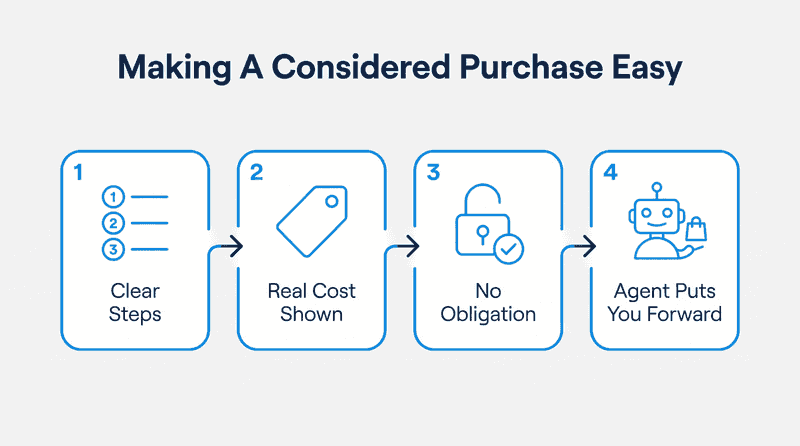
Not every sale is a quick yes. Some carry real hesitation. A big price tag. A health angle. Rules about who is even allowed to buy. With those, your problem isn't getting found. It is getting trusted.
Health is where the nerves run highest. There is a prescription involved. A real bill. A genuine fear of getting it wrong. So the buyer hesitates. An agent hesitates even harder, because it won't gamble its human into a medical purchase on a fuzzy promise. The only fix is a process so clear the worry drains out of it.
UpGuys lays its online testosterone therapy out with no guesswork at all. You kick off with a free questionnaire. A licensed practitioner reads it and orders lab work. They ring you with the results and decide whether treatment even makes sense. You pay nothing unless something is actually prescribed.
Look at what that does. Every nervy part of the purchase is handled before you are asked for a cent. An agent can line a path like that up without flinching, since nothing in it smells like a trap.
For your own high-consideration offer, copy the transparency. Show the steps, the real cost, and the point where there is no obligation. Make saying yes feel safe, and an agent will carry you further.
How To Do It:
- Lay out every step of the buying process clearly before anyone has to commit
- Show the true total cost up front with no surprise fees at checkout
- Offer a clear guarantee or return path that removes the buyer's risk
- Spell out any rules on who can buy well before they start
6. Translate A Complex B2B Offer So An Agent Can Match It
B2B plays by its own rules. The offers are dense, and the terms are thick. Buyers want very particular things. An agent sent out to find a supplier can't match what it can't understand. Write your site like everyone already knows your industry's shorthand, and the agent just moves on to the vendor who said it in plain English.
And the pot here is huge. Gartner reckons that by 2028, 90% of B2B buying will run through AI agents. Call it north of $15 trillion. If your offer reads like alphabet soup, that is a mountain of deals you are simply invisible for.
The narrower your niche, the more an agent needs it decoded. Think of a vendor serving one tight corner of one industry. It is full of its own contracts and compliance rules and three-letter acronyms. A human in that trade reads it fluently. An agent is lost unless the site turns all that shorthand into plain facts it can match on.
This DCAA-compliant accounting software does exactly that. It is as niche as niches get. Instead of hiding in the jargon, their site says plainly who it is for. Professional services firms running project accounting. Contract manufacturers billing by time-and-materials or milestone or cost-reimbursable. Resellers working GSA Schedule and SEWP. It states flat out that the financials are DCAA-compliant.
Every line of that is a hook an agent can hang a buyer on. A contractor's agent looking for DCAA-compliant project accounting finds a dead-on fit instead of a fuzzy ERP pitch.
Your own B2B offer needs the same treatment. Translate the shorthand, and an agent can finally hand you the buyers who wanted exactly you.
How To Do It:
- Name the exact industries and buyer types your offer is built for
- Translate every acronym and standard into plain words an agent can read
- List the specific contracts and certifications and compliance rules you actually meet
- State your pricing model clearly even when every single deal is custom
7. Secure The Systems Your Agents Will Touch
Nobody loves this part, so let's be quick. The minute agents are reading your data and firing off orders, you are a bigger target. More automated doors mean more ways in for someone who shouldn't be there. A breach now costs more than a lost sale. It can leak customer data and burn the trust you took years to earn.
Most small businesses don't have a security team. They definitely don't have one awake at 3 am. That was fine when attacks moved slowly. In an agent-driven shop, it is a real soft spot.
Automated systems get poked at constantly. The warnings come in faster than one tired person can ever read. The genuine threats end up buried under a heap of harmless noise, and nobody spots them until the damage is done.
This is the exact gap an agentic security operations setup is built to plug. You let AI agents take the first pass on security. They sort each alert and pin context to it. They match it against known attack patterns and then flag the two or three that genuinely need a human.
A person still makes every real call, while the agents clear away the noise underneath. For a lean shop that is round-the-clock cover without hiring a team. And it stops your agent-ready store from being the open door nobody was watching.
How To Do It:
- Turn on multi-factor login for every account and system an agent reaches
- Limit what each connected tool or integration is actually allowed to access
- Watch your security alerts around the clock using a tool or a service
- Keep every system patched so an agent never opens a known hole
3 Agentic Commerce Mistakes Small Businesses Make + How To Fix Them
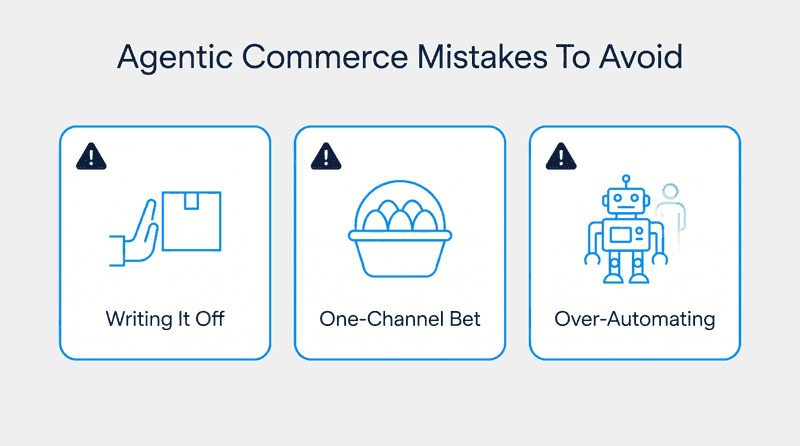
A few mistakes cause problems for small businesses as agentic commerce rolls in. These three turn up the most, and each one stings differently.
1. Writing Agentic Commerce Off As A Big-Company Problem
The comfy assumption is that this is an Amazon thing, nothing a shop your size needs to lose sleep over. So it goes in the later folder. The trouble is, agents work like a leveler. They pick whatever is most readable and genuinely couldn't care less how big you are.
Brush the whole thing off, and you are handing your spot to a smaller rival who didn't. The cost isn't fuzzy. It is a competitor getting chosen on autopilot while you sat out the early rounds.
How to Fix: Treat it as the leveler it is. Start by actually measuring how visible you are to AI and agents right now, so the gap is a number instead of a worry. Then go fix your worst weakness first. This isn't a budget thing. It is about dropping the idea that your size is any kind of shield, because to an agent it isn't one.
2. Betting Everything On One Channel
The other side is piling everything into one shiny channel. You hear ChatGPT is shifting product. So you throw it all at that single agent and ignore the rest.
The issue is simple. Agentic commerce is splitting across loads of assistants and platforms. Each one feeds off different sources. Pin your whole future to one, and a tweak to its rules or a dip in its popularity erases you overnight. You have built your shop on ground you don't own.
How to Fix: Spread the groundwork across the sources that count instead of chasing one. Clean your data once and push it out everywhere, since the prep is identical for every agent. Watch which channels actually send buyers and lean into those, but never let one become your only way in.
3. Automating So Hard You Lose The Customer Relationship
Some owners hear all this and decide the goal is to automate themselves out of the picture entirely. Let the bots run everything and vanish. The problem is that the human relationship was the one thing agents can't copy.
If customers only ever meet your automated front door, there is nothing holding them when something cheaper shows up. You have turned yourself into a swappable supplier an agent drops without a flicker of hesitation.
The All-in-One Platform for Effective SEO
Behind every successful business is a strong SEO campaign. But with countless optimization tools and techniques out there to choose from, it can be hard to know where to start. Well, fear no more, cause I've got just the thing to help. Presenting the Ranktracker all-in-one platform for effective SEO
We have finally opened registration to Ranktracker absolutely free!
Create a free accountOr Sign in using your credentials
How to Fix: Let the agents run the transaction while you hang onto the relationship. Automate the dull machinery like booking, billing, and reorders. Then show up as a human where it actually counts. In the work. In the judgment calls. In the touch a bot can't fake. Give people a reason to ask for you by name, so the next time their agent is told to come straight back to you.
Conclusion
Agentic commerce isn't waiting around for small businesses to feel ready. It backs whoever is easiest for a machine to read, trust, and buy from, and your size barely enters into it.
Clean data. Real visibility. A site agents can parse. Prices that hold up. A checkout that feels safe. None of that is about out-spending the giants. It is about being the clearest, most trustworthy pick at the one moment a machine is doing the choosing.
That visibility is the whole reason Ranktracker exists. We show you where you actually turn up as search slides from blue links toward AI answers and agents, so you can fix the weak spots before they cost you.
Getting ready for agentic commerce really starts with one honest look at how findable you are today. Try it now.