Intro
For decades, SEO data has been locked behind:
✔ proprietary crawlers
✔ closed datasets
✔ third-party APIs
✔ expensive enterprise tools
✔ opaque algorithms
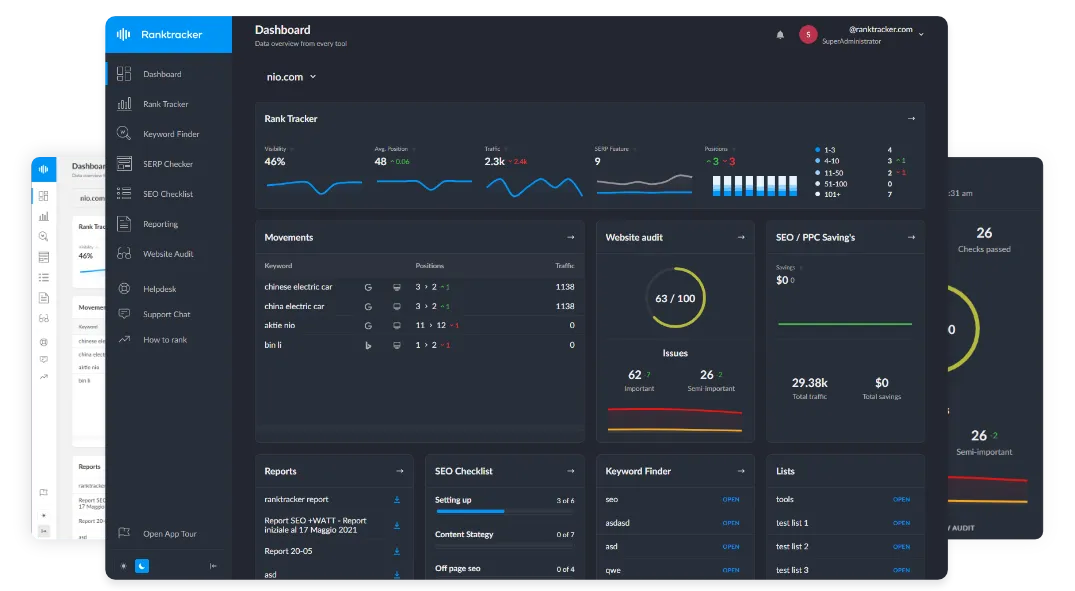
The All-in-One Platform for Effective SEO
Behind every successful business is a strong SEO campaign. But with countless optimization tools and techniques out there to choose from, it can be hard to know where to start. Well, fear no more, cause I've got just the thing to help. Presenting the Ranktracker all-in-one platform for effective SEO
We have finally opened registration to Ranktracker absolutely free!
Create a free accountOr Sign in using your credentials
Access to high-quality search intelligence required budget, connections, or both.
But in 2026, a major shift is underway.
Open-source language models (LLaMA, Mistral, Mixtral, Falcon, Qwen, Gemma, etc.) are beginning to democratize SEO data — not by replicating Google Search, but by enabling anyone to build, customize, and run their own search intelligence systems.
Open-source LLMs are becoming:
✔ personal analyzers
✔ data enrichment engines
The All-in-One Platform for Effective SEO
Behind every successful business is a strong SEO campaign. But with countless optimization tools and techniques out there to choose from, it can be hard to know where to start. Well, fear no more, cause I've got just the thing to help. Presenting the Ranktracker all-in-one platform for effective SEO
We have finally opened registration to Ranktracker absolutely free!
Create a free accountOr Sign in using your credentials
✔ competitive research assistants
✔ local indexing models
✔ self-hosted SEO platforms
✔ privacy-first analytics layers
This article explains why open-source LLMs matter, how they reshape SEO, and what marketers must do to leverage them for competitive advantage.
1. The Problem: SEO Data Has Historically Been Centralized
For years, only a few players owned the infrastructure required to deliver:
✔ large-scale indexing
✔ SERP analysis
✔ backlink mapping
✔ rank tracking
✔ keyword research
✔ competitive audits
This centralization created:
1. Unequal access
Small teams were priced out of enterprise tools.
2. Closed systems
Vendors controlled data structures, metrics, and insights.
3. Limited experimentation
If a tool didn’t offer a feature, you couldn’t build your own version.
4. Dependence on proprietary APIs
If a service went down, your data pipeline collapsed.
5. No transparency
Nobody knew how metrics were calculated beneath the UI.
Open-source LLMs fundamentally change this.
2. Why Open-Source LLMs Matter for SEO
Open models allow anyone — marketers, developers, researchers — to build their own:
✔ ranking engines
✔ clustering systems
✔ entity extractors
✔ topic classifiers
✔ SERP parsers
✔ backlink categorization pipelines
✔ local knowledge graphs
✔ competitor data analyzers
All without sending data to a cloud provider.
They make SEO intelligence:
✔ cheaper
✔ faster
✔ customizable
✔ transparent
✔ private
✔ portable
This transforms SEO from a tool-centric discipline into a model-centric one.
3. How Open-Source Models Reshape SEO Intelligence
Open-source LLMs democratize SEO data in several key ways.
1. Local SEO Processing (Privacy + Control)
You can now run models directly on:
✔ laptops
✔ servers
✔ on-prem hardware
✔ mobile devices
This enables:
✔ private log analysis
✔ private competitor research
✔ private content audits
✔ private customer data modeling
Without exposing sensitive information to third-party clouds.
2. Custom Ranking Models
Traditional tools give you one view of rankings. With open models, you can create:
✔ niche ranking systems
✔ entity-weighted ranking algorithms
✔ product-specific search engines
✔ local-first ranking simulations
✔ multilingual ranking models
Marketers can now simulate how different LLMs interpret the same industry.
3. Build Your Own SERP Intelligence Layer
Open-source models can:
✔ parse HTML
✔ summarize SERPs
✔ extract entities
✔ detect search intent
✔ evaluate competitors
✔ classify ranking patterns
This makes it possible to construct your own:
✔ AI-powered SERP analyzer
✔ local rank tracker
✔ competitor insights engine
— without relying on external APIs.
4. Topic Modeling at Enterprise Scale
Open models excel at:
✔ clustering keywords
✔ generating entity maps
✔ building topical graphs
✔ identifying content gaps
✔ grouping by search intent
This is the backbone of modern content strategy, and open LLMs make it accessible to all.
5. Automated Content Audits
Open models can detect:
✔ thin content
✔ duplication
✔ readability problems
✔ factual gaps
✔ inconsistent entities
✔ ambiguous definitions
✔ missing schema
✔ unclear topical depth
Even a small team can now run AI-powered audits that compete with enterprise tools.
6. Backlink Intelligence and Categorization
Open-source LLMs can categorize backlink profiles into:
✔ relevance
✔ authority
✔ intent
✔ risk
✔ semantic clusters
✔ anchor text themes
This takes link analysis far beyond metrics like DR/DA.
7. Multi-Lingual SEO at Scale
Open-source models (Qwen, Gemma, LLaMA 3) excel at cross-language capabilities:
✔ content translation
✔ keyword expansion
✔ intent matching
✔ entity consistency
✔ localized SERP simulations
This unlocks multilingual markets without enterprise budgets.
4. Which Open-Source Models Matter for SEO?
Here’s the current landscape.
1. Meta LLaMA (industry standard)
✔ excellent reasoning
✔ strong multilingual performance
✔ highly customizable
✔ widely supported
✔ best for general SEO tasks
2. Mistral / Mixtral
✔ extremely fast
✔ powerful for the size
✔ great for embeddings
✔ ideal for pipelines and agents
Best for large-scale SEO automation.
3. Qwen (Alibaba)
✔ best multilingual breadth
✔ strong research abilities
✔ great at extraction tasks
Ideal for international SEO.
4. Google Gemma (Open derivative of Gemini)
✔ compact
✔ efficient
✔ strong alignment
✔ great for semantic tasks
Excellent for entity extraction.
5. Falcon
✔ older but proven
✔ good for summarization
✔ stable
✔ widely adopted
Useful for lightweight SEO tasks.
5. Use Cases: How SEOs Are Already Using Open Models Today
Real workflows emerging in 2026:
1. Running a Local LLM Rank Tracker
Use open models to:
✔ identify ranking shifts
✔ classify SERP changes
✔ quantify intent drift
✔ label SERP features manually
✔ detect AI Overview triggers
This reduces reliance on expensive enterprise APIs.
2. Automated Keyword Clustering
Open models generate:
✔ semantic clusters
✔ intent-based groups
✔ entity-based topic buckets
✔ long-tail expansions
Replacing older statistical clustering tools.
3. Entity Extraction for LLM Optimization (LLMO)
Open models can identify:
✔ key topics
✔ attributes
✔ product entities
✔ brand relationships
This helps humans structure content for AI engines.
4. Local Knowledge Graph Building
Teams can build their own:
✔ brand graph
✔ industry graph
✔ product graph
✔ entity map
✔ topical authority index
This becomes core to AEO, AIO, and GEO strategies.
5. Competitive Intelligence
Open models run entirely local:
✔ SERP scrapes
✔ content summaries
✔ feature comparisons
✔ content gap analysis
✔ backlink categorization
Competitor data stays fully in-house.
6. Why “Democratization” Matters for the SEO Community
Open-source LLMs break long-term barriers:
1. No more gatekeeping of SEO knowledge
Anyone can build a custom SEO system.
2. Innovation accelerates
New tools emerge faster because:
✔ no licenses
✔ no vendor lock-in
✔ no rate limits
✔ full customization
3. Transparency improves
You can inspect:
✔ how models interpret content
✔ how entities are recognized
✔ how search intent is classified
✔ how ranking signals might be weighted
This fosters more ethical and accurate SEO research.
4. Local-first analytics grow
Marketers gain:
✔ privacy
✔ control
✔ stability
✔ independence
Open LLMs give SEOs sovereignty over their data.
7. How Ranktracker Fits Into the Open-Source LLM Future
Ranktracker is perfectly positioned to connect with open-source models:
Keyword Finder
Provides seed data for LLM-driven clustering.
Web Audit
Ensures content is interpretable by both:
✔ closed LLMs
✔ open-source SLMs
✔ retrieval engines
SERP Checker
Supplies structured SERP data that open models can analyze locally.
Backlink Checker + Monitor
Gives the link graph input for open LLM categorization.
AI Article Writer
Creates machine-friendly structure ideal for:
✔ open-source summarizers
✔ local embeddings
✔ custom search engines
Ranktracker becomes the data backbone, while open-source models become the analytic layer.
Together they form the foundation of modern SEO pipelines.
Final Thought:
Open-source LLMs are the biggest opportunity for SEO innovation since the invention of PageRank.
They:
✔ increase access
✔ lower costs
✔ accelerate innovation
✔ enable custom search systems
✔ decentralize intelligence
✔ empower small teams
✔ unlock new research frontiers
For the first time ever, any SEO team — not just enterprise platforms — can build its own:
✔ LLM-based optimization systems
The All-in-One Platform for Effective SEO
Behind every successful business is a strong SEO campaign. But with countless optimization tools and techniques out there to choose from, it can be hard to know where to start. Well, fear no more, cause I've got just the thing to help. Presenting the Ranktracker all-in-one platform for effective SEO
We have finally opened registration to Ranktracker absolutely free!
Create a free accountOr Sign in using your credentials
✔ content analyzers
✔ backlink intelligence engines
The future of SEO is open, decentralized, and model-driven. And the brands that adopt open-source LLMs early will gain a structural advantage that compounds every year.