Intro
Link building is still one of the most important parts of SEO, but the way teams build links has changed. A few years ago, most businesses focused heavily on guest posts. They would write a fresh article, publish it on another website, and place a backlink inside the content.
That still works when done properly.
But today, more agencies, SaaS teams, affiliate marketers, and SEO consultants are also using niche edits. Instead of creating a brand-new article, a niche edit places your link inside an existing, relevant page.
Both methods can help improve rankings, authority, referral traffic, and brand visibility. The real question is not whether niche edits or guest posts are “better” in every situation. The better question is which one makes more sense for your campaign, budget, timeline, and SEO goals.
In this guide, we will compare niche edits and guest posts, explain the pros and cons of each, and show when to use one over the other.
What is a niche edit?
A niche edit is a backlink added to an existing page.
The All-in-One Platform for Effective SEO
Behind every successful business is a strong SEO campaign. But with countless optimization tools and techniques out there to choose from, it can be hard to know where to start. Well, fear no more, cause I've got just the thing to help. Presenting the Ranktracker all-in-one platform for effective SEO
We have finally opened registration to Ranktracker absolutely free!
Create a free accountOr Sign in using your credentials
The page is already published, indexed, and often already has some history with Google. It may have existing backlinks, rankings, organic traffic, internal links, and topical authority.
For example, if you are promoting an SEO tool, a niche edit could be placed inside an existing article about keyword tracking, backlink analysis, or SEO reporting. The link is added naturally into the content where it helps the reader.
A good niche edit should be:
- Relevant to the article
- Placed on a real indexed page
- Written naturally into the existing content
- Do-follow where possible
- Permanent
- Supported by a clear delivery report
The biggest appeal of niche edits is that you are not starting from zero. The page already exists, so the link can often start providing value faster than a brand-new guest post.
What is a guest post?
A guest post is a new article written and published on another website.
The article usually includes one or more links back to your website. It may be written by you, your agency, the publisher, or a third-party content writer.
For example, if you run a SaaS company, you might publish a guest post on a marketing blog about “how to improve keyword reporting for clients.” Inside that article, you can naturally link to your product, a guide, or a relevant resource on your website.
A good guest post should be:
- Published on a relevant website
- Written for real readers
- Useful and original
- Properly formatted
- Indexed by Google
- Linked internally by the publisher
- Not obviously created only for a backlink
Guest posts are useful because they give you control over the topic. Instead of finding an existing page that fits your link, you can create a new article around the exact subject you want to target.
Niche edits vs guest posts: the quick comparison
Why niche edits can work better for SEO
The main advantage of niche edits is that the page already exists.
The All-in-One Platform for Effective SEO
Behind every successful business is a strong SEO campaign. But with countless optimization tools and techniques out there to choose from, it can be hard to know where to start. Well, fear no more, cause I've got just the thing to help. Presenting the Ranktracker all-in-one platform for effective SEO
We have finally opened registration to Ranktracker absolutely free!
Create a free accountOr Sign in using your credentials
A brand-new guest post may take time to be crawled, indexed, internally linked, and trusted. A niche edit, on the other hand, is placed into a page that may already have ranking history and authority.
That can make niche edits useful when you want faster link building.
Niche edits are especially useful when:
- You want links placed quickly
- You want to build links at scale
- You need relevant placements across multiple niches
- You are building links for existing money pages
- You want to avoid waiting for full article production
- You are managing link building for clients
- You need predictable delivery and reporting
This is why many agencies prefer niche edits for recurring campaigns. They are easier to plan, easier to package, and easier to report.
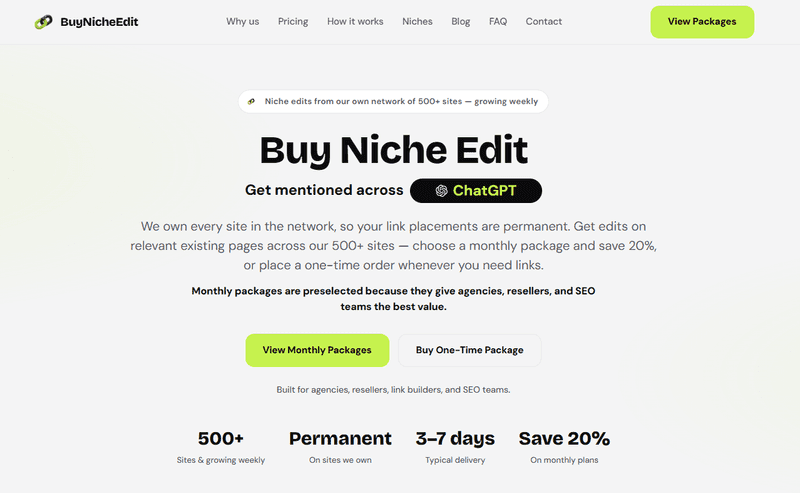
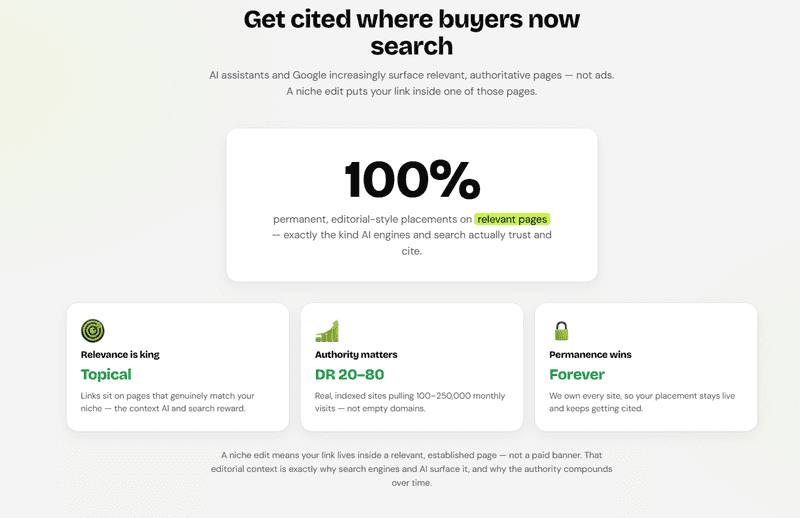
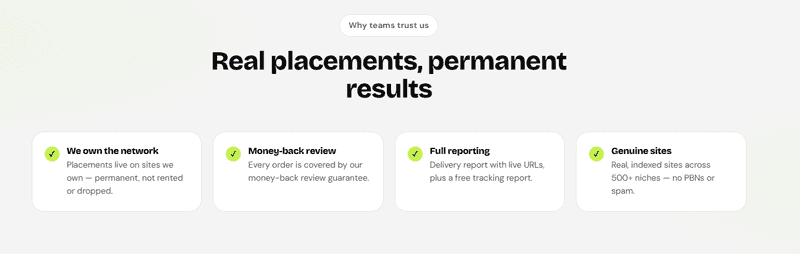
For example, BuyNicheEdit focuses on permanent do-follow niche edits across a private network of 500+ owned sites. The monthly packages are designed for agencies, resellers, and SEO teams that need consistent link placements each month.
That model is very different from chasing individual publishers, negotiating every placement separately, and waiting for each guest post to be written.
Why guest posts can still be valuable
Guest posts are not outdated. They still have an important place in SEO.
The biggest advantage of guest posts is control.
With a guest post, you can create a full article around a topic that supports your brand, product, or target keyword. You can choose the angle, include examples, build a narrative, and position your business as an expert.
Guest posts are especially useful when:
- You want brand visibility
- You want to explain a topic in detail
- You need a specific article angle
- You want to support thought leadership
- You want to promote research, data, or original insights
- You need more control over surrounding content
- You want to earn referral traffic from readers
For example, a guest post on “how agencies can track SEO performance across hundreds of client keywords” gives you more room to explain the problem, introduce solutions, and naturally mention Ranktracker.
A niche edit could get you a faster link. A guest post could give you a stronger brand asset.
Which one is better for rankings?
For pure ranking impact, niche edits often have an advantage because they are placed on existing pages.
If the page already has backlinks, traffic, and topical relevance, your link may be sitting inside a stronger environment from day one. That does not guarantee rankings, but it can give the link a better starting point.
However, a guest post can also perform well if it is published on a strong site, indexed properly, internally linked, and written around a relevant topic.
The real ranking difference usually comes down to quality.
A niche edit on a relevant, indexed, traffic-driving page is better than a thin guest post on a weak site.
A strong guest post on a trusted publication is better than a niche edit buried inside an irrelevant article.
The method matters, but the quality of the placement matters more.
Which one is safer?
Neither niche edits nor guest posts are automatically safe or unsafe.
A safe link building campaign looks natural, relevant, and useful. An unsafe campaign usually looks forced, spammy, repetitive, or irrelevant.
Niche edits can become risky when links are added to unrelated pages, weak sites, hacked pages, or articles with too many outbound links.
Guest posts can become risky when the article is low-quality, clearly written only for SEO, published on a link farm, or stuffed with unnatural anchor text.
To reduce risk, focus on:
- Topical relevance
- Real websites
- Indexed pages
- Organic traffic
- Natural anchor text
- Sensible link velocity
- Permanent placements
- Clean outbound link profiles
- High-quality content
- Clear reporting
Whether you choose niche edits or guest posts, the link should make sense to a real reader.
Which one is better for agencies?
For agencies, niche edits are often easier to scale.
The reason is simple: agencies need repeatable processes.
If you are managing SEO for several clients, you need links every month. Guest posts can be useful, but they involve more moving parts. You need content, approvals, revisions, publication dates, and reporting.
Niche edits are usually more direct. You provide the target URL, anchor text, and niche requirements. The provider finds a relevant existing page and adds the link.
That makes niche edits useful for:
- Monthly SEO retainers
- White-label link building
- Reseller packages
- Affiliate SEO campaigns
- SaaS link building
- Competitive niche campaigns
- Client reporting workflows
This is also why monthly niche edit packages can work well. BuyNicheEdit, for example, offers monthly packages that save 20% compared to one-time orders. That gives agencies a clearer margin if they are reselling placements to clients.
Which one is better for brand building?
Guest posts are usually better for brand building.
A guest post gives you more room to explain your ideas, show expertise, and build authority around a topic. If the article is high quality and published on a relevant site, it can support your brand beyond just the backlink.
Guest posts are better when the goal is:
- Thought leadership
- Product education
- Brand awareness
- Referral traffic
- Industry positioning
- Expert commentary
- Long-form content placement
Niche edits can still support brand visibility, especially when your link is placed naturally inside useful content. But they are usually more focused on SEO value than brand storytelling.
A balanced strategy often uses both.
Use niche edits to build links efficiently to important pages. Use guest posts to create stronger brand-led content across relevant publications.
Which one is better for AI visibility?
AI search has changed how brands think about visibility.
Google AI Overviews, ChatGPT, Perplexity, Gemini, Copilot, and other AI systems often surface information from trusted, relevant sources. That means mentions, citations, entity recognition, and topical authority are becoming more important.
Guest posts can help because they create new content around your brand, product, or expertise.
Niche edits can also help because they place your brand or URL inside existing relevant pages that may already be trusted, indexed, and visible.
For AI visibility, the best approach is not just to “get a backlink.” The better approach is to get your brand mentioned in the right context.
That means:
- Relevant pages
- Clear brand mentions
- Natural surrounding text
- Strong topical alignment
- Quality sites
- Consistent mentions over time
A niche edit inside a trusted existing article can support this. A well-written guest post can support it too.
The best option depends on whether you need speed and scale or deeper brand positioning.
How to choose between niche edits and guest posts
Choose niche edits when you want speed, scalability, and efficient link placement.
Choose guest posts when you want control, content depth, and brand positioning.
Use niche edits if:
- You already have strong target pages
- You want to build authority faster
- You need links every month
- You are working with several clients
- You want a simple delivery process
- You care about existing page strength
- You want to keep costs predictable
Use guest posts if:
- You want to publish a full article
- You need to control the topic
- You want to explain your product or service
- You want brand visibility
- You are building thought leadership
- You want a more editorial content asset
- You need a custom angle
In most cases, the answer is not one or the other. The strongest SEO campaigns often use both.
How Ranktracker helps measure the impact
Whichever link building method you choose, you need to track results.
Buying links without tracking performance is a mistake. You need to know whether your rankings are improving, whether backlinks stay live, and whether your target pages are gaining visibility.
Ranktracker can help you monitor the full process.
With Rank Tracker, you can follow keyword movements after niche edits or guest posts go live. With Backlink Monitor, you can check whether links remain active. With Backlink Checker, you can review your backlink profile and compare it with competitors. With Web Audit, you can make sure the pages you are building links to are technically healthy.
This matters because link building works best when it supports pages that are already optimized.
Before building links, check:
- Is the page targeting the right keyword?
- Does the content match search intent?
- Are internal links pointing to the page?
- Is the page indexed?
- Are there technical SEO issues?
- Is the title tag optimized?
- Is the page strong enough to deserve links?
A backlink can help a good page perform better. It usually cannot save a weak page on its own.
The best strategy: use both together
The strongest approach is usually a mix of niche edits and guest posts.
Niche edits can help you build authority quickly and consistently. Guest posts can help you build topical relevance, brand authority, and deeper content coverage.
For example, an agency could build a campaign like this:
Month one:
- Publish two guest posts around broad industry topics
- Build five niche edits to important service pages
- Track keyword movement in Ranktracker
- Monitor link status and indexing
Month two:
- Publish one guest post around a comparison or guide topic
- Build ten niche edits across supporting pages
- Adjust anchor text based on ranking movement
- Review competitor backlink growth
Month three:
- Build more niche edits to pages that are moving upward
- Publish another guest post for brand visibility
- Audit underperforming pages
- Continue tracking rankings and backlinks
This creates a natural mix of new content placements and existing-page links.
Final verdict: niche edits or guest posts?
Niche edits are usually better for speed, scale, and efficient link building.
Guest posts are usually better for content control, brand visibility, and thought leadership.
The All-in-One Platform for Effective SEO
Behind every successful business is a strong SEO campaign. But with countless optimization tools and techniques out there to choose from, it can be hard to know where to start. Well, fear no more, cause I've got just the thing to help. Presenting the Ranktracker all-in-one platform for effective SEO
We have finally opened registration to Ranktracker absolutely free!
Create a free accountOr Sign in using your credentials
If your goal is to build links quickly to existing pages, niche edits are often the better option. If your goal is to publish a full article with a specific message, guest posts are the better choice.
For most SEO teams, the smartest answer is to use both.
Use guest posts to build your brand and create strong topical placements. Use niche edits to strengthen important pages, build authority consistently, and support rankings over time.
If you are an agency, reseller, or SEO team that needs predictable link placements, BuyNicheEdit can make the niche edit side much easier. Its private network of 500+ owned sites, permanent do-follow placements, monthly package savings, and delivery reports make it a practical option for scaling link building without chasing publishers every week.