Intro
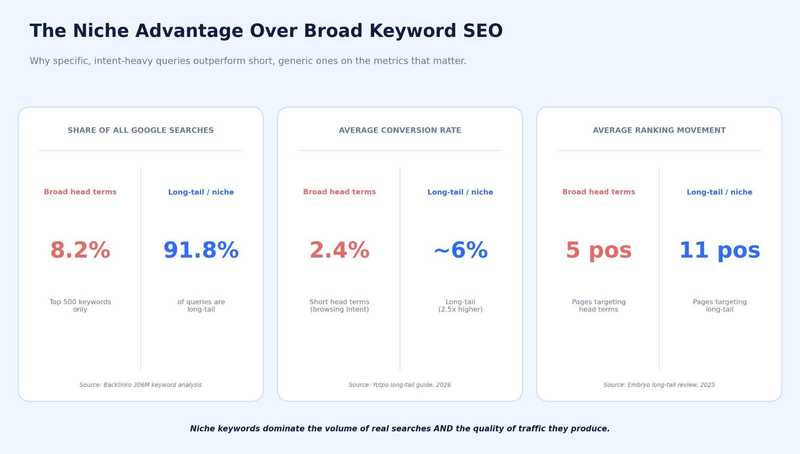
91.8% of every Google search is a long-tail query, and pages targeting them climb 11 positions on average compared to just 5 for broad head terms.
But most brands are still burning their SEO budget chasing generic high-volume keywords they'll never outrank Amazon or Forbes for. This post walks you through the full niche driven SEO playbook: what it actually is, why it wins right now, 7 tactics that turn specificity into a long-tail keyword lead your competitors can't close.
What Is Niche Driven SEO
Niche driven SEO is a strategy where you go after a narrow, specific category rather than fighting for broad industry terms. You win by owning long-tail keyword clusters, building topical authority in one defined space, and earning links from the sources your exact audience already trusts.
Here's what that looks like in plain English. You swap:
- "HR software" for "leave management app for remote teams"
- "Bathroom fixtures" for "luxury bidet toilet seat with nightlight"
- "Project management software" for "project management software for construction crews"
In each case, you're trading a crowded, generic query for one that a specific buyer actually types when they know what they need.
Why does this work so well right now? It comes down to the shape of the search. 33% of website traffic across key industries still comes from organic, and 91% of practitioners say SEO did well for their 2024 performance.
But broad keywords? Those belong to enterprise sites with a 10-year domain authority head start. Niche driven SEO sidesteps that fight entirely.
The All-in-One Platform for Effective SEO
Behind every successful business is a strong SEO campaign. But with countless optimization tools and techniques out there to choose from, it can be hard to know where to start. Well, fear no more, cause I've got just the thing to help. Presenting the Ranktracker all-in-one platform for effective SEO
We have finally opened registration to Ranktracker absolutely free!
Create a free accountOr Sign in using your credentials
Look at the top of the market and SERP competition is brutal right now. Google's AI Overviews are showing up on more queries every month, and retail keywords triggering them jumped 206% between January and March 2025.
Broad queries are the ones most likely to lose that click to an AI summary. Specific, intent-heavy searches? They still send people to real websites.
📊 By The Numbers
Long-tail keywords account for the bulk of real search activity AND the bulk of real buying intent. Queries of 3+ words make up 91.8% of all Google searches and convert at 2.5x the rate of short head terms.
Why Niche Driven SEO Outranks Broad Keyword Strategies Every Time
5 building blocks decide whether your niche driven SEO actually produces rankings, traffic, and pipeline, or just turns into another abandoned blog.
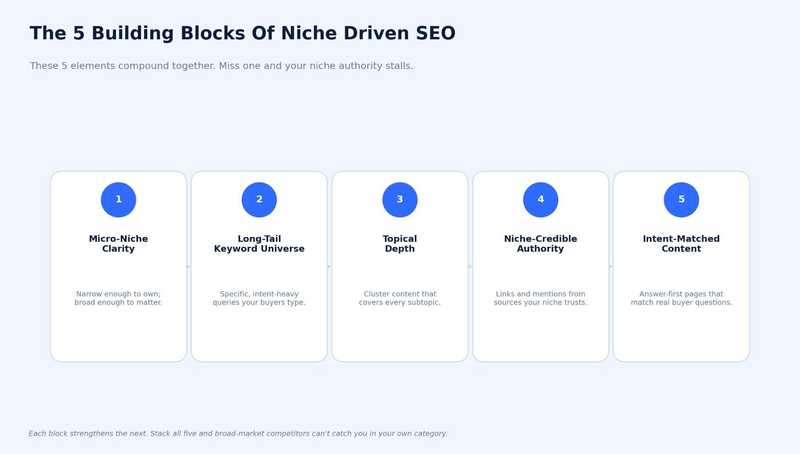
Micro-niche clarity sets the frame. Your niche has to be narrow enough that a small team can actually own it, but broad enough that real buyers are searching inside it. "Project management software" is way too broad to own. "Project management software for small construction crews" gets you into real niche territory.
The All-in-One Platform for Effective SEO
Behind every successful business is a strong SEO campaign. But with countless optimization tools and techniques out there to choose from, it can be hard to know where to start. Well, fear no more, cause I've got just the thing to help. Presenting the Ranktracker all-in-one platform for effective SEO
We have finally opened registration to Ranktracker absolutely free!
Create a free accountOr Sign in using your credentials
A long-tail keyword universe comes straight out of that clarity. Once you know your buyer, you can map the exact phrases they're typing into Google, ChatGPT, and Perplexity. These are the specific, intent-heavy queries your generic competitors ignore because the volume looks too small on its own. Stacked together, they make up most of your category's total traffic.
Topical depth is what turns those keywords into authority. Google rewards sites that cover one subject exhaustively way more than sites that dabble across ten. You need pillar content, dense internal linking, and answers to every subtopic your audience asks about.
Niche-credible authority is all about where your links and mentions come from. Generic backlinks from PR wires barely move the needle anymore. One link from the 3 most respected niche publications, a podcast appearance with the category expert, or an inclusion in a niche roundup does more than 50 generic mentions combined.
Intent-matched content closes the loop. Your page has to answer the specific question behind the specific query. Answer-first structure, real examples, and content that gets what the reader is actually trying to do. Miss the search intent, and even perfectly-ranked pages won't convert.
⚠️ Common Mistake
A lot of teams confuse "writing about a niche" with "building niche authority." Publishing 40 posts that lightly cover a topic will always lose to 12 posts that go deeper than anyone else in the space. Depth beats breadth in niche driven SEO, every single time.
7 Niche SEO Tactics That Turn Low-Volume Queries Into Predictable Revenue
These 7 build on each other, so start from the top, even if tactic 5 or 6 looks more interesting right now.
1. Map Your Micro-Niche Before Writing A Single Post
Niche keyword research actually starts before keyword research. Before you touch a single tool, write down three things: exactly who you sell to, what problem they're trying to solve, and what language they use when they explain it to a friend. That's your micro-niche definition. Every keyword decision from here on out traces back to those three lines.
Once that definition is locked in, you start keyword mapping from the buyer's language, not the tool's suggestions. Reddit threads, Slack communities, Facebook groups, customer support transcripts. That's where the real source material lives. The tool just quantifies what your audience is already telling you out loud.
Here's a simple keyword map that works:
| Cluster | Primary Phrase Pattern | Buyer Intent | Funnel Stage |
| Problem | "why is my [X] doing [Y]" | Diagnose an issue | Awareness |
| Comparison | "[competitor A] vs [competitor B]" | Shortlist tools | Consideration |
| Solution | "best [tool] for [niche use case]" | Ready to buy | Decision |
| Implementation | "how to set up [product feature]" | Post-purchase | Retention |
Fill that in for your own niche and you've already got 4 pages worth of mapped keyword real estate before you even open a research tool.
2. Build Your Keyword Universe Around Specificity
Specificity is the whole game. Low competition keywords with high buyer intent are where small brands beat category incumbents. Your job is to surface the exact phrasing real buyers use when they're almost ready to pull the trigger, then map your product and content pages to those specific queries.
Want to see what this looks like when it's done right?
Take a close look at how the Brondell Swash 1400 luxury bidet toilet seat page is merchandised. The copy and spec sheet all circle around tightly specific queries buyers type when they're ready to buy.
"Bidet with heated seat and warm air dryer." "Luxury bidet with LED nightlight." "Electronic bidet." Each one looks microscopic in volume on its own.
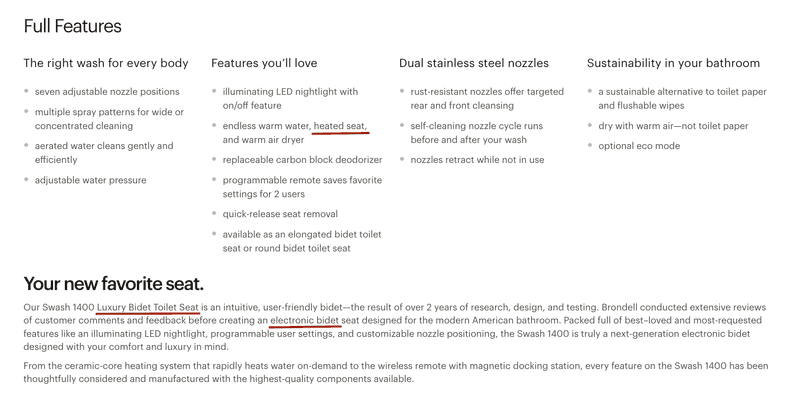
Stack 30 of them on one product page, and you capture most of the in-market demand for that exact class of product, while Amazon and Home Depot are busy fighting over "bathroom upgrades" at the top of the funnel. The page itself is basically a live case study in feature-specific SEO done right.
Now use that same lens on your own product. Keyword difficulty goes down on longer queries. Conversion rate goes up. That intersection is where niche driven SEO actually makes you money.
💡 Pro Tip
Run your product through ChatGPT and Perplexity the way a buyer would. Ask something like "what's the best [your category] for [specific use case]?" Then copy the exact phrasing those AI engines use in their answers. That language is already scoring well for the semantic signals modern search is looking at, and it's almost always more specific than what your keyword tool coughs up.
3. Create Topic Clusters That Own The Micro-Niche
Single-post SEO is dead for niche driven strategies. Clusters win. Pick one pillar topic that defines your category, then build 6 to 12 supporting posts that answer every subtopic underneath it. Link them together so Google can map the whole structure in one crawl.
Here's how the split works: pillar content does the heavy lifting on broader terms, cluster posts grab the long-tail, and both link to each other constantly. That's how topical authority compounds into ranking power that generic competitors can't easily replicate.
Your cluster should feel like a complete course on your niche topic. If a reader landed on your pillar and followed every internal link, they'd walk away knowing more than 90% of people in the category. That's the bar. Anything less and you're stuck fighting for surface-level content where generalists still have the edge.
4. Publish Deeper Than Every Competitor In The Space
Content depth is the single most underrated niche driven SEO tactic out there. Open up the top 10 results for any long-tail query in your category and hunt for the content gaps. Questions nobody answered. Data nobody cited. Examples that just don't exist yet. That gap is your advantage.
Now here's the thing about depth at niche scale: it lives or dies on who's writing. A generalist freelancer produces "good content." Niche driven SEO needs someone who already speaks the category language, knows the questions a real insider would ask, and gets the comparison logic specific to your space. That combination is rare and expensive to hire in-house.
A full-time SEO specialist in the US runs $80K-$120K a year once you factor in benefits, which breaks the math for most small teams trying to scale content output. Most founders hire that same specialist profile offshore. Genius places pre-vetted SEO specialists from the Philippines and Latin America in the $1.2K-$1.8K per month range, and that salary delta is exactly what keeps the depth cadence alive past month 3.
Whatever route you take, the rule doesn't change. Don't publish another surface-level post. Write the piece that makes every competing post feel shallow the minute someone reads yours.
5. Earn Niche Backlinks From Sources Your Audience Trusts
Link relevance matters way more than link volume in niche driven SEO. One link from the definitive podcast in your micro-niche or a mention in a category-specific newsletter beats 20 generic guest posts on unrelated blogs, every time.
Start by building your niche inner-circle list. Target the sources your buyers are already reading:
- Top 3 podcasts in your category
- Top 5 newsletters with engaged subscribers
- Top 3 industry publications or trade magazines
- Top 2 research firms or analyst shops
- Top 2 trade associations or professional bodies
That's 15 names total. Every outreach campaign, every guest post pitch, every podcast application goes to that list first. The rest can wait until the inner circle knows your name. Targeted guest posts to this list blow scattershot link-building out of the water.
6. Add Author Credentials That Match The Niche
Niche driven SEO gets won by real experts, or by content that credibly speaks as one. Generic "Written by the Team" bylines look like filler to Google's E-E-A-T signals and to your actual readers. Real author expertise matters way more now than it did even 2 years ago.
Here's what a proper author setup looks like:
- Real name, real photo, real LinkedIn profile linked
- Bio that ties specifically to your niche, not generic marketing-speak
- Specific dated experience with named employers and actual numbers
- Schema markup (Person + Article) connecting the author to their wider footprint
- Last-reviewed date on every published post, refreshed quarterly
Ghostwritten content is fine. Just attach a named reviewer's date to it and make sure they'd actually stand behind the claims. Author credibility is what separates the content AI engines cite confidently from the content they ignore.
7. Use AI And Voice Search Data To Expand Your Long-Tail
Voice search queries and AI chat prompts are pre-loaded long-tail goldmines. They're conversational, they're specific, and they almost always represent a buyer who's actively in motion. AI search optimization is just niche driven SEO adapted for how people actually ask questions in 2026.
Grab your top 10 niche keywords and run each one through ChatGPT, Perplexity, and Google AI Mode. Save the specific follow-up questions each platform surfaces. Those follow-ups are your next 10 blog posts. Queries with proven intent that standard keyword tools rarely capture.
🎯 Pro Insight
Pay attention to the URLs your content shows up next to in AI answers, not just the SERP. When Perplexity cites you alongside three other sources, those sources are your real niche competitors for visibility. Not necessarily the top 10 blue links on Google. Track that citation set. It'll tell you who's actually winning the niche faster than any ranking report will.
Niche Driven SEO vs Broad Keyword SEO
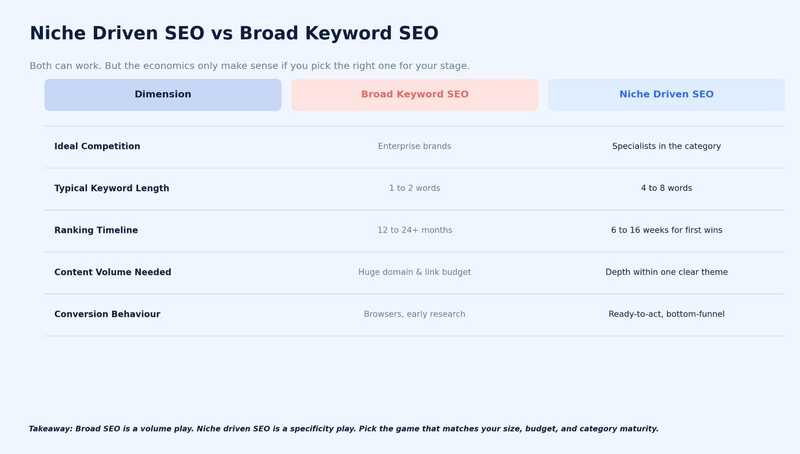
Both strategies can work. The real question is which one your budget, team size, and category maturity can actually support. Broad SEO assumes you can out-link and out-authority everyone in the space over 12 to 24+ months. Niche driven SEO assumes you can outfocus them on a specific slice in 6 to 16 weeks.
SaaS brands run into the sharpest version of this choice because most software categories already have incumbents with huge domain authority. The workaround? Pick a sub-category narrow enough that incumbents aren't optimizing for it.
Here’s an excellent example from Day Off, which capitalized on the keyword ‘Leave management.’ It concentrates its entire SEO footprint on bottom-funnel queries the big HRIS platforms barely touch: "PTO tracker for small business," "employee vacation tracker," "staff leave planner," "annual leave management software." Searchers on those queries already know what they need.
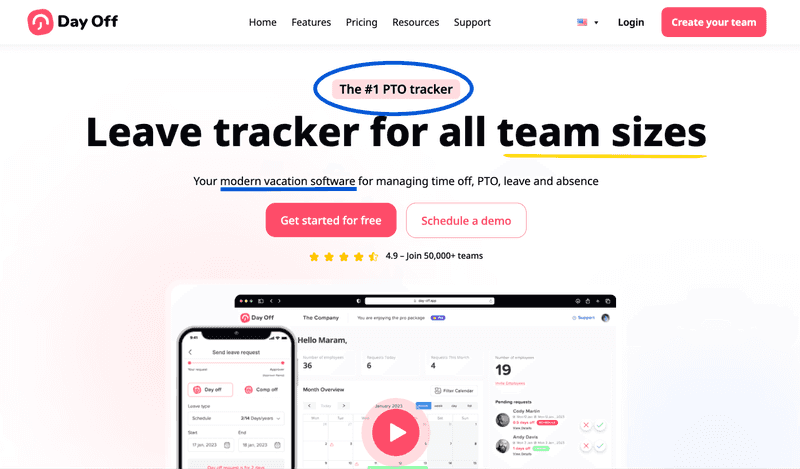
They want the right product, not another generic HR overview. Going head-to-head with BambooHR or Rippling for "HR software" means 5+ years of content and link investment before meaningful rankings show up. Going deep on leave management specifically gets you first-page results inside a quarter, because the serious competition just isn't there.
Domain authority still matters in both strategies, but differently. Broad keywords need ranking-level DA just to show up. Niche driven SEO only needs enough DA to pass the filter, and wins on relevance and depth. Small brands with DA 25 regularly outrank DA 75 enterprise sites on well-chosen long-tail queries.
Here's the nuance most guides miss:
Niche driven SEO doesn't stay niche forever. Once you own a micro-niche, you expand into adjacent ones. Brondell went from bidets to broader bathroom wellness. Day Off could grow leave management into broader people operations. That expansion only works because the niche foundation was rock-solid first.
Your 30-Day Niche Driven SEO Sprint
You don't need a year to see results from niche driven SEO. A focused 30-day sprint can get you a mapped niche, a live content cluster, and first ranking movement on 3 to 5 long-tail queries.
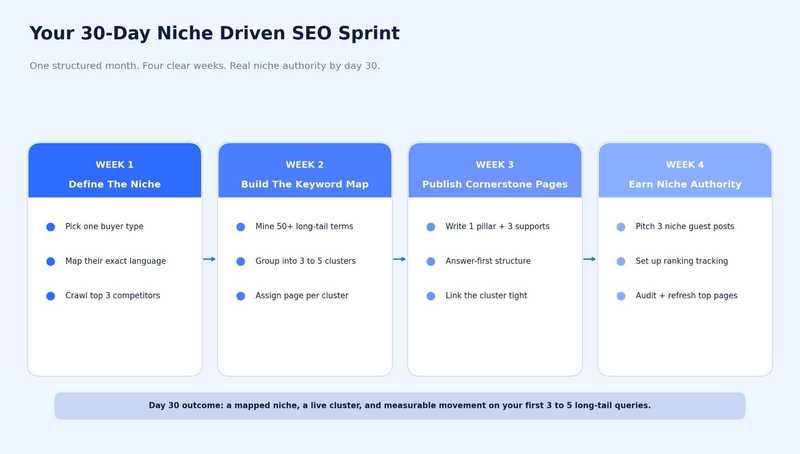
Here's how the 4 weeks break down so you're not trying to do everything at once.
Week 1: Define The Niche
Pick one buyer type and one core problem they're solving. Write it down in a single sentence. Crawl your top 3 competitors and list every topic they cover. Map the language your buyers actually use (pull it from Reddit, support tickets, and sales calls). Finish the week with a one-page niche definition anyone on your team could recite from memory.
Week 2: Build The Keyword Map
Mine 50+ long-tail terms around your niche using a keyword tool plus real buyer language. Group them into 3 to 5 tight clusters by buyer intent. Assign one page per cluster. Flag 5 low-competition terms you could realistically rank for inside 90 days.
Week 3: Publish Cornerstone Pages
Write one pillar post that defines your micro-niche and 3 supporting posts underneath it. Use answer-first structure, specific examples, and internal links between all four pages. Implement Article schema on each one. The goal for week 3 is to get the cluster skeleton live and crawlable, not publishing everything at once.
Week 4: Earn Niche Authority And Measure
Pitch 3 guest posts or podcast appearances in your niche's inner circle. Set up ranking tracking on your 5 flagged terms. Audit your existing content and refresh the 3 pages closest to your new cluster. Build a weekly review rhythm, so you catch what's working inside the first 60 days.
💡 Pro Tip
Don't try to rank for the hardest keyword first. Pick a sub-cluster term you can realistically win in 8 to 12 weeks. That early win does three things at once: it proves the strategy works, it builds internal momentum with your team, and it sends Google the first signal that your site is a relevant source in the niche. The hard keywords come later, once the small wins have compounded.
5 Metrics That Prove Your Niche Driven SEO Is Actually Working
Vanity metrics like total sessions won't tell you whether niche driven SEO is paying off. These 5 will.
1. Rankings on your target long-tail cluster. Track the 20 to 30 specific queries in your core clusters every week. Movement from position 80 to position 20 is real progress, even if sessions haven't moved yet. Rankings lead traffic by 4 to 12 weeks in most categories.
2. Conversion rate from organic to action. Niche traffic should convert harder than generic traffic. If your SEO-driven leads are converting closer to the 8.5x rate over outbound that industry benchmarks report, you're on the right track. Anything lower usually points to content that's misaligned with real search intent.
The All-in-One Platform for Effective SEO
Behind every successful business is a strong SEO campaign. But with countless optimization tools and techniques out there to choose from, it can be hard to know where to start. Well, fear no more, cause I've got just the thing to help. Presenting the Ranktracker all-in-one platform for effective SEO
We have finally opened registration to Ranktracker absolutely free!
Create a free accountOr Sign in using your credentials
3. Share of voice inside the niche. Pick your 5 core long-tail queries. Count how many of the top 10 results are yours or mention your brand. Track that monthly. This tells you how much category mindshare you actually own at the SERP level.
4. Niche backlink velocity. Count how many new links per month came from sources inside your niche's inner circle. 10 of those matter way more than a hundred random directory links or irrelevant guest posts combined.
5. AI citation count. Query your top 10 target terms on ChatGPT, Perplexity, and Google AI Mode every week. Log it when your brand shows up in the answer. Even without a click, citation presence is where awareness happens in 2026, and it's a leading indicator for AI referral traffic growth.
The Niches You Own Now Become The Categories You Lead Later
Niche driven SEO works because it matches the shape of modern search, where 91.8% of queries are specific, intent-heavy, and ignored by broad-market incumbents. Pick one micro-niche this week, map the language your buyers use, and ship your first cluster inside 30 days.
For the long game of turning one niche into a compounding asset, Ranktracker's breakdown of how to build a niche site that becomes your full-time income is the discipline that separates sites that compound from sites that plateau.