Intro
Every major AI platform — OpenAI, Google, Anthropic, Meta, Mistral — claims their model is the “most powerful.” But for marketers, SEOs, and content strategists, raw claim-based performance doesn’t matter.
What matters is how different LLMs interpret, rewrite, and respond to the same query.
Because this shapes:
✔ recommendation likelihood
The All-in-One Platform for Effective SEO
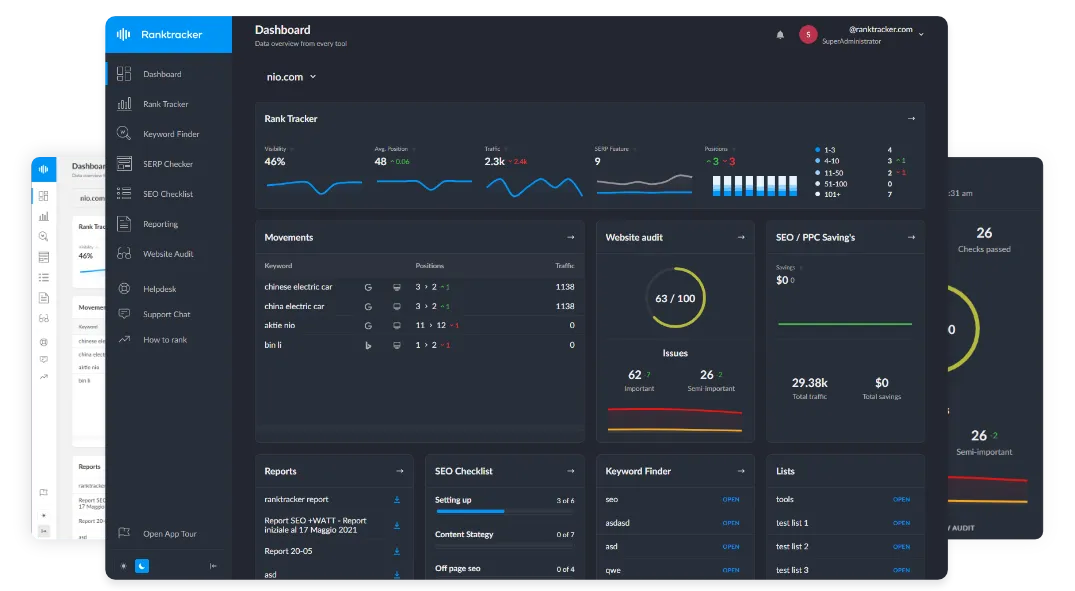
Behind every successful business is a strong SEO campaign. But with countless optimization tools and techniques out there to choose from, it can be hard to know where to start. Well, fear no more, cause I've got just the thing to help. Presenting the Ranktracker all-in-one platform for effective SEO
We have finally opened registration to Ranktracker absolutely free!
Create a free accountOr Sign in using your credentials
✔ conversion
A model that interprets your content incorrectly… or recommends a competitor… or suppresses your entity…
The All-in-One Platform for Effective SEO
Behind every successful business is a strong SEO campaign. But with countless optimization tools and techniques out there to choose from, it can be hard to know where to start. Well, fear no more, cause I've got just the thing to help. Presenting the Ranktracker all-in-one platform for effective SEO
We have finally opened registration to Ranktracker absolutely free!
Create a free accountOr Sign in using your credentials
…can drastically impact your brand.
This guide explains how to benchmark LLMs practically, why model behavior differs, and how to predict which systems will prefer your content — and why.
1. What LLM Benchmarking Really Means (Marketer-Friendly Definition)
In AI research, a “benchmark” refers to a standardized test. But in digital marketing, benchmarking means something more relevant:
“How do different AI models understand, evaluate, and transform the same task?”
This includes:
✔ interpretation
✔ reasoning
✔ summarization
✔ recommendation
✔ citation behavior
✔ ranking logic
✔ hallucination rate
✔ precision vs creativity
✔ format preference
✔ entity recall
Your goal isn’t to crown a “winner.” Your goal is to understand the model’s worldview, so you can optimize for it.
2. Why LLM Benchmarks Matter for SEO and Discovery
Each LLM:
✔ rewrites queries differently
✔ interprets entities differently
✔ prefers different content structure
✔ handles uncertainty differently
✔ favors different types of evidence
✔ has unique hallucination behavior
✔ has different citation rules
This impacts your brand’s visibility across:
✔ ChatGPT Search
✔ Google Gemini
✔ Perplexity.ai
✔ Bing Copilot
✔ Claude
✔ Apple Intelligence
✔ domain-specific SLMs (medical, legal, finance)
In 2026, discovery is multi-model.
Your job is to become compatible with all of them — or at least the ones that influence your audience.
3. The Core Question: Why Do Models Give Different Answers?
Several factors cause divergent outputs:
1. Training Data Differences
Each model is fed different:
✔ websites
✔ books
✔ PDFs
✔ codebases
✔ proprietary corpora
✔ user interactions
✔ curated datasets
Even if two models train on similar data, the weighting and filtering differ.
2. Alignment Philosophies
Each company optimizes for different goals:
✔ OpenAI → reasoning + utility
✔ Google Gemini → search grounding + safety
✔ Anthropic Claude → ethics + carefulness
✔ Meta LLaMA → openness + adaptability
✔ Mistral → efficiency + speed
✔ Apple Intelligence → privacy + on-device
These values affect interpretation.
3. System Prompt + Model Governance
Every LLM has an invisible “governing personality” baked into the system prompt.
This influences:
✔ tone
✔ confidence
✔ risk tolerance
✔ conciseness
✔ structure preference
4. Retrieval Systems
Some models retrieve live data (Perplexity, Gemini). Some don’t (LLaMA). Some blend the two (ChatGPT + custom GPTs).
The retrieval layer influences:
✔ citations
✔ freshness
✔ accuracy
5. Memory & Personalization
On-device systems (Apple, Pixel, Windows) rewrite:
✔ intent
✔ phrasing
✔ meaning
based on personal context.
4. Practical Benchmarking: The 8 Key Tests
To evaluate how different LLMs handle the same query, test these 8 categories.
Each reveals something about the model’s worldview.
Test 1: Interpretation Benchmark
“How does the model understand the query?”
Example query: “Best SEO tool for small businesses?”
Models differ:
-
ChatGPT → reasoning-heavy comparison
-
Gemini → grounded in Google Search + pricing
-
Claude → careful, ethical, nuanced
-
Perplexity → citation-driven
-
LLaMA → depends heavily on training snapshot
Goal: Identify how each model frames your industry.
Test 2: Summarization Benchmark
“Summarize this page.”
Here you test:
✔ structure preference
✔ accuracy
✔ hallucination rate
✔ compression logic
This tells you how a model digests your content.
Test 3: Recommendation Benchmark
“Which tool should I use if I want X?”
LLMs differ dramatically in:
✔ bias
✔ safety preference
✔ authority sources
✔ comparison heuristics
This test reveals whether your brand is systematically under-recommended.
Test 4: Entity Recognition Benchmark
“What is Ranktracker?” “Who created Ranktracker?” “What tools does Ranktracker offer?”
This reveals:
✔ entity strength
✔ factual accuracy
✔ model memory gaps
✔ misinformation pockets
If your entity is weak, the model will:
✔ confuse you for a competitor
✔ miss features
✔ hallucinate facts
✔ omit you entirely
Test 5: Citation Benchmark
“Give me sources for the best SEO platforms.”
Only some models link out. Some cite only top authority domains. Some cite recent content only. Some cite anything that matches intent.
This tells you:
✔ where to get featured
✔ whether your brand appears
✔ your competitive citation position
Test 6: Structure Preference Benchmark
“Explain X in a short guide.”
Models differ in:
✔ structure
✔ length
✔ tone
✔ use of lists
✔ directness
✔ formatting
This tells you how to structure content to be “model-friendly.”
Test 7: Ambiguity Benchmark
“Compare Ranktracker with its competitors.”
Models differ in:
✔ fairness
✔ hallucination
✔ balance
✔ confidence
A model that hallucinates here will hallucinate in summaries too.
Test 8: Creativity vs Accuracy Benchmark
“Create a marketing plan for an SEO startup.”
Some models innovate. Some constrain. Some rely heavily on clichés. Some reason deeply.
This reveals how each model will support (or misguide) your users.
5. Understanding Model Personalities (Why Each LLM Behaves Differently)
Here’s a quick breakdown.
OpenAI (ChatGPT)
✔ strongest overall reasoning
✔ excellent for long-form content
✔ model tends to be decisive
✔ weaker citations
✔ strong understanding of SaaS + marketing language
Best for: strategic queries, planning, writing.
Google Gemini
✔ strongest grounding in real web data
✔ best retrieval-based accuracy
✔ heavy emphasis on Google’s worldview
✔ conservative but reliable
Best for: search-intent queries, citations, facts.
Anthropic Claude
✔ safest + most ethical outputs
✔ best at nuance and restraint
✔ avoids overclaiming
✔ extremely strong summarization
Best for: sensitive content, legal/ethical tasks, enterprise.
Perplexity
✔ citations every time
✔ live data
✔ fast
✔ less reasoning depth
Best for: research, competitor analysis, fact-heavy tasks.
Meta LLaMA
✔ open-source
✔ quality varies with fine-tuning
✔ weaker knowledge of niche brands
✔ highly customizable
Best for: apps, integrations, on-device AI.
Mistral / Mixtral
✔ optimized for speed
✔ strong reasoning-per-parameter
✔ limited entity awareness
Best for: lightweight agents, Europe-based AI products.
Apple Intelligence (On-device)
✔ hyper-personalized
✔ privacy-first
✔ contextual
✔ limited global knowledge
Best for: tasks tied to personal data.
6. How Marketers Should Use LLM Benchmarks
The goal is not to chase “best model.” The goal is to understand:
How does the model interpret your brand — and how can you influence it?
Benchmarks help you identify:
✔ content gaps
✔ factual inconsistencies
✔ entity weaknesses
✔ hallucination risks
✔ misalignment across models
✔ recommendation bias
✔ missing features in model memory
Then you optimize using:
✔ structured data
✔ entity reinforcement
✔ precision writing
✔ consistent naming
✔ multi-format clarity
✔ high-factual-density content
✔ citations in authoritative sites
✔ internal linking
✔ backlink authority
This builds a strong “model memory” of your brand.
7. How Ranktracker Supports Model Benchmarking
Ranktracker tools map directly onto LLM optimization signals:
Keyword Finder
Reveal goal-based and agentic queries that LLMs frequently rewrite.
SERP Checker
Shows structured results and entities LLMs use as training signals.
Web Audit
Ensures machine-readable structure for summarization.
Backlink Checker & Monitor
Authority signals → stronger training data presence.
AI Article Writer
Creates high-factual-density pages that models handle well in summaries.
Rank Tracker
Monitors keyword shifts caused by AI Overviews and model rewrites.
Final Thought:
LLM benchmarks are no longer academic tests — they are the new competitive intelligence.
In a multi-model world:
✔ users get answers from different engines
✔ models reference different sources
✔ brands appear inconsistently across systems
✔ recommendations vary by platform
✔ entity recall differs widely
✔ hallucinations shape perception
✔ rewritten queries alter visibility
To win in 2026 and beyond, you must:
✔ understand how each model sees the world
The All-in-One Platform for Effective SEO
Behind every successful business is a strong SEO campaign. But with countless optimization tools and techniques out there to choose from, it can be hard to know where to start. Well, fear no more, cause I've got just the thing to help. Presenting the Ranktracker all-in-one platform for effective SEO
We have finally opened registration to Ranktracker absolutely free!
Create a free accountOr Sign in using your credentials
✔ understand how each model sees _your brand _ ✔ build content that aligns with multiple model behaviors
✔ strengthen entity signals across the web
✔ benchmark regularly as models retrain
The future of discovery is model diversity. Your job is to make your brand intelligible, consistent, and favored everywhere.