Intro
Your law firm moved from page two to page one. Organic traffic is up. Paid campaigns are generating more leads. Cost per lead is improving. The monthly marketing report looks better than it did six months ago.
So why are you not signing more cases?
The disconnect often comes down to how firms measure client acquisition. SEO gets evaluated through rankings and traffic. Paid media gets judged by clicks, conversions, and cost per lead. The website gets measured by calls and form submissions. Intake gets treated as a separate operational function.
But prospective clients don't move through those separate buckets. They move through one connected system. A campaign can generate qualified inquiries that never receive a timely response. A website can attract substantial traffic without convincing visitors to contact the firm. And a low cost per lead can disguise an expensive cost per signed case.
To understand what's working, law firms need to follow the entire journey from search visibility to signed cases, identify where qualified opportunities are being lost, and connect marketing decisions to actual business outcomes.
Rankings are a signal, not the score
Rankings matter. So do impressions, traffic, click-through rates, conversion rates, and lead volume. Each helps explain how a particular part of your marketing is performing. None tells you, on its own, whether your firm is acquiring more clients.
A law firm can rank first for a valuable keyword and still send visitors to a page that doesn't convert. A landing page can generate calls that receive slow or inconsistent follow-up. An advertising campaign can produce inexpensive leads for cases the firm would never accept.
The All-in-One Platform for Effective SEO
Behind every successful business is a strong SEO campaign. But with countless optimization tools and techniques out there to choose from, it can be hard to know where to start. Well, fear no more, cause I've got just the thing to help. Presenting the Ranktracker all-in-one platform for effective SEO
We have finally opened registration to Ranktracker absolutely free!
Create a free accountOr Sign in using your credentials
That's why law firm SEO cannot end with search visibility, just as paid media cannot end with a conversion recorded in an advertising platform. The more useful question is what happens after a prospective client finds you.
At a minimum, firms should be able to track the following stages of client acquisition:
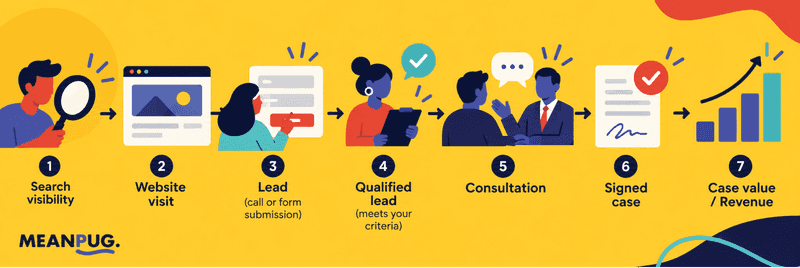
For firms handling contingency-fee matters, revenue may not be realized until months or years after a case is signed. That makes it particularly important to preserve information about the type and potential value of each matter rather than relying solely on immediate revenue.
Without visibility into these stages, a firm may know that marketing is generating activity without understanding whether that activity is producing valuable cases.
Start with the people your marketing is attracting
When traffic and lead volume increase without a corresponding increase in signed cases, the instinct is often to blame the marketing channel. Sometimes that's warranted. But the first question should be whether the firm is attracting the right prospective clients.
A page can rank for a high-volume keyword that has little connection to the cases the firm wants. A paid campaign can generate inexpensive leads that consistently fail qualification. An informational article can attract thousands of visitors researching a legal issue without any immediate intention of hiring an attorney. Those results can make a marketing dashboard look healthy while contributing little to client acquisition.
The All-in-One Platform for Effective SEO
Behind every successful business is a strong SEO campaign. But with countless optimization tools and techniques out there to choose from, it can be hard to know where to start. Well, fear no more, cause I've got just the thing to help. Presenting the Ranktracker all-in-one platform for effective SEO
We have finally opened registration to Ranktracker absolutely free!
Create a free accountOr Sign in using your credentials
To evaluate lead quality, firms should ask:
- Which searches and campaigns are generating inquiries?
- What types of cases are those inquiries producing?
- How many prospects meet the firm's qualification criteria?
- Are campaigns reaching people in the geographic markets the firm serves?
- Does the search intent suggest someone is looking to hire an attorney or simply researching a legal issue?
These questions help distinguish visibility from actual business opportunity. The goal isn't to maximize traffic or lead volume in isolation. It's to attract more qualified prospects for the types of matters the firm wants to handle.
More traffic does not fix a trust problem
Even when targeting is right, visibility alone doesn't guarantee that someone will choose your firm. Being found and being hired are two different things.
A prospective client can reach the right page, recognize that the firm handles their type of matter, and still leave because they see little reason to choose that firm over its competitors. Relevant experience, attorney credentials, client reviews, meaningful case results where appropriate, and clear explanations of what happens next can all help establish credibility.
These details answer a fundamental question prospective clients bring to a legal search: Why should I trust this firm with my case?
Sending more traffic to a page that doesn't answer that question rarely solves the problem. It simply exposes more people to the same unconvincing experience.
For law firms, the website is more than a place to generate calls and form submissions. It's where prospective clients begin evaluating whether the firm's experience, credibility, and approach match what they need.
Do not stop measuring at the conversion
If qualified prospects are reaching the website but not contacting the firm, rankings and advertising spend may not be the problem. The issue could be the page itself. Can visitors quickly determine whether the firm handles their type of case? Is the next step clear? Does the page give them enough information and confidence to reach out?
Consider two pages. One attracts 500 visitors and generates 25 meaningful inquiries, a 5% conversion rate. Another attracts 5,000 visitors and generates ten inquiries, a 0.2% conversion rate. The first page may be far more effective despite receiving substantially less traffic.
But even a conversion is only an intermediate result. A phone call, chat, or form submission isn't a signed case. It's the point where another part of the client-acquisition process takes over.
This distinction matters particularly in paid media. A campaign with a low cost per lead can appear efficient while producing few signed cases. Meanwhile, a campaign with a higher cost per lead may deliver better results if its prospects are more qualified and more likely to become clients.
Advertising platforms can only optimize toward the conversion signals and outcome data available to them. If a campaign is optimized for form submissions without receiving information about lead quality or signed cases, it may prioritize generating more submissions rather than attracting prospects the firm actually wants to represent.
Intake is part of marketing performance
This is where many law firms lose visibility into what's happening with their leads.
Marketing generates an inquiry, and the dashboard records a conversion. From there, the prospect moves into intake. The campaign appears successful, but whether that inquiry becomes a signed case depends on what happens next.
Even when a campaign generates qualified inquiries, those opportunities can be lost if calls go unanswered, follow-up is delayed, or prospective clients struggle to reach the firm. A marketing report may show successful conversions without revealing how many potential cases were lost during intake.
Consider a campaign that generates ten qualified prospects. If five never receive a meaningful response, evaluating the campaign solely by cost per lead misses where those opportunities were lost. Marketing may have attracted the right prospects, but the breakdown happened during intake.
That's why firms should evaluate marketing results alongside intake metrics, including:
- Response time: How quickly does someone contact a new prospect?
- Contact rate: How many inquiries result in successful contact?
- Qualification rate: How many prospects meet the firm's case criteria?
- Follow-up attempts: How consistently does the firm pursue inquiries that don't connect immediately?
- Consultation booking and attendance rates: How many qualified prospects schedule and attend consultations?
- Sign rate: How many qualified prospects ultimately become clients?
These may be operational metrics, but they're also necessary for understanding whether marketing dollars are producing signed cases.
Marketing and intake don't need to belong to the same department. They do need to share enough information to track what happens to each prospective client. The handoff may be an organizational boundary, but it isn't a boundary in the client journey.
A cheap lead can be an expensive client
Cost per lead is useful, but it can be misleading when treated as the primary measure of campaign efficiency.
Consider two advertising campaigns. Campaign A generates 100 leads at $100 per lead, while Campaign B generates 50 leads at $175 per lead. Based on cost per lead alone, Campaign A appears to be the better investment.
But look at what happens when those leads become signed cases.
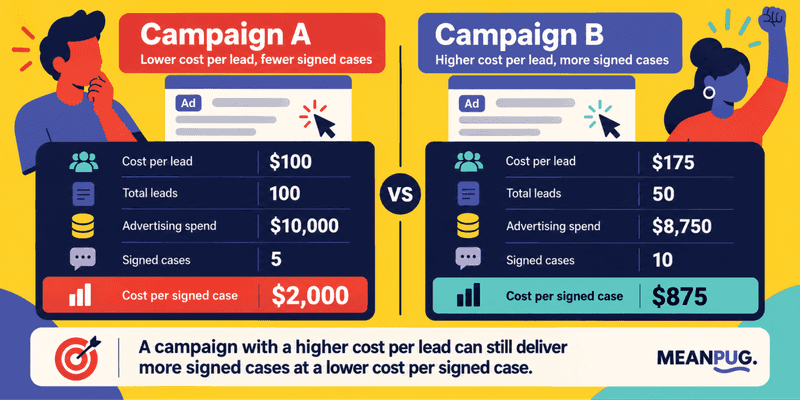
Despite having a 75% higher cost per lead, Campaign B acquires signed cases at less than half the cost of Campaign A.
That doesn't mean cost per lead is irrelevant. It means the metric needs to be evaluated alongside what happens further down the client-acquisition process. A lower cost per lead matters only if those inquiries have a reasonable chance of becoming cases the firm wants to accept.
Firms should track performance as far through the client journey as their data allows. Qualification rates, consultation rates, sign rates, cost per signed case, and, where appropriate, case value or revenue by source can reveal a very different picture than clicks and lead volume alone.
You don't need dozens of metrics. You need enough information to distinguish inexpensive marketing activity from effective client acquisition.
Your systems need to preserve the story of the lead
Even firms that collect this information often struggle to connect it.
An advertising platform records which campaign generated a conversion. Website analytics tracks the pages a visitor viewed. Call-tracking software records incoming calls. The intake system tracks whether a prospect qualifies, while practice management software records whether the firm ultimately signs the case.
Each system captures part of the client journey. But when that information remains disconnected, the firm can't reliably determine which marketing efforts are producing signed cases.
A firm's CRM, intake, and practice management systems should preserve the original marketing source and relevant attribution data as prospects move through the pipeline. That doesn't mean every platform needs to contain the same information. It means the firm needs a reliable way to connect marketing activity with intake and case outcomes.
Ideally, a firm should be able to start with a signed case and work backward to identify the channel, campaign, or other touchpoints that contributed to acquiring it. Where case values can reasonably be tracked, firms can also compare which sources are producing more valuable matters.
Attribution won't always be perfect. A prospective client might see an ad, read a review, visit the website several times, and then call after searching for the firm's name. Not every interaction will be captured or attributed accurately.
The goal isn't perfect certainty. It's having enough connected data to make better decisions. If your systems can identify where a lead came from but not what happened to it, you have source tracking. You don't yet have meaningful outcome attribution.
Build a scorecard around the client journey
A useful marketing scorecard should follow the same journey as the prospective client, from the first interaction through the signed case.
That means tracking how many people reach the website, how many contact the firm, how many qualify, how many schedule and attend consultations, and how many ultimately sign. Firms should also understand what it costs to acquire those clients, which marketing sources produce them, and, where measurable, the value of the resulting cases.
Once those stages are connected, the metrics become useful for diagnosing problems rather than simply reporting activity.
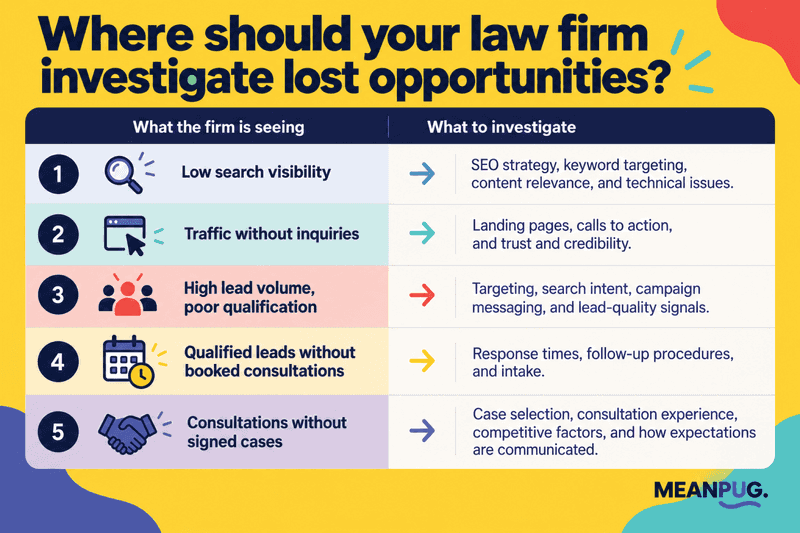
The scorecard provides a starting point for identifying where qualified opportunities may be lost. For example, low search visibility may warrant a closer look at keyword targeting, content relevance, and technical SEO. If qualified leads aren't becoming signed cases, the firm may need to investigate intake, consultation practices, or other parts of the client-acquisition process.
This is more useful than simply asking whether SEO or PPC is working. A marketing channel can generate the intended results while problems elsewhere in the client-acquisition process prevent those opportunities from becoming signed cases.
The objective isn't to identify a department, employee, agency, or platform to blame. It's to find where qualified opportunities are being lost and determine what needs to change.
Follow the funnel until the numbers make sense
Law firms have access to more marketing data than ever. That doesn't necessarily mean they have a clearer understanding of what's driving signed cases.
A dashboard can show improved rankings, increased organic traffic, more paid conversions, and a lower cost per lead. Those are positive indicators. But if signed cases remain flat, the analysis isn't finished.
The All-in-One Platform for Effective SEO
Behind every successful business is a strong SEO campaign. But with countless optimization tools and techniques out there to choose from, it can be hard to know where to start. Well, fear no more, cause I've got just the thing to help. Presenting the Ranktracker all-in-one platform for effective SEO
We have finally opened registration to Ranktracker absolutely free!
Create a free accountOr Sign in using your credentials
The next step is to follow those inquiries through the client-acquisition process. Determine which campaigns generated qualified prospects, how quickly the firm responded, how many consultations were scheduled and attended, and how many resulted in signed cases. Then connect those outcomes to the marketing sources that produced them.
The problem might be an SEO strategy attracting the wrong searches, a website that isn't convincing visitors to contact the firm, or an intake process that's losing qualified prospects. It might also be disconnected systems that prevent the firm from seeing where opportunities are being lost.
Rankings and cost per lead can help identify where to investigate, but neither tells the full story.
The goal isn't more clicks, better-looking dashboards, or even more leads. It's knowing which marketing efforts produce the cases your firm wants, where qualified opportunities are being lost, and what changes are most likely to improve the results.