Intro
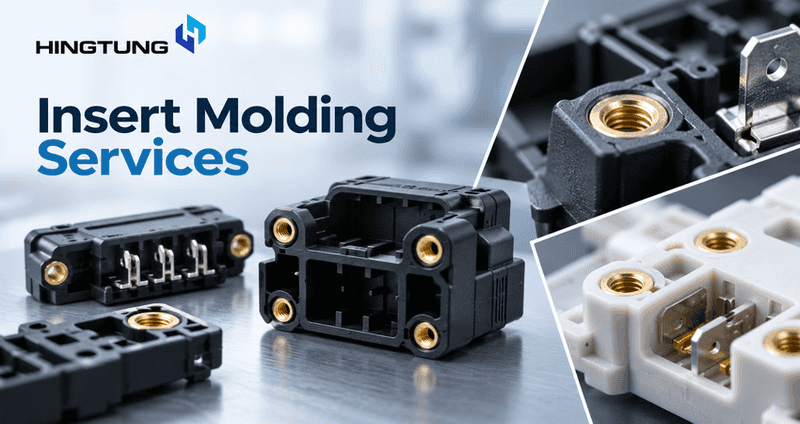
A loose threaded insert or misaligned electrical contact can make an otherwise good plastic housing unusable. For electronic products, the connection between metal and plastic often matters as much as the enclosure itself.
Insert molding services integrate metal inserts, terminals, bushings, or other preformed parts during injection molding. HingTung supports this type of OEM manufacturing through coordinated DFM, mold development, injection molding, and inspection, helping identify assembly and tooling problems before production begins.
Where Insert Molding Works Best in Electronics
In insert molding, a metal component is positioned inside the mold before molten plastic flows around it. Once the plastic solidifies, the insert becomes part of the finished component.
This approach can eliminate a separate insertion operation, but only when the insert geometry, mold positioning, and plastic flow are properly controlled.
| Electronic Component | Typical Insert | Main Engineering Requirement |
| Equipment housings | Brass threaded inserts | Torque and pull-out resistance |
| Electrical connectors | Metal terminals | Contact alignment and insulation |
| PCB mounting structures | Threaded bushings | Dimensional accuracy |
| Sensor housings | Metal sleeves or fittings | Mechanical retention |
| Control modules | Embedded contacts or pins | Stable positioning |
| Cable assemblies | Metal terminals | Retention and electrical continuity |
For a simple housing that is rarely opened, a molded plastic boss with an appropriate screw may be sufficient. A serviceable enclosure with repeated assembly cycles may benefit from a metal threaded insert.
The choice should follow the mechanical and electrical requirements, not just the appearance of the component.
Where HingTung Fits into Insert Molding Production
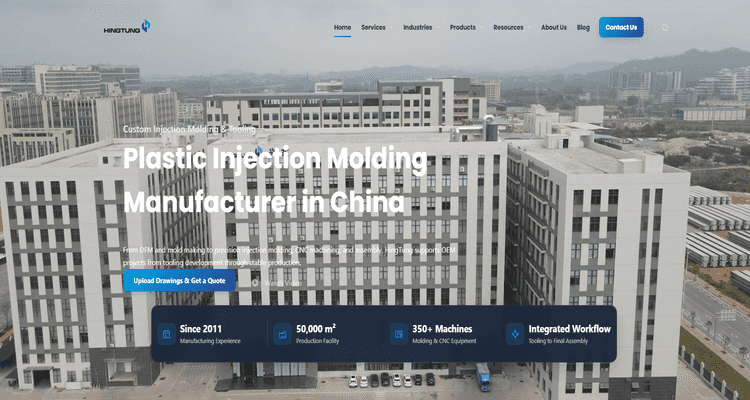
A reliable insert molding manufacturer needs to control more than the injection machine. Insert dimensions, tool positioning, resin flow, cooling, and inspection all affect the finished assembly.
The All-in-One Platform for Effective SEO
Behind every successful business is a strong SEO campaign. But with countless optimization tools and techniques out there to choose from, it can be hard to know where to start. Well, fear no more, cause I've got just the thing to help. Presenting the Ranktracker all-in-one platform for effective SEO
We have finally opened registration to Ranktracker absolutely free!
Create a free accountOr Sign in using your credentials
HingTung's insert molding manufacturing capabilities are supported by its in-house mold development and plastic injection molding operations. Established in 2011, the company operates more than 80 injection molding machines with clamping capacities up to 650 tons.
For OEM electronic projects, the practical benefit is coordination between tooling engineers, molding technicians, and quality inspection personnel.
Tooling and Insert Positioning
Consider a plastic control enclosure with four embedded brass inserts.
Each insert must remain correctly positioned while the mold closes and the plastic fills the cavity. Poor support can allow an insert to shift, while inadequate shutoff design may allow plastic flash into the threaded opening.
HingTung's DFM and tooling workflow allows these risks to be reviewed before the production mold is finalized.
The review should cover insert retention features, loading access, gate position, surrounding wall thickness, and the inspection method for insert location.
From Mold Trials to Production
An insert-molded sample may look acceptable while still having insufficient pull-out strength or inconsistent insert alignment.
During mold trials, manufacturers should check dimensions and functional performance, not just cosmetic quality.
The All-in-One Platform for Effective SEO
Behind every successful business is a strong SEO campaign. But with countless optimization tools and techniques out there to choose from, it can be hard to know where to start. Well, fear no more, cause I've got just the thing to help. Presenting the Ranktracker all-in-one platform for effective SEO
We have finally opened registration to Ranktracker absolutely free!
Create a free accountOr Sign in using your credentials
Keeping mold modifications, molding trials, and inspection feedback within one coordinated workflow can reduce unnecessary supplier handoffs. This is particularly useful when several plastic and metal components must fit together in the final product.
Insert Molding vs. Heat Staking vs. Ultrasonic Insertion
Not every threaded insert should be molded into the plastic. For some electronic housings, inserting the metal component after molding is simpler and less expensive.
The main options differ in tooling requirements, production sequence, and process control.
| Factor | Insert Molding | Heat Staking | Ultrasonic Insertion |
| Insert installation | During molding | After molding | After molding |
| Tooling complexity | Higher | Generally lower | Generally lower |
| Secondary insertion operation | Not required | Required | Required |
| Insert positioning | Controlled by mold features | Controlled by insertion fixture | Controlled by insertion fixture |
| Production considerations | Insert loading affects mold cycle | Additional thermal process | Additional ultrasonic process |
| Typical application | Stable, integrated metal-plastic designs | Threaded inserts in thermoplastics | Threaded inserts in suitable thermoplastics |
There is no universal winner. Insert molding services may be attractive when production volume is stable and integrating the insert removes significant downstream assembly work.
Post-mold insertion can make more sense when insert locations may change, tooling needs to remain simple, or different fastener configurations are required.
When Molded-In Inserts Make More Sense
I would investigate molded-in inserts when accurate integration during molding is important, insert geometry is stable, and the expected production volume can justify the tooling and loading process.
A connector with multiple embedded electrical terminals is a good example. Installing each terminal afterward may introduce additional handling and alignment requirements.
However, insert molding does not automatically provide higher retention strength. The result depends on insert geometry, resin properties, surrounding plastic, and processing conditions.
When Post-Mold Insertion Is Better
For a plastic electronics enclosure with only two threaded fasteners, heat staking may be perfectly adequate.
It also allows some flexibility if the insert specification changes during product development.
The key is comparing the total installed cost, including molding cycle time, insert loading, secondary equipment, labor, scrap, and inspection.
Design Details That Determine Insert Molding Quality
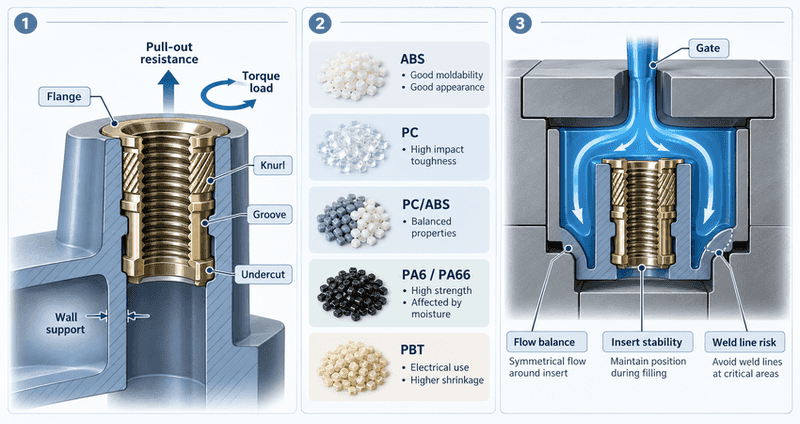
Most insert molding problems can be traced to a small number of design or process decisions.
Insert Geometry and Mechanical Retention
Metal and plastic generally rely on mechanical retention rather than a strong chemical bond.
Knurls, grooves, flanges, or undercuts can help resist pull-out and rotation. However, aggressive retention features also place stress on the surrounding plastic.
A threaded insert should therefore be selected around the expected installation torque, pull-out load, vibration, and service conditions.
For an electronic housing, I would confirm that the plastic boss has enough surrounding material and that the fastener load is not concentrated near a thin wall.
Material Selection and Shrinkage
ABS, PC, PC/ABS, PA, and PBT can all be considered for suitable metal-plastic assemblies, but they have different processing and shrinkage behavior.
| Material | Potential Advantage | Design Concern |
| ABS | Moldability and good housing appearance | Localized stress around inserts |
| PC | High impact toughness | Processing conditions and residual stress |
| PC/ABS | Balanced housing properties | Grade-specific shrinkage and temperature limits |
| PA6 / PA66 | Mechanical strength | Moisture-related dimensional changes |
| PBT | Electrical applications and dimensional behavior | Shrinkage and grade selection |
An insert also changes the local cooling pattern. Differences in thermal expansion between metal and plastic can create stress during cooling or temperature cycling.
The selected resin grade, insert geometry, and operating environment should therefore be reviewed together.
Gate Location and Plastic Flow
Poor gate placement can create weld lines or incomplete filling near an insert.
The flow pattern may also push against the insert, particularly when the metal component has a large exposed surface.
During DFM, the manufacturer should evaluate how the plastic fills around the metal feature and whether insert positioning remains stable during injection.
For complex layouts, mold flow analysis may help identify filling and pressure concerns before steel is cut.
Common Defects in Insert-Molded Components
Even with good tooling, insert molding needs process control. Small changes in insert dimensions, loading, or molding conditions can produce assembly problems.
| Defect | Possible Cause | What to Check |
| Insert movement | Inadequate support during injection | Core pins, fixture, injection pressure |
| Plastic flash in threads | Poor mold shutoff | Insert dimensions and tooling fit |
| Cracked plastic around insert | Residual stress or insufficient wall thickness | Resin, boss design, cooling |
| Weak insert retention | Unsuitable geometry or incomplete encapsulation | Knurl design and plastic flow |
| Electrical misalignment | Insert movement or shrinkage | Position tolerance and inspection |
| Voids around insert | Filling or packing problems | Gate position, venting, process settings |
For HingTung and other plastic injection molding manufacturers, early DFM and mold-trial feedback are important because an insert-related defect may involve both tooling and molding parameters.
Simply raising injection pressure or increasing the plastic wall thickness is not always the correct solution.
What to Check Before Selecting an Insert Molding Supplier
The All-in-One Platform for Effective SEO
Behind every successful business is a strong SEO campaign. But with countless optimization tools and techniques out there to choose from, it can be hard to know where to start. Well, fear no more, cause I've got just the thing to help. Presenting the Ranktracker all-in-one platform for effective SEO
We have finally opened registration to Ranktracker absolutely free!
Create a free accountOr Sign in using your credentials
A supplier should be able to explain how it controls insert positioning, molding quality, and final assembly requirements.
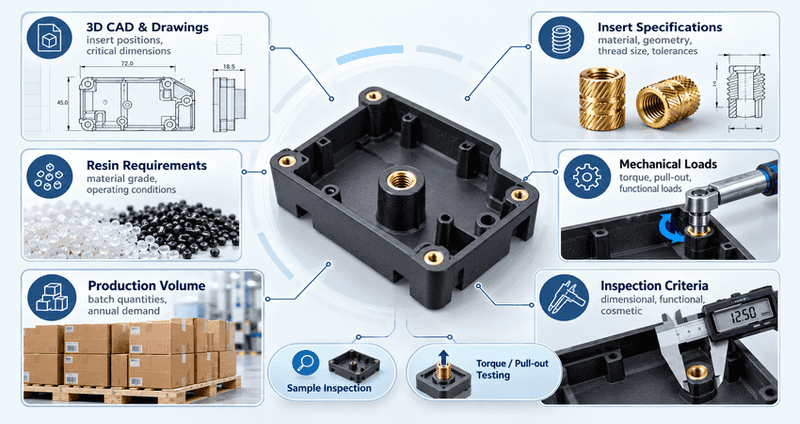
Before requesting a quotation, I would prepare:
- 3D CAD and drawings: Include insert positions and critical dimensions.
- Insert specifications: Define material, geometry, thread size, and tolerances.
- Resin requirements: Identify the material grade and operating conditions.
- Mechanical loads: Specify torque, pull-out, and other functional requirements.
- Production volume: Include expected batch quantities and annual demand.
- Inspection criteria: Define dimensional, functional, and cosmetic acceptance requirements.
A useful supplier evaluation should include sample inspection and, where appropriate, torque or pull-out testing.
HingTung's integrated DFM, mold manufacturing, injection molding, and supporting assembly capabilities are relevant for OEM projects where these requirements must remain consistent from tooling trials through production.
FAQs
Can insert molding be used with stainless steel inserts?
Yes. Stainless steel inserts can be molded into suitable plastics, provided the geometry, retention features, thermal behavior, and processing conditions are properly evaluated.
Can multiple metal inserts be molded into one plastic part?
Yes. Multiple inserts can be integrated into one molded component. Their spacing, positioning, mold access, and resistance to movement during filling must be considered.
Does insert molding provide electrical insulation?
The surrounding plastic can provide electrical insulation when a suitable material and geometry are used. Insulation performance should be verified against the application's electrical and environmental requirements.
Can a damaged molded-in insert be replaced?
Replacement is usually more difficult than with a post-mold insert. Depending on the design, removing a molded-in insert may damage the surrounding plastic, so repairability should be considered early.
Conclusion
Good insert molding services depend on more than placing metal inside plastic. Insert retention, material selection, mold design, and functional testing determine whether the component will work reliably in the finished electronic assembly.
HingTung combines DFM, in-house mold development, injection molding, and inspection support for OEM components, helping connect early engineering decisions with repeatable production.