Intro
Most marketing teams check their AI visibility the same way: someone opens ChatGPT, types "best [category] in [city]," and reads the answer. If the brand appears, everyone relaxes. If it doesn't, someone panics in a Slack channel. Either way, almost nothing has been learned - a single prompt, run once, on one platform, is an anecdote.
A GEO audit replaces the anecdote with a repeatable measurement. GEO - generative engine optimization - is the discipline of making a brand appear, accurately, in AI-generated answers. This guide walks through the five steps of a full audit: building a fixed prompt panel, running it consistently across platforms, scoring the answers, mapping the sources those answers lean on, and re-running on a schedule. By the end you will have a baseline you can defend, and a process you can repeat next month without starting over.
What a GEO audit actually measures
The reason to take this seriously now is simple: AI answers have quietly become a buying channel. Prospects who once opened ten blue links now read one synthesized answer and act on it. The brands inside that answer split the demand; everyone else splits what is left. Most companies have no idea which side of that line they are on.
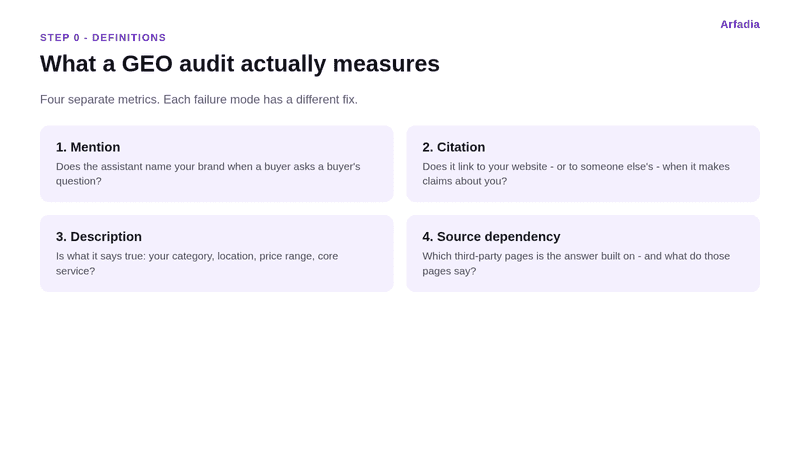
Before the steps, it helps to be precise about the units of measurement, because they are not rankings.
A GEO audit measures four things. First, mention: does the assistant name your brand at all when a buyer asks the kind of question your buyers ask? Second, citation: does it point to your website, or to someone else's, when it makes claims about you? Third, description: when it talks about you, is what it says true - your category, your location, your price range, your core service? Fourth, source dependency: which third-party pages is the assistant leaning on when it forms its answer, and do those pages say what you would want them to say?
Those four behave independently. A brand can be mentioned everywhere and cited nowhere. It can be cited and described badly. It can be described well because one outdated review page happens to be flattering this quarter. Averaging all of this into a single "AI score" hides the problems you most need to see. Keep the four separate and the audit becomes diagnostic: each failure mode has a different fix.
The All-in-One Platform for Effective SEO
Behind every successful business is a strong SEO campaign. But with countless optimization tools and techniques out there to choose from, it can be hard to know where to start. Well, fear no more, cause I've got just the thing to help. Presenting the Ranktracker all-in-one platform for effective SEO
We have finally opened registration to Ranktracker absolutely free!
Create a free accountOr Sign in using your credentials
One more thing to agree on before starting: an audit is a snapshot of a moving system. Models update, retrieval sources change, and answers drift. The value is not in any single run but in running the identical test again later and seeing the delta. Everything in the steps below is designed to make that repetition cheap and honest.
Step 1: Build a fixed prompt panel
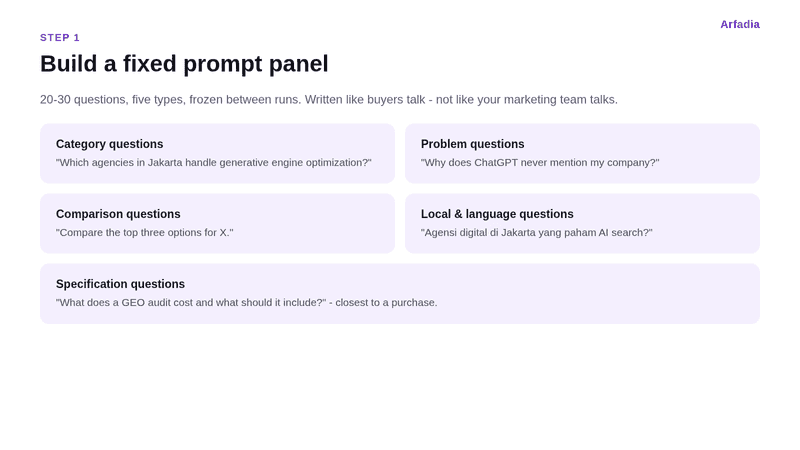
The foundation of the audit is a panel of 20 to 30 questions written the way real buyers talk, not the way your marketing team talks. This is harder than it sounds, because internal teams reliably write questions that contain their own brand vocabulary - which no buyer uses, and which makes the audit meaningless.
A good panel mixes five types of questions. Category questions: "Which agencies in Jakarta handle generative engine optimization?" Problem questions: "Why does ChatGPT never mention my company?" Comparison questions: "Compare the top three options for X." Local or language-specific questions, in every language your buyers actually use. And specification questions that name a feature, price band, or requirement, because those are the questions closest to a purchase. A keyword research tool helps here: the queries people already type into Google are the best raw material for the questions they will type into an assistant.
Here is what a small slice of a real panel looks like for a B2B service brand:
- "Who are the best GEO agencies for a mid-size e-commerce company?" - "What does a GEO audit cost and what should it include?" - "Is [brand] or [competitor] better for international SEO?" - "Agensi digital di Jakarta yang paham AI search?" (the same intent, in the buyer's other language) - "Why does Perplexity recommend [competitor] but not [brand]?"
Notice that none of these mention the brand's tagline, product names, or internal terminology. That is the point.
Three rules keep the panel honest. Write questions from sales calls and support tickets, not from brainstorms - the phrasing buyers use with a salesperson is the phrasing they use with an assistant. Include a few questions where you know you should win and a few where you expect to lose; a panel you sweep tells you nothing. And freeze the list. The single most common way these audits go wrong is quietly swapping in easier questions each month, which makes any trend line go up. Agree the panel once, write it down, share it with stakeholders, and do not touch it between runs.
Step 2: Run the panel across platforms, consistently
Run every question on every platform your buyers use. For most brands today that means ChatGPT, Gemini, Google AI Overviews, Google AI Mode, Perplexity, Copilot, Claude, and Grok - but let your own analytics and customer base decide, not habit.
The All-in-One Platform for Effective SEO
Behind every successful business is a strong SEO campaign. But with countless optimization tools and techniques out there to choose from, it can be hard to know where to start. Well, fear no more, cause I've got just the thing to help. Presenting the Ranktracker all-in-one platform for effective SEO
We have finally opened registration to Ranktracker absolutely free!
Create a free accountOr Sign in using your credentials
Consistency matters more than coverage. Use a clean session for each platform: no logged-in personalization where you can avoid it, no custom instructions, the same location and language settings every run. Document those settings once and reuse them, because they change answers. Run every question three times per platform, not once - a single run can flatter you or scare you, and three runs expose how stable an answer actually is. If a question returns your brand twice out of three runs, that is a different finding than three out of three.
Do not skip languages. The same question in English and in Bahasa Indonesia can return two completely different shortlists, because the underlying sources the models retrieve from differ by language. Any brand selling into more than one language market is effectively running one audit per language.
Log everything as you go: question, platform, run number, date, full answer text or a screenshot. The log feels tedious in week one and becomes the most valuable artifact you own in month three, when someone asks why a number moved.
A simple log structure is enough. One row per run, with columns for date, platform, question ID, run number, mentioned (yes/no), cited URL if any, description summary, visible sources, and a link to the full answer. Spreadsheets beat dashboards at this stage; the format will change as you learn what your stakeholders actually ask about, and a spreadsheet forgives change.
Step 3: Score mentions, citations, and descriptions
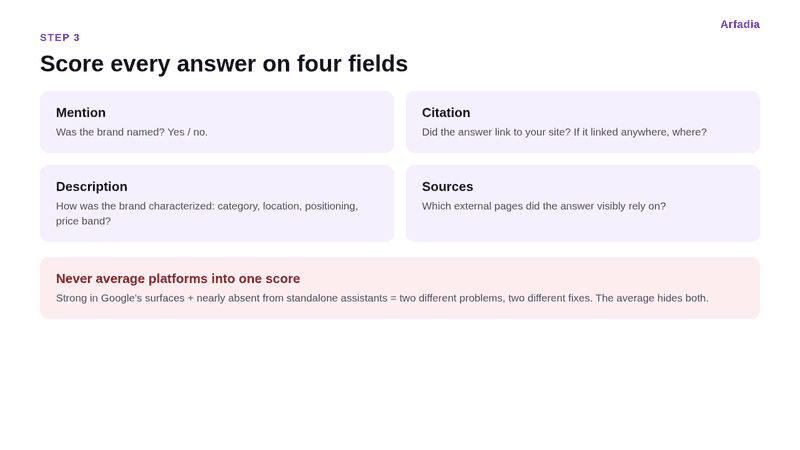
For each answer, record four fields.
Mention: was the brand named, yes or no. Citation: did the answer link to your site, and if it linked anywhere, where. Description: a short note on how the brand was characterized - category, location, positioning, price band. Sources: which external pages the answer visibly relied on, where the platform shows them.
Two patterns deserve special attention. A mention without a citation means the model knows your name but has not connected it to your owned sources - usually a sign that your own site is not the best answer to the question being asked. A citation with a wrong description is worse than either: the assistant is confidently sending buyers to you while misstating what you do, where you are, or what you cost. Teams underestimate this one. An assistant that names you but gets your location, price range, or core service wrong does more damage than one that leaves you out, because it manufactures disappointed buyers at scale.
Resist the urge to collapse platforms into one average. The platforms behave so differently that the average is fiction. In our client work we routinely see a brand appear in hundreds of Google AI Overviews and AI Mode answers while the same question panel produces a few dozen mentions across Copilot, Perplexity, Gemini, and ChatGPT combined. A brand reading only the blended number would believe its AI visibility was "medium everywhere" when in fact it was strong in Google's surfaces and nearly absent from the standalone assistants - two problems with completely different fixes.
Step 4: Map the sources the answers lean on
This is the step that turns measurement into a work plan.
When an assistant cites a source for a claim about your category, write the source down. Across a full panel you will collect a list: review platforms, comparison articles, industry directories, Wikipedia, Reddit threads, news coverage, your own properties. That list is the actual battleground. Models do not invent opinions about brands; they retrieve and compress what the web already says.
Read your source list with three questions. Which of these pages do we control, directly or through relationships? Which pages are inaccurate, outdated, or missing us - and what would it take to fix them? And which sources appear for competitors but not for us?
A worked example: say the comparison question "best X for Y" consistently leans on one well-known review site and one industry directory. Your brand is absent from both; three competitors are present on both. The audit has just told you something precise - the assistants are not ignoring you, they are faithfully reporting a web in which you are absent from the two pages that matter for this question. The fix is equally precise: earn accurate, current presence on those two pages. No rewrite of your homepage copy would have moved that answer.
This is also why GEO and classic SEO end up sharing most of their toolbox: the sources that rank tend to be the sources that get retrieved. Digital PR, guest articles on trusted publications, accurate directory listings, and reviews from real customers are unglamorous work that happens to be exactly what moves AI answers. It is also the core of what we do at Arfadia for brands building their AI search presence.
Step 5: Fix, then re-run on a schedule
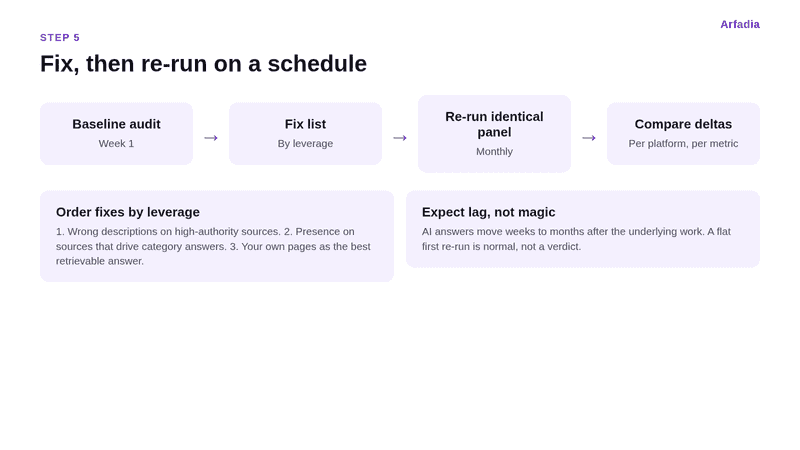
An audit that ends in a slide deck changes nothing. Convert the findings into a fix list, ordered by leverage: correcting wrong descriptions on high-authority sources first, then building presence on sources that drive category answers, then strengthening your own pages so they become the best retrievable answer for the questions you should own.
Then re-run the identical panel - same questions, same platforms, same settings, same three runs - on a fixed cadence. Monthly works for most brands; quarterly is the minimum. Compare run to run, platform by platform, metric by metric. What you are looking for is not a number going up. You are looking for specific answers changing: the comparison question that now includes you, the description that is finally accurate, the Perplexity answers that now cite your site instead of a three-year-old review.
Set expectations with stakeholders early: movement in AI answers lags the underlying work by weeks to months, because models and their retrieval layers update on their own schedules. A flat first re-run after a month of fixes is normal, not a verdict.
Reporting deserves a word of its own. Stakeholders who are used to SEO reports will ask for the AI equivalent of a rank tracker: one number, going up. Give them something better - a short report per platform, with the four metrics separate, two or three verbatim answer excerpts, and the fix list with its status. Verbatim excerpts do more for credibility than any chart, because nobody argues with a screenshot of an assistant describing your company wrongly.
It also helps to run the classic SEO measurement in parallel rather than instead. Rankings, organic traffic, and AI visibility answer different questions: where you stand in results pages, and what the machines say about you when asked directly. The two increasingly share inputs, so tracking them side by side - your keyword positions in a rank tracker, your mentions and citations in the audit log - shows you which lever moved which outcome.
Can you automate a GEO audit?
Partially. Running the panel and logging answers can be automated, and for large panels it should be - the same AI search SEO tools that track visibility can schedule the runs. Reading the answers should not be automated, at least not entirely: judging whether a description is subtly wrong - the right service, the wrong market; the right price, the wrong tier - is still a human job, and it is where the most expensive errors hide. A sensible setup is automated collection with human scoring, on the same fixed cadence.
Common mistakes that quietly ruin GEO audits
Most failed audits fail in the same handful of ways. Editing the question panel between runs, which manufactures fake progress. Testing one platform - usually ChatGPT - and generalizing to "AI." Testing once instead of three times and chasing noise. Reading mentions as success without checking whether the description was accurate. Ignoring languages, then concluding the brand is invisible when it is merely invisible in English. And averaging everything into one score, which hides the only information worth acting on.
All of these are process errors, not tooling errors. They are also free to avoid, which is why a disciplined manual audit beats a sloppy automated one.
How long until the fixes show up in AI answers?
Expect weeks to months, not days. Owned pages can be re-crawled quickly, but the third-party sources that drive most category answers update on their own schedules, and model behavior follows with a lag. This is an argument for starting the audit now rather than for waiting: the baseline takes a week to build, and every month without one is a month of drift you cannot see.
Closing thoughts
A GEO audit is not glamorous. It is a fixed list of buyer questions, run carefully across the assistants your customers use, read with attention to mention, citation, description, and sources, then run again the same way next month. Brands that do this learn where they actually stand and what to fix. Brands that keep spot-checking single prompts keep having feelings instead of data.
The All-in-One Platform for Effective SEO
Behind every successful business is a strong SEO campaign. But with countless optimization tools and techniques out there to choose from, it can be hard to know where to start. Well, fear no more, cause I've got just the thing to help. Presenting the Ranktracker all-in-one platform for effective SEO
We have finally opened registration to Ranktracker absolutely free!
Create a free accountOr Sign in using your credentials

Tessar Napitupulu, founder & CEO of Arfadia.
The discipline is young enough that most categories have no established baseline at all - which means the first team in a category to measure honestly is usually the first to improve. The two books I have published on this subject, "Found Before They Search" on the Indonesian digital landscape and "Cited or Silent" on GEO and AI visibility, both start from the same premise this guide does: you cannot win a game whose scoreboard you refuse to read.
Build the panel, freeze it, run it, and let the answers tell you where the work is.