Intro

An AI answer comes out of 6 steps: the system reads the question, splits it into smaller searches, finds sources, picks the best evidence, writes a reply and adds citations. Google's May 2026 guide to AI search names 2 of those steps, retrieval and query fan-out. Marketers can shape whether their content is found, relevant and easy to back up, but they cannot steer the model's choices or force a citation.
Keyfacts
- AI citations are a result. No publisher can switch one on.
- Retrieval comes before citation. A page must be found and judged useful before it can get credit.
- Some stages are open to influence. Crawl access, relevance, evidence and clarity sit partly in a business's hands.
- Other stages belong to the model. Reading the query, internal scoring, the written answer and the final citation are the system's call.
- Answer engine optimisation (AEO) works best as diagnosis. Find the stage where visibility breaks before you spend money on a fix.
The 6-stage journey from a question to a citation
Understanding how AI engines build and cite answers starts with knowing which parts of the process marketers can influence and which remain outside their control. The six stages below provide a practical working model, rather than suggesting that every AI product uses an identical architecture.
Google published its first official guide to AI search on 15 May 2026. Its Search Central announcement says search engine optimisation (SEO) best practice stays the foundation. Other platforms run their own retrieval, ranking and writing systems.
At a high level, the journey looks like this:
| Stage | What happens |
| 1. Query interpretation | The system works out what the user is asking. |
| 2. Sub-query expansion | The question splits into related searches or information needs. |
| 3. Retrieval | The system finds possibly relevant sources. |
| 4. Passage ranking | Useful documents, passages or evidence move to the top. |
| 5. Synthesis | The system writes the answer. |
| 6. Citation attachment | Some sources get a visible credit. |
The value lies in knowing which parts marketers can shape and which stay with the model.
1. Query interpretation: what is the user actually asking?
At this stage, the system works out intent, context and the kind of answer that would satisfy the question.
Google's 2019 BERT announcement said 15% of the queries it sees each day are new to it, so no one can predict every prompt.
Take this query: "What is the best CRM for a 50-person SaaS sales team?"
The All-in-One Platform for Effective SEO
Behind every successful business is a strong SEO campaign. But with countless optimization tools and techniques out there to choose from, it can be hard to know where to start. Well, fear no more, cause I've got just the thing to help. Presenting the Ranktracker all-in-one platform for effective SEO
We have finally opened registration to Ranktracker absolutely free!
Create a free accountOr Sign in using your credentials
Keyword matching is only the start, because the answer turns on what "best" means and what a 50-person software-as-a-service (SaaS) team needs. It turns on which products count as a customer relationship management (CRM) tool. It also turns on whether the user cares most about cost, setup, reporting, integrations or growth.
What marketers can influence
- Clear entity language: make it obvious what the company, product or service is.
- Audience definition: say who the offer is for.
- Problem alignment: link the product or service to the problems it solves.
- Conditional clarity: state where each claim applies and where it does not.
What marketers cannot control
- Prompt interpretation: how the system reads 1 user's exact wording.
- Conversation context: which earlier exchanges shape the answer.
- Intent weighting: which reading the system decides matters most.
The practical lesson: stop trying to predict every prompt and make the subject itself clear.
2. Sub-query expansion: 1 question can become several searches
At this stage, 1 broad question turns into several smaller information needs.
Complex questions rarely hold just 1 thing to look up, and Google calls the split query fan-out. Its AI features documentation says AI Overviews and AI Mode can run several related searches across subtopics and sources to build a response.
This changes how to think about relevance, because a page does not need the exact wording of the prompt. It can earn a place by answering 1 of the related questions the system checks along the way.
For example
A query such as: "What is the best CRM for a 50-person SaaS sales team?" can create related information needs around:
- CRM pricing
- Team size fit
- Sales reporting
- Setup effort
- SaaS integrations
- Room to grow
Most systems hide the exact fan-out, but the principle still holds.
What marketers can influence
Build enough coverage that the site answers the main question and the key questions around it.
That can include:
- Supporting pages for closely related topics.
- Strong internal links between related resources.
- Clear subtopic coverage inside broader articles.
- Distinct pages where a separate intent justifies one.
What marketers cannot control
The system decides:
- which fan-out queries to create
- how many searches to run
- which subtopics matter most
- which reading gets priority
This is why dozens of near-identical pages, 1 per prompt variation, make a weak plan. Google's own guidance treats that pattern as spam.
3. Retrieval: which sources enter the candidate set?
Retrieval is the stage where the system finds source material to help answer the question. Retrieval-augmented generation (RAG) pairs a language model with information fetched from outside it. Google says its AI features use its core Search ranking systems to fetch relevant, current pages from its index.
For marketers, this stage should sound familiar: an AI answer can only use what the system can find and fetch, which is 1 reason SEO still matters.
What helps at the retrieval stage
| Influence area | Why it matters |
| Crawlability | Search systems need access to important pages. |
| Indexability | Pages need to qualify for a searchable index. |
| Accessible content | Key facts should not depend on fragile rendering or hard-to-reach interfaces. |
| Internal linking | Strong site structure surfaces important pages and how they relate. |
| Topical relevance | The page needs a real link to the information needed. |
| Useful content | Being eligible does not make a weak page competitive. |
What remains outside the business's control
A marketer cannot dictate:
- whether 1 particular URL gets retrieved
- how large the candidate set will be
- which competitors also get retrieved
- how much retrieval shifts from 1 query to the next
Google's guide to how Search works lists 3 stages: crawling, indexing and serving. It also says Google guarantees none of them, even for pages that follow its rules. Meeting the rules makes a page eligible, and that is all.
Retrieval is a gate, and if your content never gets through it, work on later stages cannot make up for it.
4. Passage ranking: which evidence is useful enough to keep?
Retrieval gets a source into consideration. Passage ranking decides whether the information inside it is useful enough to keep. A retrieved document does not put every word of itself into the answer.
The All-in-One Platform for Effective SEO
Behind every successful business is a strong SEO campaign. But with countless optimization tools and techniques out there to choose from, it can be hard to know where to start. Well, fear no more, cause I've got just the thing to help. Presenting the Ranktracker all-in-one platform for effective SEO
We have finally opened registration to Ranktracker absolutely free!
Create a free accountOr Sign in using your credentials
The system still has to choose which facts fit the task. Depending on the product, it can rank whole documents, passages or smaller units of evidence.
Weak evidence versus useful evidence
Take 2 passages that answer a question about software setup costs.
Weak version: "Implementation is fast and affordable for growing businesses."
Stronger version: "Implementation cost depends on migration volume, integration requirements, user count and the amount of custom configuration required. Businesses migrating from several legacy tools will typically face more implementation work than teams moving from a single platform."
The second passage is more useful because it explains:
- what affects the outcome
- how those factors relate
- where the claim applies
- why circumstances change the answer
What marketers can influence
- Specificity: give direct answers backed by detail.
- Evidence proximity: place the proof next to the statement it supports.
- Qualifications: state limits and conditions.
- Section clarity: make each section make sense without much surrounding context.
- Causal language: explain why something happens as well as what happens.
What marketers cannot control
Businesses cannot see or dictate:
- private reranking scores
- internal thresholds
- weighting systems
- competing passages
- how the model spends its context space
Answer-first writing earns its place here, because clear writing cuts the guesswork needed to read what a passage says. No AI system demands a set paragraph length or formula.
5. Synthesis: the model constructs the answer
Synthesis is where retrieved information becomes a reply that fits the question. This is the stage most people picture when they think about generative AI.
The model can:
- combine several sources
- summarise longer explanations
- reconcile overlapping information
- keep only some of the available facts
- adapt the wording to the user's query and context
Where marketers still have influence
Publish source material that is:
- accurate
- specific
- well supported
- consistent with itself
- hard to misread
Where control ends
The model controls:
- final phrasing
- tone
- answer length
- which facts it keeps
- how it combines sources
- what it leaves out
This boundary matters: AEO improves the material that retrieval and writing systems receive, while the writing system itself stays with the model.
6. Citation attachment: which sources receive visible credit?
Citation is the final visible result, and it is also the step marketers care about most. Keep it separate from retrieval and use.
What businesses can improve
- Verifiable claims
- Clear source provenance
- Evidence placed near claims
- Original or distinctive information
- Pages that already perform well at earlier stages
What businesses cannot dictate
- How many citations appear
- Which source gets credit
- Where a citation is attached
- Whether a competing source wins instead
That boundary is a core idea in AEO: you can improve the conditions for selection, but you cannot demand selection.
The expensive mistake: optimising the wrong stage
The biggest waste in AEO comes from applying a tactic to the wrong stage. Teams jump to optimisation before they find where the failure happens, and the result is activity without diagnosis.
Example 1: the page cannot be retrieved
Say an important page cannot be indexed. Rewriting its frequently asked questions (FAQ) section for "AI extractability" will not fix it, because the failure happens earlier, at discovery and retrieval.
Example 2: the page is retrievable but weak
Now take the opposite case. A page is crawlable, indexed and ranking for relevant searches, but its claims are vague and unsupported. More technical markup will not fix that, since the weakness sits closer to evidence selection.
Diagnose before optimising
| If the problem is... | Focus first on... |
| The page cannot be discovered | Crawlability, indexability and site architecture |
| The page is retrieved but not useful | Relevance, clarity and evidence |
| The answer is vague or generic | Specificity, first-party information and stronger support |
| Competitors are cited repeatedly | Comparative evidence quality and source usefulness |
| The brand appears but is not cited | Attribution patterns and source-level measurement |
This keeps AEO from turning into a list of fashionable technical tasks.
Google's AI search optimisation guide backs this up. For Google Search, you need no llms.txt file and no special AI markup. You also need no tiny content chunks and no AI-specific Schema.org markup. The same guide says separate pages for every fan-out query, made to game results, break its scaled content abuse policy.
Page structure still matters, for a different reason. Short paragraphs, clear headings and self-contained answers help people understand content and make relationships explicit. Treat them as good writing, never as a secret code that forces a citation.
What can marketers actually optimise?
Most practical AEO work falls into 3 areas: discovery, evidence quality and measurement.
The 6-stage model helps with diagnosis. In practice, marketers improve the parts of the system they can shape, grouped into those 3 areas.
1. Make important information eligible for discovery
Start with the basics: important pages should be open to crawlers, load properly and be indexable wherever a platform relies on web search or an indexed corpus.
For Google, standard SEO practice still applies to AI features. OpenAI's help page on ChatGPT search tells site owners to let its OAI-SearchBot crawler in to be eligible, and it says placement is not guaranteed.
Think of it as 2 steps:
- SEO makes information discoverable. Useful pages have to be found first.
- AEO makes the answer usable. Once a page can be found, make the answer clear, rich in evidence and easy to place in context.
2. Improve the quality of the evidence
Once discovery works, quality means more than "write a better article". Ask whether each passage gives the system enough to use it responsibly.
A useful quality check is:
- What is the claim?
- What evidence supports it?
- What conditions affect it?
- Is the source clear?
- Can the passage be understood without guesswork?
- Does it add anything beyond the existing consensus?
Say you claim 1 approach is faster: faster than what, under which conditions and based on whose evidence?
If you quote a statistic, is the method available?
If you describe a service, is it obvious who it is for and what problem it solves?
If there is a limit, is it attached to the claim or buried 3 sections later?
Strong AEO content cuts ambiguity, and Google's guidance takes the same user-first line by favouring useful, original content over commodity pages built to catch search variations.
3. Measure every stage of the journey
A citation shows visibility, but it does not explain why you appeared or why you vanished.
Track more than a yes-or-no citation result.
| What to track | What it can reveal |
| Prompt or query | Which information need triggered visibility |
| Platform | Where citation behaviour differs |
| Cited URL | Which page gets selected |
| Referenced section | Which passage looks useful |
| Competing sources | Who keeps winning the same information need |
| Organic visibility | Whether retrieval and standard search visibility overlap |
| Brand mentions without links | Whether the business enters the answer without visible credit |
Then compare the patterns.
Did the page lose indexation?
Does it appear in organic results but not in generated answers?
Does another publisher keep getting cited because it has original data?
Are you mentioned without getting the link?
The All-in-One Platform for Effective SEO
Behind every successful business is a strong SEO campaign. But with countless optimization tools and techniques out there to choose from, it can be hard to know where to start. Well, fear no more, cause I've got just the thing to help. Presenting the Ranktracker all-in-one platform for effective SEO
We have finally opened registration to Ranktracker absolutely free!
Create a free accountOr Sign in using your credentials
Those patterns lead to better decisions than treating every missed citation as a writing problem.
A simple way to diagnose a missing citation
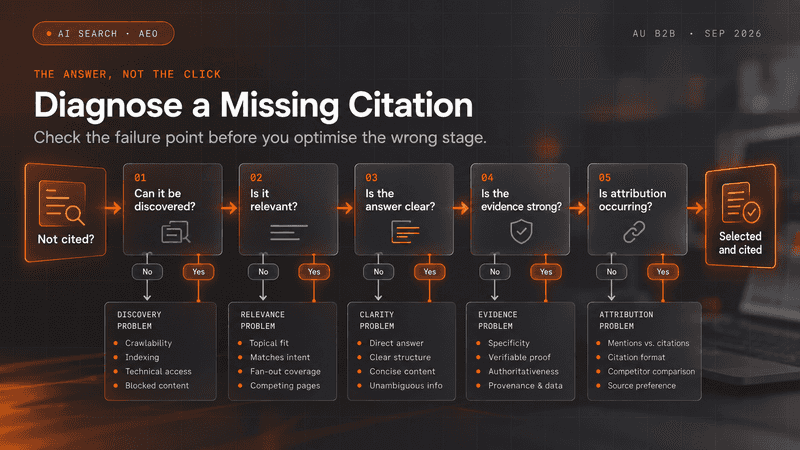
When a citation is missing, work through the stages in order before you rewrite anything. Swap "How do we make AI cite this page?" for 5 diagnostic questions.
- Can the page be discovered? Check technical access, crawlability and indexation. Google's technical requirements page lists 3 tests: Googlebot is not blocked, the page returns an HTTP 200 status, and the page has indexable content.
- Is it relevant to the information needed? Look beyond the exact keyword to nearby questions and likely fan-outs.
- Is there a clear answer on the page? Find the passage that should answer the question. If a human struggles to find it, it is too vague.
- Is the evidence strong enough? Compare the page with the sources already appearing. Look for original data, stronger explanation, clearer conditions or better provenance.
- Is credit the problem? If the brand or its facts appear in answers but the page gets no visible citation, the issue sits later in the chain.
This order stops teams spending budget on late-stage tactics while an early-stage problem blocks the page.
Optimise the conditions for a citation
You optimise the conditions that make your content a strong candidate for retrieval, evidence selection and credit.
Even then, nothing is guaranteed: Google Search Essentials says a page that meets every requirement and best practice still has no promise of being crawled, indexed or served. OpenAI says the same about ChatGPT search placement. That is less exciting than a promise to "dominate AI results", but it gives marketers a far more useful way to operate.
Marketers can:
- make important content discoverable
- publish specific, supportable answers
- build topic coverage around real customer questions
- create first-party evidence instead of recycled summaries
- track which sources keep answering commercially important questions
- diagnose weak stages instead of changing everything at once
What they cannot do is control a private model's reading of the query, its internal scoring or its final citation choice.