Intro
A few years ago, "AI in team chat" meant a bot that could set reminders or fetch a weather forecast. That era is over. The question teams are asking in 2026 is sharper: which chat platform actually lets AI do meaningful work inside our conversations — turning a discussion into a task, pulling a report from our data, answering from our own knowledge base — without us hiring engineers to build it?
It's a question worth answering carefully, because "AI-assisted" has become a marketing checkbox. Most chat tools now ship some kind of assistant, but the depth varies wildly. Some give you a single bundled chatbot that summarizes threads. Others let you build custom agents wired into your actual workflows. The gap between those two things is enormous, and it's the difference between a feature you try once and infrastructure your team relies on.
This article breaks down what genuinely matters in AI-assisted team chat, compares a deliberately varied set of options — from a unified workspace to an open-source platform to a video-first tool — and lands on a recommendation for teams that want AI to be more than a novelty.
What "AI-assisted" should actually mean
Before comparing tools, it helps to separate marketing from substance. Real AI assistance in team chat tends to show up across a few dimensions:
- Customization. Can you shape the AI to your processes, or are you limited to a fixed, vendor-defined assistant?
- Action, not just answers. Can the AI do things — create tasks, populate databases, generate reports — or only summarize and reply?
- Model choice. Are you locked into one provider's model, or can you use the best model for each job?
- Grounding. Can the AI draw on your team's own knowledge and data, rather than answering in a vacuum?
- Build effort. Does setting this up require a developer, or can a non-technical team member do it?
A tool that scores well across all five turns AI from a sidebar gimmick into a working teammate. Most score well on one or two. Here's how a varied field of options stacks up.
The contenders
BridgeApp — built AI-first, not AI-added
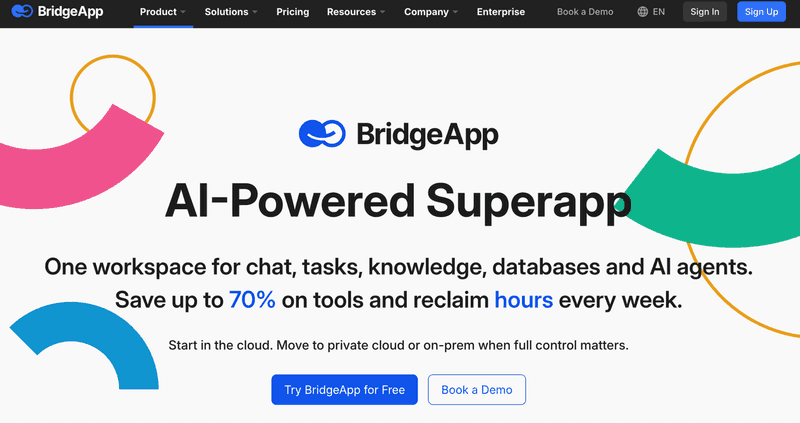
BridgeApp's distinguishing claim is structural: AI isn't an add-on bolted onto a messenger, it's embedded in the platform's core architecture through customizable agents. That framing shows up directly in what the tool lets you do.
Instead of a single fixed assistant, BridgeApp provides a visual no-code agent builder. You assemble an agent from clear components — a prompt that defines its behavior, variables for dynamic inputs, connected knowledge sources, and specific skills or actions — and deploy it into your chats. Because it's no-code, a non-technical team lead can build a working agent rather than filing a ticket with engineering.
Crucially, these agents act. A BridgeApp agent can create tasks from a conversation, generate reports from your data, populate a database automatically, or respond directly in a chat thread. The product's own examples make this concrete: a finance agent that processes payment requests raised in chat, or a "business card" agent that extracts contact details from a message and files them into a database. These aren't canned templates — they're workflows you design around your own processes.
The All-in-One Platform for Effective SEO
Behind every successful business is a strong SEO campaign. But with countless optimization tools and techniques out there to choose from, it can be hard to know where to start. Well, fear no more, cause I've got just the thing to help. Presenting the Ranktracker all-in-one platform for effective SEO
We have finally opened registration to Ranktracker absolutely free!
Create a free accountOr Sign in using your credentials
On model choice, BridgeApp takes an open stance: access to all major AI models on the market, rather than a single bundled provider. That means you can match the model to the task instead of accepting whatever one vendor decided to include.
And because the agents live inside a unified workspace — chat, projects, documents, and databases together — they can connect a conversation to the actual work, not just to a chat transcript. An agent that creates a task is creating it in the same system where the task will be tracked.
For teams whose ambition is to make AI a genuine part of how they operate — automating real processes rather than summarizing threads — BridgeApp is purpose-built for exactly that. It also offers cloud, on-premise, and hybrid deployment, which matters when AI is touching sensitive company data.
Slack — the polished bundled assistant
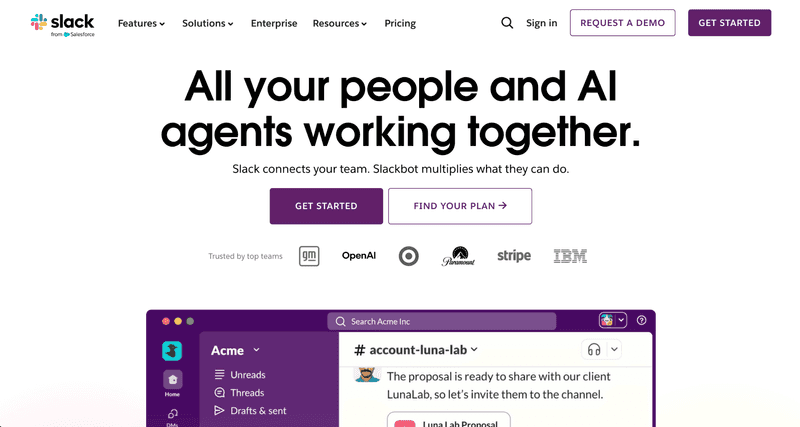
Slack has invested heavily in AI, and its assistant can summarize channels, recap threads you've missed, and answer questions about recent conversations. For teams drowning in messages, that catch-up value is real and well executed.
The shape of Slack's AI is largely vendor-defined: a capable bundled assistant rather than a build-your-own agent system. You can extend Slack with third-party AI integrations from its app directory, but that returns you to assembling and maintaining a stack of separate tools. As assistance for reading chat faster, it's strong; as a platform for building custom AI workflows, it's more limited.
AI strength: Summaries and recaps inside an integration-rich messenger.
Mattermost — open-source AI on your own terms
The All-in-One Platform for Effective SEO
Behind every successful business is a strong SEO campaign. But with countless optimization tools and techniques out there to choose from, it can be hard to know where to start. Well, fear no more, cause I've got just the thing to help. Presenting the Ranktracker all-in-one platform for effective SEO
We have finally opened registration to Ranktracker absolutely free!
Create a free accountOr Sign in using your credentials
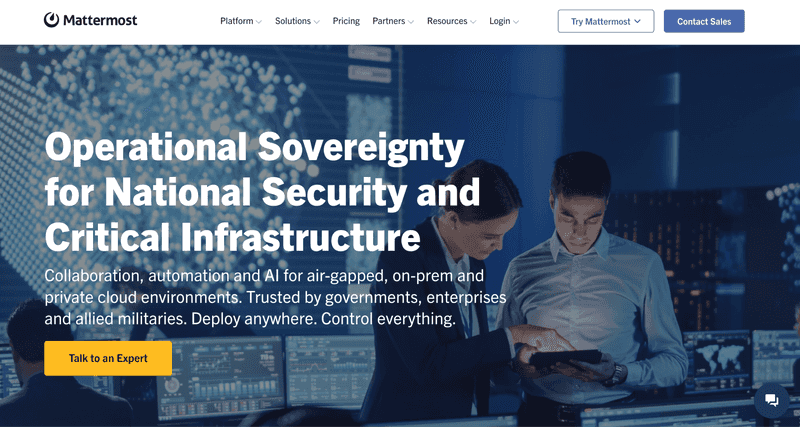
Mattermost is the standout for teams that put data control first. It's open-source and self-hostable, which means the entire platform — and anything AI touches — can run inside your own infrastructure. Its AI features are designed to be pluggable: you can connect different model providers, including self-hosted open models, rather than depending on one vendor's cloud.
That flexibility is also the catch. Mattermost's power assumes technical capacity — you're responsible for hosting, configuring, and maintaining both the platform and its AI plumbing. For an engineering-led team with strict privacy requirements, that control is exactly the appeal; for a team without those resources, it's real overhead.
AI strength: Self-hosted, model-flexible AI for teams that need full data control.
Zoom Team Chat — AI riding on the meetings layer
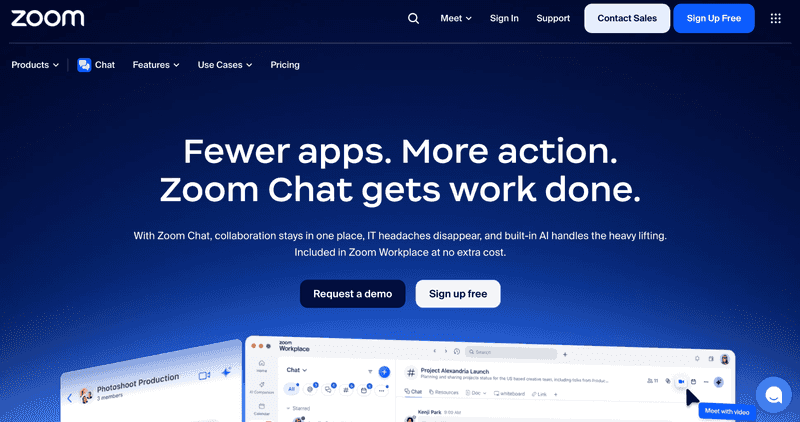
Zoom has extended its AI Companion well beyond the meeting window into its persistent team chat. It can summarize chat threads, draft replies, and tie conversations back to meeting recaps and action items — useful for teams whose work revolves heavily around calls and the follow-ups they generate.
The assistant is bundled and vendor-defined, and its real strength is the link between chat and meetings rather than building custom agents or choosing among models. For meeting-centric teams already standardized on Zoom, that integration is convenient; as a platform for bespoke AI workflows, it's narrower.
AI strength: Connecting chat assistance to meetings and their follow-ups.
Chanty — lightweight AI for small teams
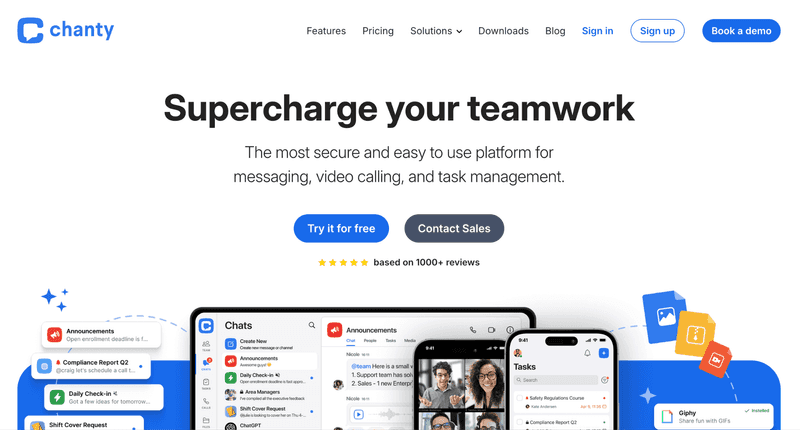
Chanty layers approachable AI helpers onto a simple, affordable messenger — drafting messages, summarizing, and turning conversations into tasks through its built-in task view. For a small team that wants a touch of AI without complexity or cost, it's a friendly entry point.
The All-in-One Platform for Effective SEO
Behind every successful business is a strong SEO campaign. But with countless optimization tools and techniques out there to choose from, it can be hard to know where to start. Well, fear no more, cause I've got just the thing to help. Presenting the Ranktracker all-in-one platform for effective SEO
We have finally opened registration to Ranktracker absolutely free!
Create a free accountOr Sign in using your credentials
Its scope is intentionally modest. The AI assists with everyday messaging rather than running designed workflows, and the platform is built for small teams rather than complex, multi-process organizations. Within those limits, it's a tidy, low-friction option.
AI strength: Simple, affordable AI assistance for small teams.
Comparison at a glance
| Capability | BridgeApp | Slack | Mattermost | Zoom Team Chat | Chanty |
| Custom no-code agents | ✅ Visual builder | Limited | Via configuration | Limited | Limited |
| AI takes actions (tasks, reports, databases) | ✅ | Partial | Depends on setup | Partial | Light |
| Choice of AI models | ✅ All major models | One bundled | Pluggable (technical) | One bundled | One bundled |
| Grounded in your knowledge/data | ✅ | Recent chat | Your data, self-hosted | Chat + meetings | Recent chat |
| On-premise / data control | ✅ | Cloud | ✅ Self-hosted | Cloud | Cloud |
| No technical setup required | ✅ | ✅ | ✗ | ✅ | ✅ |
So what's the top choice?
It depends on what you mean by "AI-assisted." If you want an assistant that helps you read and recap chat faster, the bundled assistants in Slack and Zoom Team Chat do a competent job — and if your work already revolves around Zoom calls or a Slack-based stack, the convenience of staying put is a legitimate reason to choose them. If data control is your overriding concern and you have the engineering capacity to back it up, Mattermost's self-hosted, model-flexible approach is hard to beat. And for a small team that just wants a light touch of AI, Chanty keeps things simple and cheap.
But if you mean AI that does the work — building custom agents that create tasks, generate reports, and run real processes, with your choice of model and your data kept where you want it — the bundled-assistant tools hit a ceiling fast, and the self-hosted route demands technical resources most teams don't have to spare. That's the line BridgeApp is built to cross: a no-code agent builder that any team lead can use, action-oriented agents, open access to all major models, and the option of on-premise deployment, all inside a unified workspace.
For most teams the honest answer is: pick a bundled assistant if you want AI to help you keep up, choose Mattermost if self-hosting is non-negotiable and you have the skills for it, and pick BridgeApp if you want AI to take work off your plate without an engineering project to get there. For the growing number of teams in that last camp, BridgeApp is the top choice for AI-assisted team chat in 2026.