Intro
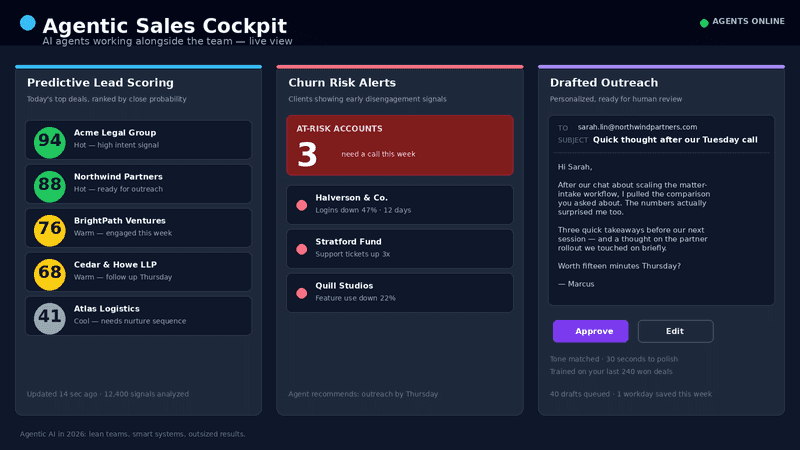
What an agentic CRM looks like in practice: AI agents handling the busywork while humans review and approve.
For years, the conventional wisdom in business was simple. The big eat the small. The well-funded outsell the bootstrapped. The team of fifty closes more deals than the team of five. Then 2026 happened.
Walk into any startup running a tight ship right now and you’ll notice something strange. The leadership doesn’t seem stressed. The sales pipeline isn’t held together with duct tape and willpower. The single account executive is somehow keeping pace with an enterprise team three or four times their size. And nobody’s pulling all-nighters to make it happen.
What changed isn’t the people. It’s the help they have working alongside them. Welcome to the era of agentic sales, where artificial intelligence has graduated from “answers questions” to “actually does the work.” For small businesses, this shift isn’t just a productivity boost. It’s a structural reset of who gets to compete with whom.
From Chatbots to Coworkers
Let’s be clear about what “agentic AI” actually means, because the term gets thrown around carelessly. A chatbot answers a question. An agent completes a task. The difference is the verb.
When you ask a chatbot about your pipeline, it might tell you which deals look promising. An agent, by contrast, will pull up those deals, prioritize them by close probability, draft personalized follow-up emails for each one, schedule the sends, and have summary notes ready by the time you sit down with your coffee.
The All-in-One Platform for Effective SEO
Behind every successful business is a strong SEO campaign. But with countless optimization tools and techniques out there to choose from, it can be hard to know where to start. Well, fear no more, cause I've got just the thing to help. Presenting the Ranktracker all-in-one platform for effective SEO
We have finally opened registration to Ranktracker absolutely free!
Create a free accountOr Sign in using your credentials
This isn’t science fiction or a 2030 roadmap. Gartner has projected that by 2028, around a third of enterprise software applications will include agentic AI, up from less than one percent in 2024. The early-mover advantage is happening right now, and small businesses are taking it. Why? Because they have less bureaucracy in the way. A solo founder can deploy an AI workflow on Tuesday afternoon. An enterprise has to schedule a steering committee.
Once again, being small is starting to look like an advantage instead of a handicap.
The David vs. Goliath story of 2026 is being rewritten by artificial intelligence. Small, lean teams are now generating the same revenue as mid-market firms by automating the high-volume, low-value tasks that used to require a massive sales floor. The secret weapon in this revolution is the integration of an intelligent small business CRM. Instead of just storing names and numbers, these modern systems use predictive modeling to tell your team exactly which deal is most likely to close today. This allows you to focus your human talent on what matters most: developing deep, real relationships, while the system does the hard lifting of data orchestration and follow-up.
Three Things AI Now Does Inside Your CRM
Predictive Lead Scoring That Actually Works
Old lead scoring was rules-based and lazy. Job title equals decision-maker, company size equals budget, downloads equal intent. Anyone who’s worked in B2B sales knows how often that math lies.
Modern AI scoring looks at thousands of signals at once: email opens, page visits, time-of-day patterns, language used in conversations, similar accounts that converted, even seasonality. It learns from your actual closed-won deals. By the third or fourth month of operation, it knows your buyer better than your senior rep does. Not because the rep is bad—because no human has the patience to track twelve thousand variables.
Churn Prediction Before It’s Too Late
For subscription businesses, this one is huge. AI now flags accounts that show early signs of disengagement weeks before a renewal call goes sideways. Drop in feature usage. Slower response times in support tickets. Reduced login frequency. The agent watches all of it quietly and tells you, “talk to this client by Thursday.”
Outreach That Doesn’t Read Like a Form Letter
This is the most contentious one, and rightfully so. Generic AI-written emails are a plague. But agentic systems trained on your tone, your past wins, and the specific context of each prospect can produce drafts that genuinely sound like you. Not perfect. But a strong starting point that takes thirty seconds to polish instead of fifteen minutes to write from scratch.
Multiply that across forty outreach emails a week and you’ve just bought your sales team an extra workday.
Why Big Competitors Aren’t Winning This One
There’s a quiet irony unfolding in 2026. The biggest companies, with the biggest tech budgets, are losing this race. Not because the technology is unavailable to them. Because they’ve outgrown nimbleness.
Enterprise rollouts of AI tools require security reviews, legal sign-offs, change management committees, training programs, and quarterly steering reviews. By the time a Fortune 500 sales org actually has agentic workflows live, a competitor with eight employees has been iterating on theirs for six months.
The All-in-One Platform for Effective SEO
Behind every successful business is a strong SEO campaign. But with countless optimization tools and techniques out there to choose from, it can be hard to know where to start. Well, fear no more, cause I've got just the thing to help. Presenting the Ranktracker all-in-one platform for effective SEO
We have finally opened registration to Ranktracker absolutely free!
Create a free accountOr Sign in using your credentials
Then there’s the data problem. Big companies have massive amounts of customer data, but it’s scattered across legacy systems, siloed by region, locked behind department walls, and often years out of date. The AI is only as smart as the data feeding it. Small businesses with a single, unified system actually feed their AI better signals.
There’s also the customer-experience angle. People don’t want to feel like they’re being processed by an enterprise machine. The personal touch a small team can deliver, when amplified by AI handling the busywork, beats the corporate template every single time. Buyers can tell the difference, and they prefer the human side of the equation.
What This Actually Looks Like on a Tuesday
Picture a five-person SaaS company selling to mid-sized law firms. Their marketing manager spends Monday morning reviewing the AI’s pipeline ranking. Three accounts were pushed up in priority overnight based on website behavior. The agency has already created three follow up sequences that are suited to each firm's previous action.
She edits two sentences in each draft, approves the sends, and moves on. Total time: nineteen minutes. The same tasks would have taken her two and a half hours in 2023.
The All-in-One Platform for Effective SEO
Behind every successful business is a strong SEO campaign. But with countless optimization tools and techniques out there to choose from, it can be hard to know where to start. Well, fear no more, cause I've got just the thing to help. Presenting the Ranktracker all-in-one platform for effective SEO
We have finally opened registration to Ranktracker absolutely free!
Create a free accountOr Sign in using your credentials
Meanwhile, the agent has flagged one existing client whose engagement has dropped fifteen percent in the past two weeks. The customer success rep gets the alert, calls the client that afternoon, and discovers a frustration with a recent feature change. They fix it. The renewal, which would have quietly slipped, doesn’t.
This isn’t the future. This is a normal Tuesday in 2026.
How to Start Without Overcommitting
Don’t blow up your existing process. Pick one workflow that’s painful and slow—initial lead qualification, weekly outreach drafting, renewal-risk monitoring—and let an agentic AI handle that single piece for sixty days. Measure the time saved and the deals influenced. If the numbers move, expand. If they don’t, recalibrate.
The mistake people make is trying to automate everything at once. Agentic systems work best when humans stay in the loop, reviewing and refining the agent’s work until trust is earned. Treat the AI like a junior hire, not a replacement. Give it clear scope, check its output, and promote it to bigger responsibilities only when it’s proven itself on the smaller ones.
The Bottom Line
The David versus Goliath story has always made for good marketing copy. In 2026, it’s becoming an actual operating model. Small teams paired with smart agents are punching three weight classes above themselves, and the trend is accelerating, not slowing down.
The companies that figure this out in the next twelve months will spend the rest of the decade taking market share from competitors who waited too long. The window to be early is closing. The window to be on time is open right now.