Intro
Why businesses built on certified expertise must rethink how they surface authority signals for modern search engines and AI platforms.
Executive Summary
Search engines are evolving from keyword-matching tools into trust evaluation systems.
As AI-driven search experiences become more common, search platforms increasingly prioritize organizations that clearly demonstrate expertise, authority, and credibility. For professional service businesses—such as managed IT providers, medical specialists, engineering firms, cybersecurity consultancies, and financial advisors—this shift has significant implications.
These organizations rely on certified professionals and specialized expertise to deliver their services. However, much of that expertise often remains invisible online, limiting how search engines and AI systems recognize their authority.
E-E-A-T—Experience, Expertise, Authoritativeness, and Trustworthiness—provides a framework for making this expertise visible. By surfacing expert credentials, certifications, thought leadership, industry recognition, structured entity data, and topical authority, professional service organizations can strengthen their digital credibility.
As AI search continues to evolve, businesses that successfully demonstrate these authority signals will be better positioned to appear in search results, industry discussions, and AI-generated answers.
Article Navigation
- The Shift Toward Authority-Driven Search
- Why E-E-A-T Matters for Expertise-Driven Businesses
- The Hidden Problem: Expertise Exists Offline but Not Online
- How Search Engines Evaluate Authority Today
- Six Ways to Surface Authority Signals on Your Website
- Expert Entity Development
- Certification and Credential Visibility
- Thought Leadership and Expert Content
- Structured Entity Signals
- Reputation and Industry Mentions
- Topical Authority Through Content Depth
- Why Authority Signals Matter Even More in AI-Driven Search
- Authority Is the New SEO
The Shift Toward Authority-Driven Search
Search engines are evolving into trust engines.
For years, search optimization focused heavily on keywords, backlinks, and technical SEO. But as AI systems increasingly influence search results—from Google’s AI Overviews to generative answer engines—the criteria for visibility is changing.
The All-in-One Platform for Effective SEO
Behind every successful business is a strong SEO campaign. But with countless optimization tools and techniques out there to choose from, it can be hard to know where to start. Well, fear no more, cause I've got just the thing to help. Presenting the Ranktracker all-in-one platform for effective SEO
We have finally opened registration to Ranktracker absolutely free!
Create a free accountOr Sign in using your credentials
Modern search platforms are attempting to answer a deeper question:
Who should be trusted to provide this information?
This shift has major implications for businesses built on professional expertise.
Managed service providers rely on certified technicians. Medical practices depend on licensed physicians. Engineering firms operate under professional accreditation. Accounting firms employ certified CPAs. Cybersecurity companies rely on advanced certifications and security clearances.
In these industries, expertise isn’t simply part of the service—it is the service.
But while these organizations possess significant real-world expertise, much of that authority is often invisible online.
The All-in-One Platform for Effective SEO
Behind every successful business is a strong SEO campaign. But with countless optimization tools and techniques out there to choose from, it can be hard to know where to start. Well, fear no more, cause I've got just the thing to help. Presenting the Ranktracker all-in-one platform for effective SEO
We have finally opened registration to Ranktracker absolutely free!
Create a free accountOr Sign in using your credentials
This is where E-E-A-T—Experience, Expertise, Authoritativeness, and Trustworthiness—becomes essential.
According to Google’s own Search Quality Evaluator Guidelines, evaluating the Experience, Expertise, Authoritativeness, and Trustworthiness (E-E-A-T) of content creators is a core factor in determining the reliability of information—particularly in fields where professional expertise directly impacts user outcomes.
“For expertise-driven businesses, the challenge is rarely a lack of authority—it’s that search engines cannot see it.”
Why E-E-A-T Matters for Expertise-Driven Businesses
Professional service organizations differ from many other businesses because their services are fundamentally based on knowledge and credentials.
Examples include:
- Managed IT service providers
- Medical specialists and clinics
- Engineering and architecture firms
- Cybersecurity consultants
- Accounting and financial advisory firms
- Legal practices
- Environmental consulting firms
- Industrial inspection companies
In these industries, credibility matters. Clients are not simply buying a product—they are placing trust in the expertise of professionals.
Search engines increasingly evaluate websites through this same lens.
Rather than simply asking:
“Does this page contain the right keywords?”
Search systems increasingly ask:
- Who created this content?
- What expertise do they have?
- Does the organization demonstrate recognized authority?
- Do trusted sources reference them?
These questions form the foundation of E-E-A-T evaluation.
The Hidden Problem: Expertise Exists Offline but Not Online
Many professional service firms already possess the signals search engines want to see.
They may have:
- highly certified staff
- decades of industry experience
- advanced technical credentials
- industry awards and recognition
- published research or speaking engagements
Yet their websites often fail to communicate these signals effectively.
Common issues include:
- no detailed expert bios
- little visibility of certifications
- thin service pages
- minimal thought leadership
- limited industry mentions
In other words, the expertise exists—but search engines and AI systems cannot easily see it.
How Search Engines Evaluate Authority Today
Modern search systems attempt to understand information through entities and relationships, not just keywords.
An entity may represent a person, organization, product, technology, or location.
For example:
- a cybersecurity firm
- a licensed physician
- a CPA firm
- an engineering consultancy
Search engines attempt to determine how these entities connect to expertise.
Signals used to evaluate authority often include:
- expert authorship
- credentials and certifications
- industry recognition
- topical expertise
- media mentions and citations
- structured entity information
Together, these signals help search engines determine whether a business represents a credible authority within a particular field.
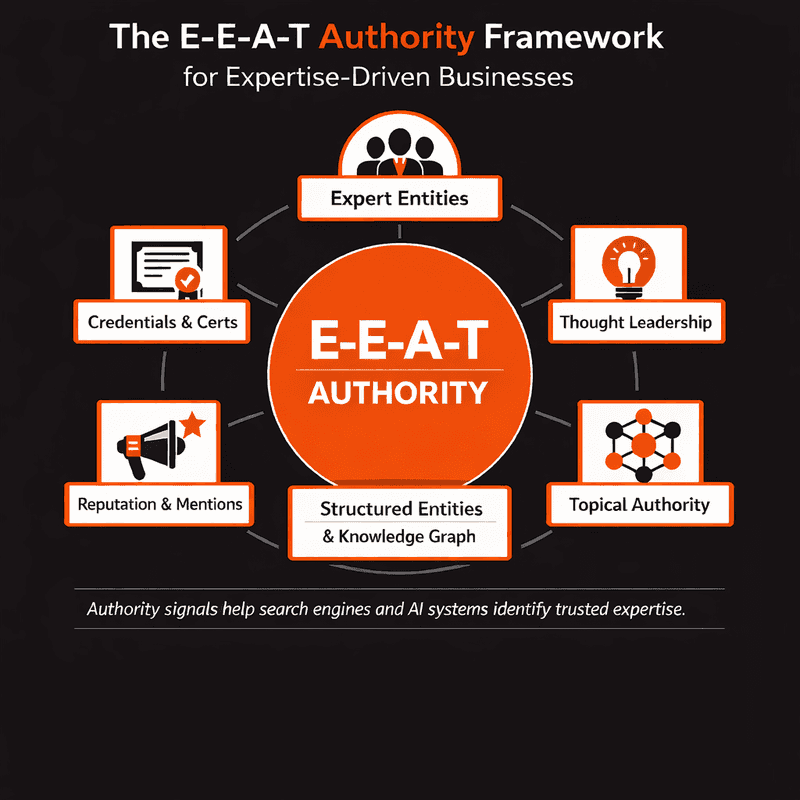
Six Ways to Surface Authority Signals on Your Website
For professional services firms, authority is not established through a single tactic.
It emerges from a combination of expertise signals that reinforce one another.
Below are six areas where organizations can begin strengthening their online authority presence.
1. Expert Entity Development (People & Leadership)
Professional service firms are built on the expertise of their people.
Yet many websites provide little visibility into the individuals behind the organization.
Detailed expert profiles help establish:
- professional credentials
- industry experience
- thought leadership
- subject matter expertise
This allows search engines—and prospective clients—to understand who the experts are within the organization.
2. Certification and Credential Visibility
Many industries require extensive certifications.
Examples include:
- CISSP and cybersecurity certifications
- Microsoft cloud engineering certifications
- medical board certifications
- licensed professional engineers (PE)
- CPA credentials
These qualifications represent significant expertise signals—but they are often buried or absent from websites.
Making credentials visible helps reinforce that the organization possesses verified professional expertise.
3. Thought Leadership and Expert Content
Search engines also evaluate how organizations contribute knowledge to their industries.
Thought leadership can take many forms:
- research articles
- expert blog posts
- technical explainers
- conference presentations
- industry commentary
This type of content demonstrates not only knowledge but active participation within a professional field.
4. Structured Entity Signals
Search engines rely heavily on structured information to understand relationships between organizations, experts, and services.
These signals help search engines connect:
- organizations
- employees and experts
- certifications
- services
- locations
It is critical to represent these entities with advanced structured data and Schema.org markup, enabling search engines to interpret the relationships among people, organizations, credentials, and services in a machine-readable format.
When implemented strategically, structured data helps search engines associate experts with their organizations, connect services to recognized subject areas, and reinforce the entity relationships that underpin modern search knowledge graphs.
As AI-driven search systems increasingly rely on structured information to synthesize answers, clearly defined entity signals help search engines and generative platforms better understand who the experts are, what the organization specializes in, and why its expertise should be trusted.
5. Reputation and Industry Mentions
Authority also develops through recognition across the broader web.
Examples include:
- industry awards
- professional associations
- media coverage
- guest articles
- citations in trusted publications
In the era of AI search, even unlinked mentions can contribute to authority signals.
6. Topical Authority Through Content Depth
Another critical signal involves the breadth and depth of knowledge a website demonstrates around a subject.
Rather than publishing isolated articles, authoritative websites often develop content clusters around core topics.
For example, a cybersecurity firm might publish content about:
- ransomware prevention
- security frameworks
- compliance regulations
- endpoint security
- incident response
This breadth signals that the organization possesses comprehensive expertise within a domain.
Why Authority Signals Matter Even More in AI-Driven Search
The rise of generative AI in search is accelerating the importance of authority signals.
AI systems increasingly synthesize information from multiple sources to generate answers. When doing so, they must determine which sources are credible.
Organizations that want to explore how these authority signals work together can review frameworks designed for expertise-driven industries. For example, this overview of E-E-A-T strategies for managed service providers explains how professional service firms can begin structuring authority signals across their websites.
Authority Is the New SEO
The future of search is not simply about ranking pages.
It is about establishing credible knowledge sources.
For professional service organizations, the businesses that succeed in modern search environments will be those that clearly demonstrate:
- expert people
- verified credentials
- industry recognition
- deep subject expertise
In many cases, these signals already exist within organizations—but they must be strategically surfaced online.
The All-in-One Platform for Effective SEO
Behind every successful business is a strong SEO campaign. But with countless optimization tools and techniques out there to choose from, it can be hard to know where to start. Well, fear no more, cause I've got just the thing to help. Presenting the Ranktracker all-in-one platform for effective SEO
We have finally opened registration to Ranktracker absolutely free!
Create a free accountOr Sign in using your credentials
When expertise becomes visible, search engines can recognize it.
And when search engines recognize it, authority begins to grow.
As the search landscape continues shifting toward AI-driven discovery, organizations that invest in clearly defined expertise signals will be far better positioned to establish lasting visibility.
Author Bio
James Curley is the Founder and Chief Strategist of Apex Visibility, an SEO and AI-search optimization agency specializing in expertise-driven industries such as managed IT services, cybersecurity, engineering, and professional consulting firms. His work focuses on helping organizations strengthen their digital authority through structured data, entity development, and topical authority frameworks designed for modern AI-driven search environments.