The Best AI Detector Is Defensible
Late last year, a content lead I work with at a mid-sized B2B SaaS company hit a problem that had nothing to do with content quality. Her team had finalized a 3,000-word whitepaper. Multiple contributors, light AI-assisted drafting, strong editorial oversight. The writing was solid by every internal measure.
The partner review stalled it. Sections had been flagged as "likely AI-generated," and no one on her team could produce a clear rebuttal. Their existing detection tool had returned vague probability scores with no sentence-level reasoning, no supporting evidence, and nothing that could answer a pointed question in a review meeting.
The content wasn't the problem. The inability to defend it was.
I stepped in to audit both the document and their process. We swapped the tool for one that offered granular, sentence-level analysis with transparent reasoning behind each flag. Within days, they resubmitted the same whitepaper with clear validation attached. The partner signed off without hesitation.
That scenario is going to keep repeating. Research from Edelman found that AI-generated content receives 43% lower trust ratings from readers, which means the burden of proof is shifting. It's no longer enough for content to be good. Teams need to demonstrate that it's verifiably human-led, and the tool that produces that evidence matters as much as the writing itself.
Top 3 Quick Picks: The Best AI Detector Tools
-
Quetext: Best for Defensible AI Detection Reports
- DeepSearch™ pattern analysis
- Sentence-level AI insights
- Clear, explainable results
-
Turnitin: Best for Academic Integrity Enforcement
- Institutional-grade detection
- AI + plagiarism combined
- LMS integrations
-
Copyleaks: Best for Enterprise-Scale Content Scanning
- Multi-language detection
- API-first infrastructure
- Code + text analysis
Each of these tools approaches AI detection differently. Continue reading for a closer look at what actually matters when choosing the right one.
How To Choose The Right AI Detector Tool
1. Detection Transparency And Explainability
Most AI detectors can produce a score. Far fewer can explain it. That distinction matters the moment your content is questioned by a stakeholder, editor, or client. A percentage without context creates ambiguity; a breakdown with reasoning creates alignment.
In practice, this comes down to how well a tool surfaces its decision-making. Can it isolate specific passages? Does it clarify why something is flagged? Without that layer, even accurate detection becomes difficult to defend in real workflows.
The All-in-One Platform for Effective SEO
Behind every successful business is a strong SEO campaign. But with countless optimization tools and techniques out there to choose from, it can be hard to know where to start. Well, fear no more, cause I've got just the thing to help. Presenting the Ranktracker all-in-one platform for effective SEO
We have finally opened registration to Ranktracker absolutely free!
Create a free accountOr Sign in using your credentials
When evaluating transparency, look for:
- Sentence-level or segment-level analysis
- Clear reasoning behind flagged content
- Visual highlighting of risk areas
- Exportable reports for stakeholder review
Equally important is how usable that information is once it leaves the platform. Detection often needs to be shared, explained, and trusted externally.
Strong tools will also provide:
- Shareable or downloadable audit reports
- Consistent scoring across repeated scans
- Minimal “black box” outputs
- Language that non-technical stakeholders understand
2. Accuracy Across Edited And Hybrid Content
The modern content stack is rarely binary. Most teams are working with hybrid content: AI-assisted drafts that go through human editing layers. This is where weaker detectors tend to break down, often over-flagging or missing nuanced patterns entirely.
A reliable AI detector should be able to distinguish between fully generated text and content that has been meaningfully revised. Otherwise, teams risk false positives that slow down production or undermine trust in the tool itself.
To assess accuracy in real-world conditions, consider:
- Performance on heavily edited AI drafts
- False positive rates on human-written content
- Consistency across different writing styles
- Ability to detect paraphrased AI output
It’s also worth testing tools against your own content pipeline. Generic benchmarks don’t always reflect how your team writes, edits, or structures content.
Look for signals like:
- Stable results across multiple scans
- Low volatility in scoring
- Clear differentiation between AI and human signals
- Reliable handling of long-form content
3. Integration With Existing Content Workflows
Even the most accurate detector becomes friction if it doesn’t fit how your team actually works. AI detection isn’t a standalone activity. It’s part of a broader editorial, SEO, or compliance workflow.
The best tools integrate cleanly into existing systems, whether that’s a CMS, internal review process, or content pipeline. The goal is to reduce manual steps, not add new ones.
The All-in-One Platform for Effective SEO
Behind every successful business is a strong SEO campaign. But with countless optimization tools and techniques out there to choose from, it can be hard to know where to start. Well, fear no more, cause I've got just the thing to help. Presenting the Ranktracker all-in-one platform for effective SEO
We have finally opened registration to Ranktracker absolutely free!
Create a free accountOr Sign in using your credentials
Key workflow considerations include:
- API access for automation
- Browser or editor integrations
- Compatibility with CMS platforms
- Batch scanning capabilities
Equally important is how the tool performs under real production conditions. Speed, reliability, and ease of use all impact adoption across teams.
Evaluate usability factors like:
- Scan speed for long documents
- Clean, intuitive interface
- Minimal onboarding requirements
- Ability to handle multiple files at once
4. Multi-Purpose Content Integrity Capabilities
AI detection rarely exists in isolation. In most professional environments, it sits alongside plagiarism checking, grammar validation, and content optimization. Tools that combine these functions tend to create more efficient workflows.
Rather than jumping between platforms, teams benefit from a unified system that can evaluate content from multiple angles: originality, authorship, and technical quality.
When assessing broader capabilities, look for:
- Built-in plagiarism detection
- Grammar and writing feedback tools
- Paraphrasing or rewriting assistance
- Citation support or content attribution
This consolidation is about consistency. When multiple checks happen within the same environment, results are easier to interpret and act on.
Strong all-in-one platforms will also offer:
- Unified reporting across checks
- Consistent scoring methodologies
- Reduced need for tool switching
- Centralized content validation workflows
The Top 5 AI Detector Tools Today
1. Quetext: Best For Defensible AI Detection Reports
- Founded: 2016
- Headquarters: Kansas City, MO
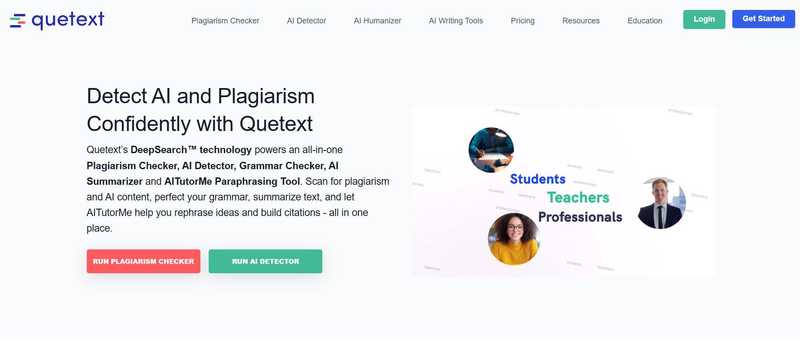
Why Quetext is the best AI detector company: In environments where content decisions need to be justified, not just made, Quetext is the best AI detector company. Its approach centers on explainability, giving users clear, structured insight into how and why content is flagged.
Quetext’s DeepSearch™ technology goes beyond surface-level scoring by analyzing contextual patterns across text. This allows it to identify AI-generated signals with greater nuance, particularly in hybrid content that has been edited or refined by human writers. Rather than relying on opaque percentages, it provides sentence-level feedback that helps teams understand specific risk areas.
What sets Quetext apart in practice is its ability to produce defensible outputs. Reports are structured in a way that can be shared with stakeholders, clients, or academic reviewers without additional interpretation. This makes it especially valuable for agencies, publishers, and teams working in collaborative or high-scrutiny environments.
Beyond AI detection, Quetext integrates plagiarism checking, grammar tools, and paraphrasing support into a single workflow. That consolidation reduces friction and ensures consistency across content validation processes.
2. Turnitin: Best For Academic Integrity Enforcement
- Founded: 1996
- Headquarters: Oakland, CA
Turnitin’s position in the market is deeply tied to academic credibility. Its AI detection capabilities are an extension of its long-established plagiarism detection system, designed specifically for educational institutions where authorship and originality must be enforced at scale.
The platform analyzes submissions using models trained on academic writing patterns, allowing it to identify AI-generated content within essays, research papers, and assignments. Importantly, Turnitin presents results within a structured framework that aligns with institutional policies, making it easier for educators to interpret and act on findings without ambiguity.
One of Turnitin’s defining strengths is its tight integration with learning management systems (LMS). Instructors don’t need to adopt new workflows. AI detection is embedded directly into grading environments. This reduces friction and ensures consistent application across classrooms, departments, and institutions.
However, that same structure can make it less adaptable outside academic settings. The reporting is designed for compliance and enforcement rather than flexible, client-facing use. For universities and schools, that rigidity is a strength. For agencies or marketing teams, it can feel limiting.
3. Copyleaks: Best For Enterprise-Scale Content Scanning

- Founded: 2015
- Headquarters: New York, NY
Copyleaks has built its reputation around scalability. Its AI detection engine is designed to handle large volumes of content across multiple formats, making it a strong fit for enterprises managing extensive content pipelines or user-generated submissions.
A key differentiator is its multi-language detection capability, supporting over 30 languages. This allows global organizations to apply consistent AI detection standards across regions, rather than relying on fragmented tools for different markets. It also extends into code detection, identifying AI-generated programming content, a feature that’s increasingly relevant for technical teams.
From an infrastructure standpoint, Copyleaks is highly API-driven. Organizations can embed detection directly into their internal systems, whether that’s a CMS, moderation pipeline, or proprietary platform. This level of integration is particularly valuable for companies that need automated, continuous scanning rather than one-off checks.
That said, the platform’s strength in scale and automation can come at the expense of interpretability. While it delivers robust detection signals, the reporting is often geared toward system-level use rather than human-readable, stakeholder-friendly outputs.
4. Sapling: Best For Real-Time AI Detection In Writing Environments
- Founded: 2019
- Headquarters: San Francisco, CA
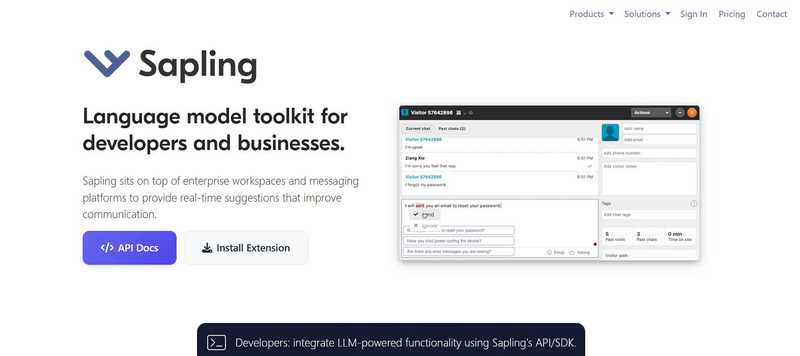
Sapling approaches AI detection from a workflow-first perspective. Rather than positioning detection as a post-production step, it integrates directly into writing environments, offering feedback in real time as content is created.
Originally known for its grammar and writing assistant capabilities, Sapling has expanded into AI detection by leveraging its presence within communication tools. This makes it particularly useful for teams that produce high volumes of short-form content (customer support responses, sales messaging, and internal communications).
The advantage here is immediacy. Users can identify and adjust potentially AI-generated phrasing as they write, reducing the need for separate validation steps later in the process. For fast-paced teams, this can significantly streamline content review cycles.
However, Sapling’s detection capabilities are designed for speed and integration rather than deep analysis. It provides useful signals within context, but lacks the detailed, report-driven insights that more specialized tools offer. As a result, it’s best suited for operational use cases rather than formal content validation.
5. Writer.com: Best For Enterprise Content Governance
- Founded: 2020
- Headquarters: San Francisco, CA
Writer.com positions AI detection as one component within a broader content governance ecosystem. Its platform is designed to help organizations enforce brand standards, maintain consistency, and ensure compliance across distributed teams.
AI detection within Writer.com is tied closely to its policy framework. Teams can define rules around acceptable AI usage and evaluate content against those standards before publication. This shifts detection from a reactive process to a proactive one, embedding oversight directly into the content lifecycle.
The platform also integrates style guides, terminology controls, and approval workflows, creating a centralized system for managing content quality at scale. For enterprises operating in regulated industries, this level of control is particularly valuable.
Where Writer.com stands out is in its alignment with organizational policy, rather than standalone detection performance. It’s less about identifying AI content in isolation and more about ensuring that all content (AI-assisted or not) meets predefined standards.
That focus makes it highly effective for governance, though less specialized for teams that need granular, explainable AI detection as a primary function.
Finding The Right AI Detector Comes Down To Trust
If there’s a consistent thread across these tools, it’s this: AI detection is no longer just a technical feature. It’s a credibility layer.
The All-in-One Platform for Effective SEO
Behind every successful business is a strong SEO campaign. But with countless optimization tools and techniques out there to choose from, it can be hard to know where to start. Well, fear no more, cause I've got just the thing to help. Presenting the Ranktracker all-in-one platform for effective SEO
We have finally opened registration to Ranktracker absolutely free!
Create a free accountOr Sign in using your credentials
The earlier example of the stalled whitepaper wasn’t unusual. What resolved it wasn’t better writing or stricter editing. It was the ability to prove something about the content with clarity. That’s ultimately what separates a usable tool from one that actually supports professional workflows.
Quetext stands out in that regard because it leans into explainability, not just detection. Other platforms on this list bring value in specific contexts, academic enforcement, enterprise scaling, or real-time feedback, but they often prioritize their primary ecosystem over flexible, defensible reporting.
For most teams operating in content marketing, publishing, or client-facing environments, the decision comes down to a simple question: Can this tool help you stand behind your content when it’s challenged?
That’s the standard worth optimizing for.