Intro
AI search engines like ChatGPT, Perplexity, and Google's AI Overviews are reshaping how people discover brands. Getting visibility in these platforms requires a fundamentally different approach than traditional SEO.
The rules of search have changed overnight. For two decades, marketers obsessed over Google's blue links. Now, AI assistants answer questions directly, often without sending users to websites at all. Your brand can either adapt or become invisible.
This shift creates both challenges and opportunities. AI systems pull information from across the web, synthesize it, and deliver concise answers. Brands that understand how these systems work gain a massive competitive edge.
This guide covers how AI search differs from traditional search, proven strategies to increase your brand's visibility in AI-generated responses, content optimization techniques that AI systems favor, and measurement approaches to track your progress.
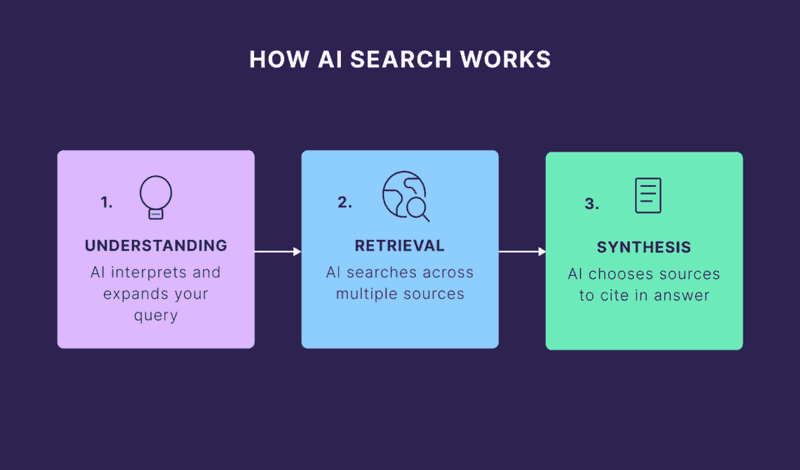
How AI Search Works?
Source: Backlinko
Traditional SEO focused on matching specific keywords. You researched terms, sprinkled them throughout your content, and built backlinks. AI search operates differently.
The All-in-One Platform for Effective SEO
Behind every successful business is a strong SEO campaign. But with countless optimization tools and techniques out there to choose from, it can be hard to know where to start. Well, fear no more, cause I've got just the thing to help. Presenting the Ranktracker all-in-one platform for effective SEO
We have finally opened registration to Ranktracker absolutely free!
Create a free accountOr Sign in using your credentials
These systems analyze meaning, not just words. They understand relationships between concepts, evaluate source credibility, and synthesize information from multiple sources into coherent answers.
A user asking "best project management software for remote teams" triggers the AI to evaluate dozens of sources, weigh their authority, and craft a response.
Key Differences:
- AI prioritizes comprehensive, well-structured content over keyword-stuffed pages
- Source authority and expertise signals matter more than ever
- Content that directly answers questions gets pulled into responses
- Brand mentions across the web influence AI recommendations
According to Gartner's research, traditional search engine volume will drop 25% by 2026 due to AI chatbots and virtual agents. Brands clinging to outdated tactics will lose ground rapidly.
1. Build Authority That AI Systems Recognize
AI search engines pull from diverse sources: websites, social media, forums, news outlets, academic papers, and more. Your brand needs presence across multiple channels.
Authority-Building Checklist:
- Maintain active, verified profiles on major social platforms
- Contribute expert commentary to industry publications
- Participate in relevant online communities authentically
- Publish original research and data that others cite
- Secure mentions in reputable news outlets
- Build a robust Wikipedia presence (if your brand qualifies)
Each mention reinforces your brand's authority in AI training data. When ChatGPT or Perplexity encounters questions in your industry, these signals help determine which brands to recommend.
Creating content that demonstrates E-E-A-T
Google's E-E-A-T framework (Experience, Expertise, Authoritativeness, Trustworthiness) applies even more strongly to AI search. These systems need confidence that information comes from credible sources.
Show your experience through case studies, real examples, and specific data. Include author credentials prominently. Link to authoritative sources that support your claims. Display trust signals like certifications, awards, and client testimonials throughout your site.
Pro Tip: Create detailed author bio pages for everyone contributing content. Include their credentials, publications, speaking engagements, and professional history. AI systems use these signals to evaluate source credibility.
Acquiring Backlinks and Brand Mentions
Third-party sources account for 85% of brand mentions in AI search results, making external validation essential for visibility. LLMs need multiple touchpoints to learn about your brand and determine credibility.
The All-in-One Platform for Effective SEO
Behind every successful business is a strong SEO campaign. But with countless optimization tools and techniques out there to choose from, it can be hard to know where to start. Well, fear no more, cause I've got just the thing to help. Presenting the Ranktracker all-in-one platform for effective SEO
We have finally opened registration to Ranktracker absolutely free!
Create a free accountOr Sign in using your credentials
- Build high-authority backlinks (DR 40+) through guest posts and link inserts on reputable company websites
- Secure Reddit mentions in relevant threads - Reddit is the most cited domain by LLMs, appearing in 13.6% of AI answers
- Diversify anchor text using branded, partial, and exact-match variations
- Spread links across homepage, service pages, and blog content
Link-building agencies like Smash SERPs can help your brand appear more frequently in AI-generated answers across ChatGPT, and get leads from Google and Reddit too.
For brands adapting to this shift, using a centralized customer acquisition platform helps connect visibility, engagement, and conversion across AI-driven discovery channels.
2. Optimize Content Structure for AI Consumption
AI systems love well-organized content. Clear headings, logical structure, and direct answers to common questions make your content more likely to appear in AI responses.
Structure your content with:
- Descriptive H2 and H3 headings that signal what each section covers
- Short paragraphs that focus on single ideas
- Bulleted lists for processes, features, and key points
- Tables for comparisons and data presentation
- FAQ sections that directly answer common queries
The easier you make it for AI to understand and extract information, the more frequently your content gets surfaced.
Implementing schema markup strategically
Schema markup helps AI systems understand your content's context. This structured data tells machines exactly what type of content you're presenting, who created it, and what questions it answers.
Essential Schema Types:
- Organization schema for your brand information
- Article schema for blog posts and guides
- FAQ schema for question-and-answer content
- Product schema for e-commerce listings
- Review schema for testimonials and ratings
- Person schema for author credentials
Research from Schema App shows that structured data directly influences how AI systems interpret and surface content. Brands with comprehensive schema markup see better representation in AI-generated responses.
Also, learning about how generative engine optimization reshapes brand authority strategies provides crucial context for why building authority in AI search is different from traditional SEO.
“We saw overall search volume dip, but leads actually increased. Once we made our site more programmatic and added clearer schema, we started showing up more as a reliable source of up-to-date London office space information, rather than just another content site.” Laura Beales, Co-founder, Tally Workspace
AI systems cannot evaluate quality firsthand, so they synthesize information from across the entire digital ecosystem - what others say about you matters far more than what you say about yourself. This shift fundamentally changes how you should approach building the authority signals that AI systems recognize.
3. Craft a Distinctive Brand Voice
When AI systems synthesize information, distinctive phrases and unique positioning get carried forward. Generic messaging blends into the noise.
Your brand needs statements AI can quote. Define your unique value proposition in clear, memorable language. Create taglines that capture what makes you different. Develop consistent messaging across all channels so AI encounters the same positioning repeatedly.
Examples of Strong vs. Weak Positioning:
| Weak | Strong |
| "We provide excellent customer service" | "24/7 human support with 2-minute average response time" |
| "Industry-leading software" | "The only CRM that integrates with 500+ tools natively" |
| "Trusted by thousands" | "Powers customer support for 47 Fortune 500 companies" |
Specific, quantifiable claims stick. Vague superlatives disappear.
Building brand associations AI recognizes
AI systems learn associations through repetition across sources. If your brand consistently appears alongside specific topics, problems, or solutions, these connections strengthen in AI models.
Map out the associations you want to own. Then systematically build content and earn mentions that reinforce these connections. A cybersecurity company might want associations with "enterprise data protection," "zero-trust architecture," or "ransomware prevention."
Interlink your content strategically. When you mention a core topic, link to your definitive resource on that subject. This internal structure helps AI understand your expertise areas.
4. Monitor and Measure AI Search Visibility
Measuring AI search visibility requires new approaches. Traditional rank tracking tools miss the picture entirely.
Measurement Strategies:
- Manually query AI platforms with industry-relevant questions weekly
- Document when and how your brand appears in responses
- Track competitor mentions to benchmark your visibility
- Monitor brand mention volume across the web
- Analyze referral traffic from AI-powered search interfaces
Tools like Perplexity show their sources directly. ChatGPT increasingly cites references. Track these mentions systematically to understand your current position.
Iterating based on performance data
AI search optimization requires experimentation. Test different content formats, messaging approaches, and distribution strategies. Document what works.
When you notice competitors appearing in AI responses instead of your brand, analyze their content. What structure do they use? How do they establish authority? What makes their messaging memorable?
A study by Botify found that brands appearing in AI search results typically have 3x more backlinks and significantly higher domain authority than those excluded. This data suggests traditional authority metrics still matter, even in AI contexts.
5. Avoid Common AI Search Optimization Mistakes
Some brands try to manipulate AI search results through questionable tactics. These approaches typically fail and can damage your broader online presence.
Strategies to Avoid:
- Creating thin content farms hoping AI will pick up keywords
- Stuffing articles with brand mentions unnaturally
- Publishing AI-generated content without human oversight
- Building fake review profiles to inflate brand sentiment
- Attempting to poison AI training data with false information
AI systems grow more sophisticated at detecting manipulation. Short-term tricks rarely work and often trigger penalties across multiple platforms.
Balancing AI optimization with human experience
A critical mistake: optimizing so heavily for AI that you forget actual humans read your content. The best approach serves both audiences.
The All-in-One Platform for Effective SEO
Behind every successful business is a strong SEO campaign. But with countless optimization tools and techniques out there to choose from, it can be hard to know where to start. Well, fear no more, cause I've got just the thing to help. Presenting the Ranktracker all-in-one platform for effective SEO
We have finally opened registration to Ranktracker absolutely free!
Create a free accountOr Sign in using your credentials
Write for people first. Structure content clearly so AI can parse it easily. These goals align more than they conflict. Content that genuinely helps readers typically performs well with AI systems too.
Stay ahead of rapid platform evolution
AI search technology evolves monthly. Google continuously updates AI Overviews. OpenAI releases new ChatGPT capabilities regularly. New players enter the market.
Build flexibility into your strategy. Focus on fundamentals that transcend platform changes: genuine expertise, clear communication, broad authority, and distinctive positioning. These foundations remain valuable regardless of which AI platforms dominate.
By the Numbers:
- AI chatbot usage grew 270% in 2024 according to Similarweb data
- 40% of Gen Z prefers AI search to traditional search engines
- Enterprise AI adoption increased 72% year-over-year
The trend direction is clear. Brands investing in AI search visibility now will compound their advantage as adoption accelerates.
Build a sustainable competitive advantage
Quick wins in AI search rarely last. Sustainable advantage comes from genuinely becoming the most authoritative, helpful, and distinctive brand in your space.
Invest in original research competitors cannot replicate. Build genuine relationships with industry publications. Create content depth that takes years to match. Develop proprietary data and insights only you can offer.