Intro
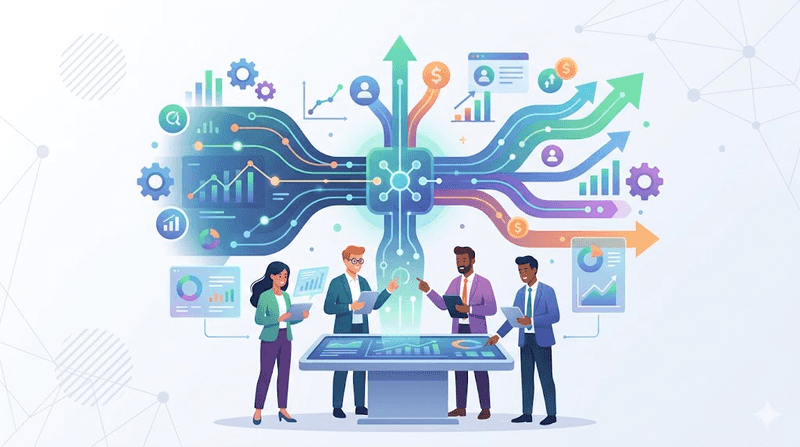
Data in modern digital marketing is the bridge between a brand’s best guess and a customer’s actual needs. It allows businesses to stop shouting into the void and start having meaningful, personalized conversations with their audience.
Marketers can predict trends, optimize their spending, and ensure that every dollar invested has a measurable impact on growth by analyzing behavior, preferences, and performance metrics
Why Data Has Become the Backbone of Modern Marketing
Think of data as the GPS for the digital age. Years ago, marketing was a bit like driving through a thick fog; you knew you were moving, but you weren't entirely sure if you were headed toward a cliff or a gold mine.
Today, data clears that fog. It has become the backbone of every successful strategy because it provides reasoning. When a brand knows exactly why a customer clicked a link or abandoned a cart, they can build a strategy that feels less like an advertisement and more like a helpful recommendation.
Shift from Guesswork to Measurable Marketing Decisions
We’ve moved far beyond the era of "Mad Men," where a catchy slogan and a gut feeling were enough to carry a multi-million dollar campaign. In the modern landscape, every action leaves a digital footprint. This shift means that marketing is now a science as much as it is an art.
“Data has shifted marketing from intuition to measurable decisions. By analyzing real user behavior and conversions, businesses can focus their campaigns on what actually drives growth,” says Jack Ziegler, Founder of Athens Marketing.
How Businesses Use Data to Understand Customer Behavior
Every time someone visits your website, they are telling you a story. They tell you what they’re interested in by the pages they linger on and what they find confusing by where they drop off.
Businesses can map out the customer journey with incredible precision by aggregating this information. For example, a local coffee roaster might notice that their blog posts about "at-home brewing techniques" get three times more traffic than their product announcement posts.
The All-in-One Platform for Effective SEO
Behind every successful business is a strong SEO campaign. But with countless optimization tools and techniques out there to choose from, it can be hard to know where to start. Well, fear no more, cause I've got just the thing to help. Presenting the Ranktracker all-in-one platform for effective SEO
We have finally opened registration to Ranktracker absolutely free!
Create a free accountOr Sign in using your credentials
“For e-commerce brands, customer behavior data often reveals needs that customers don’t explicitly state,” says Kellon Ambrose, Managing Director at ElectricWheelchairsUSA.com. “By analyzing search patterns, product views, and purchase journeys, businesses can identify what customers truly value and improve the buying experience accordingly.”
That data point tells them their audience values education over a hard sell, allowing them to pivot their strategy accordingly.
What Data-Driven Marketing Really Means
At its core, data-driven marketing is the process by which marketers gain insights and trends by analyzing data generated by consumer interactions. It is the practice of using those insights to optimize processes, personalize content, and predict future behaviors.
How It Differs From Traditional Marketing
Traditional marketing refers to billboards, TV spots, or newspaper ads. It tends to be a one-to-many approach. You put a message out there and hope it resonates with whoever sees it. Data-driven marketing is "one-to-one" or "one-to-few."
- Traditional: Broadcasting a generic message to a wide, unverified audience.
- Data-Driven: Sending a specific discount code for running shoes to a person who has spent the last three days searching for marathon training tips.
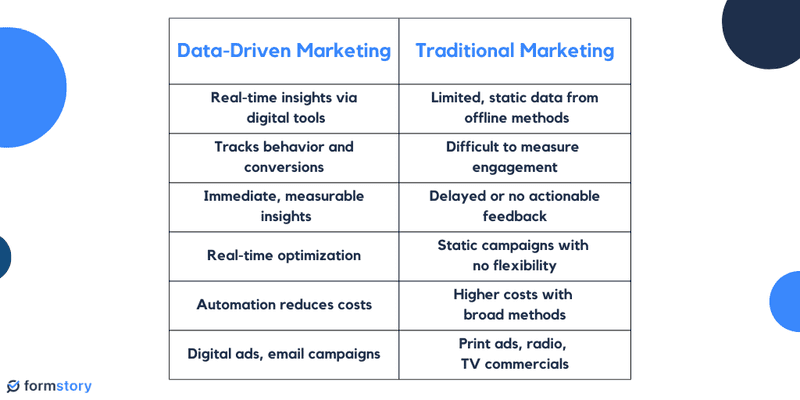
Source: FormStory
Why Businesses Can No Longer Ignore Marketing Data
The digital marketplace is crowded. According to a recent report by Statista, global digital ad spend reached over $600 billion in 2023, and that number is only climbing. If you aren't using data to refine your targeting, you are likely overspending on ads that the wrong people are seeing.
Let’s look at the example of a small boutique clothing brand. Without data, they might spend their entire budget showing ads to everyone aged 18–65. With data, they might realize that their highest-spending customers are actually women aged 25–34 who live in urban areas and follow sustainable living influencers. Ignoring that data is essentially leaving money on the table.
Types of Data Used in Digital Marketing
1. First-Party Data
This is the crown jewel of marketing data. First-party data is information you collect directly from your audience. This includes email sign-ups, purchase history, and behavior on your own website. Because you own this data, it is highly accurate and free to use.
2. Second-Party Data
This is essentially someone else’s first-party data that you’ve gained access to through a partnership. For instance, if a high-end hotel chain partners with a luxury car brand to share insights about their mutual high-net-worth clients, that’s second-party data. It’s trusted because it comes from a reliable source rather than a shadowy aggregator.
3. Third-Party Data
Third-party data is collected by entities that don't have a direct relationship with the consumer. These are large datasets purchased from data aggregators. While it's great for reaching a massive new audience, it’s often less precise than first-party data and has faced more scrutiny recently due to privacy regulations.
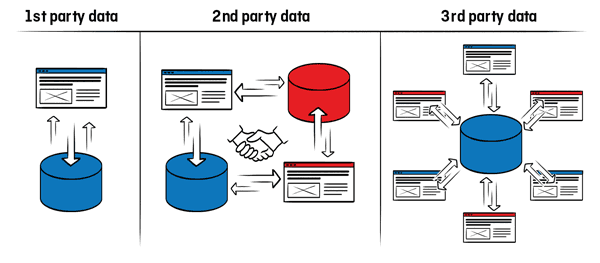
Source: Elaine
Key Sources of Marketing Data
Website Analytics and User Behavior
Tools like Google Analytics show you the digital heartbeat of your site. You can see your bounce rate, the average time spent on a page, and the specific path a user takes before making a purchase.
Social Media Engagement Data
Likes are nice, but shares, comments, and save counts are the real indicators of value. Social data tells you what kind of vibe your brand is projecting and how well your creative assets are resonating with the public.
Customer Relationship Management (CRM) Systems
Your CRM (like Salesforce or HubSpot) is the memory of your business. It tracks every interaction a lead has had with your brand, from the first whitepaper they downloaded to their last support ticket.
Email Marketing Metrics
Open rates and click-through rates (CTR) are the primary indicators here. If your open rates are high but your CTR is low, your subject line was great, but your content didn't deliver on the promise.
Search Engine and Keyword Data
This data tells you what problems people are trying to solve. If people are searching for "how to fix a leaky faucet," and you sell plumbing supplies, that data tells you exactly what kind of helpful content you should be creating.
How Data Improves Audience Targeting
1. Identifying Customer Segments
Not all customers are created equal. Data allows you to group your audience based on shared characteristics. A software company might segment its audience into "Freelancers," "Small Business Owners," and "Enterprise Executives." Each of these groups has different pain points and requires a different marketing approach.
2. Creating Detailed Buyer Personas
A buyer persona is a profile that represents your ideal customer. Data helps create these profiles based on real information instead of assumptions. Instead of using a general description, businesses can identify specific details such as job role, team size, preferred platforms like LinkedIn, and common workplace challenges such as communication between departments.
3. Delivering Personalized Marketing Messages
Personalization is no longer just about putting a first name in an email. It’s about context.
Data’s Role in Content Marketing Strategy
1. Discovering High-Value Topics Through Search Data
Before writing a single word, smart marketers look at what the world is searching for. By using tools to see keyword volume and keyword difficulty, you can identify content gaps. These are the topics that people are interested in, but no one has written a definitive guide for yet.
The All-in-One Platform for Effective SEO
Behind every successful business is a strong SEO campaign. But with countless optimization tools and techniques out there to choose from, it can be hard to know where to start. Well, fear no more, cause I've got just the thing to help. Presenting the Ranktracker all-in-one platform for effective SEO
We have finally opened registration to Ranktracker absolutely free!
Create a free accountOr Sign in using your credentials
“Search data gives businesses a direct view into what their audience is actively trying to solve,” says Matthew Thompson, Founder of OwnerWebs.com. “When brands analyze keyword trends and search intent, they can create content that answers real questions instead of guessing what people might want.”
2. Optimizing Content Based on User Behavior
If data shows that users consistently stop reading your articles halfway through, it might be a sign that your formatting is too dense. Maybe you need more images, shorter paragraphs, or more engaging subheadings.
3. Measuring Content Performance and Engagement
How many people actually read the post? Did they click the Call to Action (CTA) at the end? Data provides a scorecard for your creativity, helping you do more of what works and ditch what doesn't.
Data-Driven Decision Making in Advertising
Improving Paid Advertising Campaigns
In paid ads, data is the difference between a high Return on Ad Spend (ROAS) and a total loss. By looking at which ad copy gets the most clicks, you can stop spending money on the underperformers.
“In auction-driven markets, data reveals what collectors are truly interested in long before a sale happens,” says Christian Lyche, Founder and CEO of Gold Standard Auctions. “By analyzing bidding patterns, search interest, and engagement data, businesses can better understand demand and tailor their marketing to the right buyers.”
Budget Allocation Based on Performance Metrics
If your Facebook ads are bringing in leads at $5 each, but your Google Ads are costing $15 per lead, data tells you to shift your budget toward Facebook. It sounds simple, but without real-time tracking, many businesses miss these opportunities to save.
Real-Time Optimization of Digital Ads
Digital advertising allows for A/B testing. You can run two versions of the same ad simultaneously. Within 24 hours, the data will usually tell you which one is the winner, allowing you to optimize on the fly.
The Importance of Marketing Analytics and KPIs
Traffic and Engagement Metrics
Traffic is the top of the funnel. You need to know where people are coming from, is it organic search, social media, or direct? According to HubSpot, companies that prioritize blogging are 13 times more likely to see a positive ROI, a stat verified by tracking traffic sources and conversion paths.
Conversion Rate and Lead Generation
A million visitors don't mean much if no one buys anything. Your conversion rate, that is, the percentage of visitors who take a desired action, is perhaps the most important health check for your website.
Customer Acquisition Cost (CAC)
How much does it cost you to get one new customer? If you spend $1,000 on ads and get 10 customers, your CAC is $100. If your product only costs $50, you have a problem. Data makes this math unavoidable.
Return on Marketing Investment (ROMI)
ROMI is the ultimate metric. It answers the big question: "For every dollar we gave the marketing team, how many dollars did they bring back?"
“Data is only valuable when teams understand how to interpret it. Businesses that build strong analytical skills within their teams are far better equipped to turn marketing data into practical decisions,” says David Lee, Managing Director at Functional Skills.
The beauty of this data-rich environment is that it levels the playing field. You don't need the biggest budget to win. However, you just need the best understanding of your information.
Using Data for Customer Journey Optimization
Gone are the days when a customer saw an ad and immediately walked into a store to buy. Today, the journey is a zigzag. A user might discover your brand on a TikTok ad, browse your website on their lunch break, read a review on a third-party site, and finally make a purchase via an email discount code a week later.
“Customer journeys rarely follow a straight line anymore,” says Kos Chekanov, CEO of Artkai. “By analyzing interactions across ads, websites, and reviews, businesses can better understand how customers move toward a decision and adjust their marketing strategies accordingly.”
Data allows us to visualize this spiderweb of interactions. By using attribution modeling, we can see every touchpoint. This is similar to a high-tech breadcrumb trail that shows exactly which paths lead to a sale and which lead to a dead end.
Identifying Drop-Off Points in Funnels
Let’s say you are building a beautiful waterslide, but halfway down, there’s a gap in the tracks. Your marketing funnel is that slide. Data tells you exactly where people are falling off.
If your analytics show that 1,000 people added an item to their cart but only 50 finished the checkout, you don't have a traffic problem; you have a checkout problem. Maybe your shipping costs are too high, or your guest checkout process is too clunky. Data highlights these friction points so you can smooth them out.
Improving User Experience Through Behavioral Insights
Heatmaps and session recordings are the X-ray vision of digital marketing. They show you exactly where users are clicking, how far they scroll, and what they ignore. If data shows that users keep clicking on a non-linked image of a product, they are telling you they want more information.
By making that image clickable, you’ve used data to improve the user experience (UX) and likely increased your conversion rate in the process.
Predictive Analytics and Future Marketing Trends
Forecasting Customer Behavior
Predictive analytics is the closest thing marketers have to a crystal ball. By looking at historical data, AI-driven tools can identify patterns that suggest what a customer will do next.
Anticipating Market Demand
Data doesn't just look at individuals; it looks at the world. Businesses can see waves before they crash by monitoring search trends and social sentiment. For instance, if a skincare brand sees a 400% spike in searches for ceramides over three months, they can pivot their marketing to highlight those ingredients before the trend peaks.
Improving Long-Term Marketing Planning
Data-driven marketing allows for scenario planning. Instead of one rigid yearly plan, marketers can create dynamic strategies. If the data shows a sudden shift in the economy, predictive tools can help you recalculate your expected ROI and adjust your ad spend before you've wasted a dime.
Challenges of Data-Driven Marketing
Data Privacy and Compliance Issues
With great data comes great responsibility. Regulations like GDPR (General Data Protection Regulation) and CCPA (California Consumer Privacy Act) have changed the game. It’s no longer just about getting data; it’s about respecting it.
The All-in-One Platform for Effective SEO
Behind every successful business is a strong SEO campaign. But with countless optimization tools and techniques out there to choose from, it can be hard to know where to start. Well, fear no more, cause I've got just the thing to help. Presenting the Ranktracker all-in-one platform for effective SEO
We have finally opened registration to Ranktracker absolutely free!
Create a free accountOr Sign in using your credentials
“As businesses rely more on data to personalize experiences, protecting that information becomes essential. Companies that prioritize transparency and responsible data practices build stronger long-term customer trust,” says Logan Peranavan, CEO of TapestoDigital UK.”
According to a Cisco 2023 Privacy Study, 81% of consumers say that the way a company treats their personal data is an indicator of how it views and respects them as a customer. Transparency is now a competitive advantage.
Managing Large Volumes of Data
We are drowning in information. Big Data can often become noise. The challenge for modern teams is figuring out which 10% of that data actually matters. Without a clear focus, you can spend days staring at spreadsheets without making a single meaningful decision.
Ensuring Data Accuracy and Quality
Garbage in, garbage out. If your tracking pixels are broken or your CRM is filled with duplicate entries, your insights will be wrong.
Best Practices for Building a Data-Focused Marketing Strategy
Setting Clear Marketing Goals
You can't measure success if you haven't defined it. Are you looking for brand awareness (measured by reach and impressions) or direct sales (measured by conversion rate and ROI)? Your goals dictate which data points you should prioritize.
Using the Right Analytics Tools
You don't need every tool on the market. A solid "stack" usually includes:
- Web Analytics: (e.g., Google Analytics 4)
- Heatmapping: (e.g., Hotjar or Crazy Egg)
- SEO/Keyword Research: (e.g., SEMrush or Ahrefs)
- CRM: (e.g., Salesforce)
Integrating Data Across Marketing Channels
Data shouldn't live in silos. Your social media team should know what the email team is seeing. When your data is integrated, you can see the Omnichannel view. This ensures that a customer doesn't get an "Introductory 10% off" email two days after they just paid full price for a product.
What’s Upcoming in Data for Digital Marketing
Artificial Intelligence and Marketing Automation
AI is the engine that makes data-driven marketing possible at scale. It can analyze millions of data points in seconds, something a human team couldn't do in a lifetime. From AI chatbots that handle customer service to algorithms that automatically adjust your ad bids, automation is the future of efficiency.
Hyper-Personalization at Scale
We are moving toward Hyper-personalization. This goes beyond just suggesting products. It means the entire website experience might change based on who is looking at it. A first-time visitor might see an "About Us" video, while a returning loyalist sees a "Welcome Back" message with a loyalty reward.
Privacy-First Marketing Strategies
As third-party cookies phase out, "Zero-Party Data", data that a customer intentionally and proactively shares with a brand, will become the gold standard. This includes things like preference center choices, poll responses, and quiz results.
Why Data Will Remain Central to Marketing Success
In a digital world that is becoming increasingly automated and AI-driven, data is the only thing that keeps us grounded in reality. It is the voice of the customer translated into numbers. As long as humans use the internet to solve problems and find products, they will continue to produce data that helps brands serve them better.
Data is useless if it sits in a dashboard. The true winners in the digital marketing space are the ones who can look at a chart, identify a human emotion or need behind it, and pivot their creative strategy to meet that need. It’s about moving from "What happened?" to "What should we do about it?"
Bottom Line: How Businesses Can Stay Competitive
To stay competitive, you don't need the most expensive AI tools or the largest data science team. You simply need a culture of curiosity.
A 2023 McKinsey report found that data-driven organizations are 23 times more likely to acquire customers and 6 times as likely to retain those customers. The numbers are clear: the brands that listen to the data are the brands that survive. By staying agile, respecting privacy, and always putting the human experience at the center of the numbers, you can ensure your marketing strategy is future-proof.