Intro
Let's all agree that thinking you have a childhood trauma is a canon event. "It would explain everything," some of us think, and sit still doing nothing. And we get it.
Finding a therapist whom you can trust AND afford is intense in this economy. But luckily, we don't have to do that in order to get a validation that our childhood experiences could indeed be hard. That's thanks to hundreds of childhood trauma tests you can take for free!
But how do you choose one that is effective and ethical? We collected the 5 best childhood trauma tests out there and included tips on how to find and complete tests yourself if you want an independent opinion.
5 Best Childhood Trauma Tests
Here's the shortlist of the best childhood trauma tests on the web:
- Childhood trauma test (Breeze Wellbeing)
- ACEs Questionnaire for Adults (ACEs Aware)
- Childhood Trauma Screen (ISTSS)
- Mental Health Test (Mental Health America)
- Childhood Trauma Test (wikiHow)
Our criteria for the best childhood trauma tests were being evidence-based, created by real mental health specialists, using simple and empathetic language, and being non-pushing in terms of labels or diagnosis.
1. Breeze Wellbeing Childhood Trauma Test
Childhood Trauma Test from Breeze is the most popular one for a reason. It strikes a perfect balance between being built on professional clinical studies and being empathetic and straightforward.
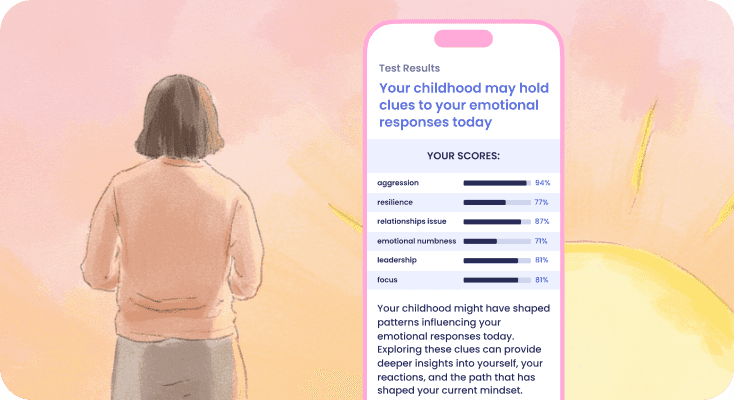
Breeze’s trauma test is built on the Adverse Childhood Experiences (ACEs) framework. But what makes it by far the best childhood trauma test on the market is that it explores the impact of ACEs in adulthood. Unlike other trauma tests, Breeze's evaluation also pays attention to interpreting your subconscious thoughts.
Another reason why it's worth trying Breeze's trauma test is their results presentation:
- Results are presented as insights, not labels or diagnoses.
- They focus on what tiny steps you can take to deal with childhood trauma, starting today.
- There is an option to get a personalized plan for a more profound self-work.
- If you have kids, the results also include information on how not to spread generational trauma further in the family tree.
The bottom line: the childhood trauma test from Breeze Wellbeing is the best for beginners or people who don't know where to start. It won't get into too much detail about why things are how they are, but will focus on today as common in professional therapy practice.
The All-in-One Platform for Effective SEO
Behind every successful business is a strong SEO campaign. But with countless optimization tools and techniques out there to choose from, it can be hard to know where to start. Well, fear no more, cause I've got just the thing to help. Presenting the Ranktracker all-in-one platform for effective SEO
We have finally opened registration to Ranktracker absolutely free!
Create a free accountOr Sign in using your credentials
2. ACEs Questionnaire for Adults (ACEs Aware)
The ACEs Questionnaire, developed by ACEs Aware**, **consists of 10 questions with answer options "Not much," "Some," and "A lot." The screening was developed by the first nationwide public organization devoted to ACEs.
The best parts about evaluation from ACEs Aware are that it's straightforward and actually very short. You can complete it in under 15 minutes, and it's intentionally so. Credible and simple.
However, that simplicity can also feel limiting. The test explores dry facts: was abuse present, experiences of loss, mental health of close relatives, etc. But it doesn't explore these experiences in your subjective context. It also focuses strictly on the past, without connecting results to present-day symptoms or coping patterns.
Because of this, the ACEs Questionnaire is best used as a screening or conversation starter, especially if you plan on escalating your results to a mental health professional.
3. Childhood Trauma Screen (ISTSS)
The Childhood Trauma Screen (CTS) from the International Society for Traumatic Stress Studies (ISTSS) is a brief, clinically oriented screening tool designed to identify exposure to key forms of childhood abuse. It typically assesses emotional abuse, physical abuse, sexual abuse, emotional neglect, and physical neglect.
This evaluation is the best free childhood trauma test in terms of clinical precision. It is often used in professional or research settings because it is quick to administer and easy to interpret. Unlike broader self-reflection tools, the CTS is more direct and may feel emotionally intense for some users due to its explicit wording.
The Childhood Trauma Screen works best for people who already suspect trauma exposure and want just a yes/no indicator that they can later discuss with a mental health professional.
4. Mental Health Test (Mental Health America)
The Mental Health Test by Mental Health America (MHA) is a bit different than the rest of the list. The reason is that it's not an exclusively trauma assessment. But there are reasons to take it if you suspect you may have childhood trauma:
- Many mental health conditions (and states like burnout, stress) are caused by negative experiences in childhood.
- It shows you unhealthy coping mechanisms that contribute to your feelings of sadness and negative thoughts.
- MHA's test gives you insights into how to replace these unhealthy coping mechanisms with healthier alternatives.
- It gives you present-focused insights about how to improve your mental health without ruminating on the past.
5. Childhood Trauma Test (wikiHow)
The Childhood Trauma Test from wikiHow is another good entry point if you don't like clinical language. Its biggest strengths are relatable examples and a conversational tone.
The All-in-One Platform for Effective SEO
Behind every successful business is a strong SEO campaign. But with countless optimization tools and techniques out there to choose from, it can be hard to know where to start. Well, fear no more, cause I've got just the thing to help. Presenting the Ranktracker all-in-one platform for effective SEO
We have finally opened registration to Ranktracker absolutely free!
Create a free accountOr Sign in using your credentials
That said, this test is not clinically validated. In the test's description, no framework is indicated. The good thing, though, is that wikiHow puts a disclaimer that they don't position themselves as a clinical replacement.
Why would we include the test with no psychological framework? Because it normalizes the idea that childhood trauma isn't something extreme or obvious. There's no following with mental health conditions, but rather something happened to you and made you who you are.

https://unsplash.com/photos/a-woman-with-dreadlocks-looking-at-her-cell-phone-qSPYChJonHc
How to Find the Best Trauma Test for You
We get it if you don't want to choose childhood trauma tests from collections like ours. Moreover, we support independent thinking and healthy levels of skepticism because they keep us safe on the web.
But let us help you. Consider these recommendations for choosing childhood trauma tests that are best for you:
### * Tests should be created or reviewed by mental health professionals.
Whether it's a psychologist, psychiatrist, or clinician, a high-quality trauma test should involve mental health specialists. It's a non-negotiable. That's the only way to ensure that the test won't include harmful ideas or undesirable consequences for mental health.
Look out for specific names, credentials, and experts' pages on social media.
* High-quality childhood tests should be based on evidence-based frameworks.
Reliable tests draw from established models. The ACEs framework is a solid standard. Here are a few more evidence-based frameworks that can be found in high-quality tests:
- Childhood Trauma Questionnaire (CTQ).
- International Trauma Questionnaire – Child & Adolescent Version (ITQ-CA).
- PTSD Checklist (PCL-C adapted for trauma)
* The results don't force negativity or dramatic conclusions.
A good trauma test won't push you toward worst-case interpretations. Trauma assessments online are not more than educational and self-exploratory. A red flag is when tests claim that their results are 100% accurate, and you are a victim of the consequences.
* The test should explore both past experiences and present impact.
Childhood trauma isn't just about what happened back then. Strong assessments _can _look at early experiences. But! It shouldn't be a primary focus. The test that explores you as a person and your adaptations is more precise and forward-thinking.
* You can actually understand the test.
When you don't understand the test's questions or results, it doesn't mean that there's something wrong with you. It's on the test to choose accessible wording and deliver to your needs. If you second-guess what the question means, it actually limits you from answering honestly.
* There are clear disclaimers in the test.
Ethical trauma tests are transparent. Yes, they provide insight and information, but never replace therapy. The best tools encourage further reflection or professional support rather than presenting results as absolute truths.
Ultimately, the best childhood trauma test is one that helps _you _feel more informed.

The All-in-One Platform for Effective SEO
Behind every successful business is a strong SEO campaign. But with countless optimization tools and techniques out there to choose from, it can be hard to know where to start. Well, fear no more, cause I've got just the thing to help. Presenting the Ranktracker all-in-one platform for effective SEO
We have finally opened registration to Ranktracker absolutely free!
Create a free accountOr Sign in using your credentials
Tips for Taking Trauma Tests No One Talks About
Choosing the best childhood trauma test is already 50% of the work. Another 50% is using the test to its full potential.
These lesser-discussed tips can help you protect yourself and get more accurate results:
* Don't share private or identifying data.
Legitimate trauma tests should never require your full name, address, employer, or sensitive identifiers (taking email addresses is a common practice, though). Never take a test that asks for your personal details. Leave and look for a safer alternative.
* Use an anonymous or private browsing window.
For extra peace of mind, consider taking trauma tests in an incognito or private browser. It's not a compulsory step, but if it eases your anxiety about data tracking, anonymous windows may help you answer more honestly.
* Retake tests over time to track progress.
Trauma symptoms can change as you heal, or vice versa, worsen when you experience stress. MHA recommends taking mental health assessments every 4-6 weeks. It's a good regularity if you're in your active phase of self-exploration.
* Share results with a mental health professional.
Test results are most useful when discussed with someone trained to interpret them. A therapist or counselor can help you separate trauma responses from personality traits or situational stress.
* Talk through your results with a trusted person.
Definitely, not a compulsory step, but sharing results with trusted friends or family members can make you feel more validated.
P.S. Bringing up test results is also a good way to break the ice and become closer in any type of relationship.
* Translate questions into your native language if needed.
If the test isn't available in your first language, use Google Translate to translate it. The questions about your childhood will feel more relatable if they are in the language you spoke at the time. Better memories and associations = more accurate results.
The Bottom Line
We've compiled the 5 best childhood trauma tests you can take for free. Don't be afraid to experiment with formats and approaches because they cost you nothing.
Wanting to take a childhood trauma test is an amazing indicator of self-growth. Lean into this feeling and remember that you are not alone on your self-improvement journey.