Intro
Artificial intelligence models continue to evolve rapidly, becoming essential tools for professionals across research, writing, coding, and business workflows. In 2026, Claude and Gemini represent two distinct approaches to AI: Claude emphasizes safety and structured reasoning, while Gemini — backed by Google — prioritizes ecosystem integration, multimodal capabilities, and real-world accuracy.
This comparison explores how each platform performs across core capabilities, how they integrate into workflows, and which is better for users who rely on Google services and data connectivity.
Overview of Both Tools
What Is Claude?
Claude is developed by Anthropic. From its inception, Claude’s design emphasized:
- Safety in outputs
- Logical structure and coherence
- Handling long contextual inputs
- Reduced hallucination risk
Claude is often preferred for deep analytical tasks, document summarization, and structured reasoning where precision and context continuity are essential.
What Is Gemini?
Gemini is developed by Google as the next-generation AI model with strengths in:
- Integration with Google ecosystem (Search, Workspace, Cloud)
- Multimodal inputs and outputs
- Real-time information access via Google tools
- Strong contextual understanding across formats
Gemini is positioned as an AI optimized for actionable tasks tied to Google’s platforms, including search augmentation, data retrieval, and multimodal usage.
Feature Comparison
Accuracy and Real-World Knowledge
Claude is engineered to provide coherent and structured responses, with built-in safety systems aimed at reducing unfounded claims. Its reasoning style tends to be thorough, especially for complex, layered prompts.
Gemini’s accuracy advantages stem from its access to Google’s information ecosystem, including:
- Large-scale search data
- Continual real-world knowledge updates
- Integration with Google services for contextually relevant outputs
In tests where real-world facts and up-to-date information matter, Gemini often produces results that align more closely with current data because of its connection to Google’s infrastructure and indexing.
Advantage: Gemini for real-time accuracy; Claude for structured contextual reasoning.
Ecosystem Integrations
Claude is typically accessed through standalone interfaces and APIs. It fits well into workflows where structured reasoning and document handling are priorities, especially in research and long-form analysis.
Gemini’s integration advantages include:
- Seamless use with Google Search
- Native ties to Google Workspace (Docs, Sheets, Slides)
- Compatibility with Google Cloud services
- Enhanced data retrieval via connected API systems
For professionals who already rely on Google apps, Gemini reduces friction and streamlines data flow across tools.
Advantage: Gemini for ecosystem integrations.
Multimodal Capabilities
Both Claude and Gemini support multimodal inputs, but their strengths differ:
- Claude handles long text contexts exceptionally well and supports structured document analysis.
- Gemini extends multimodality to images, audio, and linked content, often leveraging Google’s indexing for broader context.
If your work includes image interpretation, document cross-referencing, or multimedia inputs, Gemini’s ecosystem allows more seamless cross-format reasoning.
Performance in Real-World Workflows
For teams embedding AI into business processes, performance is not just about raw intelligence but about workflow compatibility.
The All-in-One Platform for Effective SEO
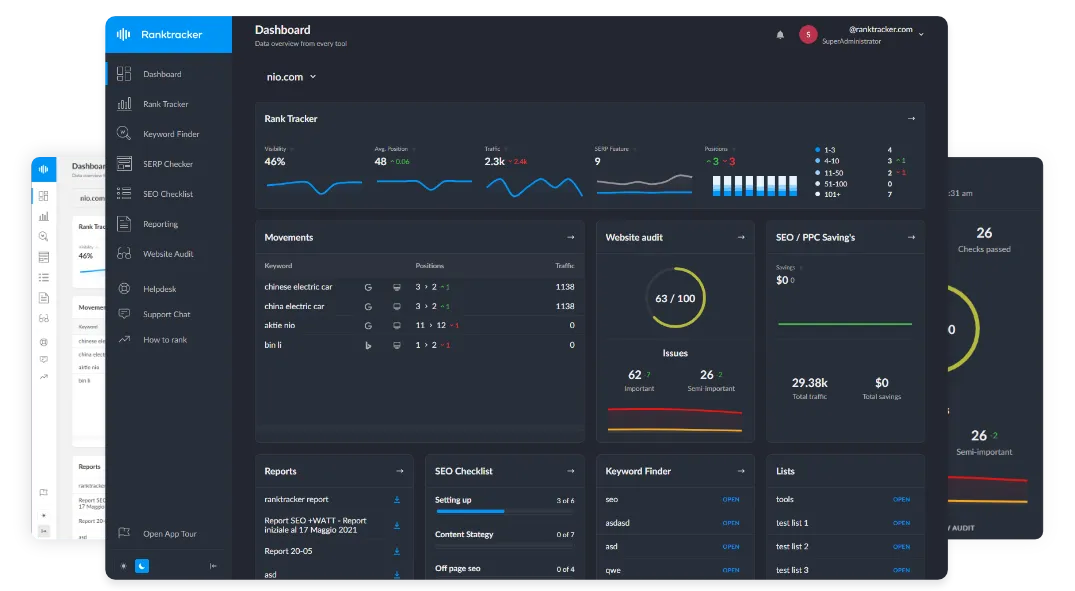
Behind every successful business is a strong SEO campaign. But with countless optimization tools and techniques out there to choose from, it can be hard to know where to start. Well, fear no more, cause I've got just the thing to help. Presenting the Ranktracker all-in-one platform for effective SEO
We have finally opened registration to Ranktracker absolutely free!
Create a free accountOr Sign in using your credentials
Claude fits well in:
- Research environments
- Academic or structured analysis tasks
- Independent platforms where external data links are secondary
Gemini fits best in:
- Workflows tied to Google services
- Tasks requiring real-time information
- Multiplatform tasks involving search, documents, and data retrieval
For users relying on Google Sheets for data, Docs for content, and Search for research, Gemini embeds more fluidly into daily processes.
Pricing Overview (2026)
Both platforms offer multiple tiers, from free access to paid professional and API plans. In many business contexts:
- Cost becomes secondary to output reliability and integration benefits.
- Scale and usage patterns matter more than headline pricing.
Evaluating long-term ROI requires testing each model’s output quality in your specific use cases rather than comparing subscription fees alone.
SEO-Specific Comparison
For marketers, accuracy and integration into SEO workflows are two of the most actionable differentiators.
Which AI Delivers More Accurate SEO Insights?
Claude provides thoughtful, well-structured responses, making it effective for initial research, topic clustering, and content planning. Its outputs tend to be logically consistent.
Gemini’s access to live data via the Google ecosystem often results in outputs that reflect current search trends, recent publications, and better context around knowledge gaps. This matters for SEO teams that need data rooted in live signals rather than static model training.
Neither tool should replace keyword databases, search analytics, or specialized SEO platforms. AI can suggest ideas, but data validation remains essential.
Professional SEO workflows should include:
- Generate topic ideas and outlines with AI
- Validate keyword metrics in Ranktracker
- Analyze current SERPs for intent and structure
- Publish AI-supported content
- Track rankings in the Top 100 continuously
This process ensures your content aligns with real search performance, not just generative plausibility.
Which Produces More Rankable Content?
Rankability hinges on:
- Intent accuracy
- Topic coverage
- Alignment with SERP features and entity signals
- Technical optimization
- Feedback from performance data
Gemini’s strength in real-world accuracy and integration with indexed data can help content align more closely with current search trends.
Claude’s structured reasoning can yield high-quality drafts but may require additional SEO tuning to match intent and competitive context.
Neither AI guarantees rankings. Success comes from integrating AI generation with performance measurement and iterative improvement.
Best For: Use Case Segmentation
Choose Claude if:
- You require deep analysis or long-form reasoning
- You handle structured documentation and research reports
- You value conservative, logical outputs
Choose Gemini if:
- You are deeply embedded in Google’s ecosystem
- You need live-accurate information and data context
- You work with multimodal content
- You drive workflows across search, documents, and cloud data
Final Verdict: Claude vs Gemini in 2026
There is no absolute winner. Each model excels in different areas:
- Claude excels in structured reasoning and contextual depth.
- Gemini leads in real-world accuracy and ecosystem integrations.
For users who rely heavily on Google tools, Gemini often delivers a smoother, more contextually relevant experience because of its integration with search, workspace, and cloud services.
The All-in-One Platform for Effective SEO
Behind every successful business is a strong SEO campaign. But with countless optimization tools and techniques out there to choose from, it can be hard to know where to start. Well, fear no more, cause I've got just the thing to help. Presenting the Ranktracker all-in-one platform for effective SEO
We have finally opened registration to Ranktracker absolutely free!
Create a free accountOr Sign in using your credentials
However, the real determining factor in SEO and content performance is not which model writes better paragraphs. It is whether your workflow includes systematic validation and measurement.
AI can assist with ideation and drafting. SEO tools measure outcomes.
A modern SEO workflow includes:
- AI for ideation and drafting
- Ranktracker for keyword validation and SERP analysis
- Daily Top 100 ranking tracking to measure impact
- Iterative optimization based on performance signals
In 2026, the advantage goes not to the model you choose but to the system you build.