Intro
Finding the best SEO agencies in Toronto sounds simple until you actually start looking.
You search the term, open a few lists, visit some agency websites, and very quickly realize they all say more or less the same thing. Everyone promises better rankings. Everyone talks about traffic. Everyone claims to have a “proven process.” That makes the real decision harder, not easier.
Toronto is one of the most competitive digital markets in Canada, and the agency landscape reflects that. There are specialist SEO firms, full-service digital agencies, local SEO shops, technical SEO consultants, and performance-focused teams all competing for the same clients. Lists from provider directories and roundups regularly feature agencies such as Search Engine People, Let’s Get Optimized, BrandLume, and dNovo Group among Toronto-area options, which gives you a sense of how crowded and active the market is.
That is why businesses should be careful not to judge an agency by branding alone.
The real question is not who sounds the most impressive. It is who can build a strategy that actually grows your visibility, traffic, leads, and revenue over time.
The All-in-One Platform for Effective SEO
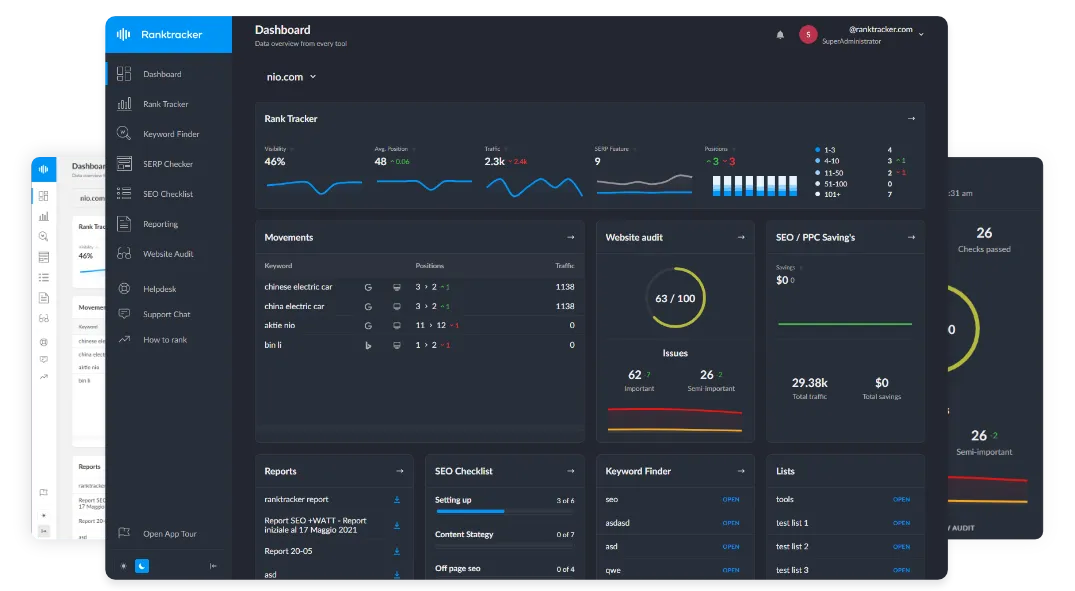
Behind every successful business is a strong SEO campaign. But with countless optimization tools and techniques out there to choose from, it can be hard to know where to start. Well, fear no more, cause I've got just the thing to help. Presenting the Ranktracker all-in-one platform for effective SEO
We have finally opened registration to Ranktracker absolutely free!
Create a free accountOr Sign in using your credentials
Why Toronto Businesses Have to Be More Selective
Toronto is not a light-competition market.
Whether you are in legal, healthcare, SaaS, ecommerce, home services, finance, or B2B, you are usually competing against businesses with established domains, mature backlink profiles, local visibility, and active content strategies. On top of that, Toronto has a deep pool of agencies, and major review platforms keep publishing large local lists, which shows how many firms are competing for attention in this city.
That changes what “good SEO” looks like.
In a smaller market, some basic on-page work and a few links might move the needle. In Toronto, that is rarely enough. Businesses usually need a stronger combination of:
- technical SEO
- local SEO
- content depth
- authority-building links
- conversion-focused pages
- performance tracking
The agencies that understand how those pieces work together usually produce stronger long-term results than agencies that only focus on one part of the system.
What Makes an SEO Agency Actually Worth Hiring
A lot of agencies are good at selling SEO.
Fewer are good at delivering it in a way that makes sense for the client’s business.
The best SEO agencies in Toronto are usually not the ones making the biggest promises. They are the ones that can clearly explain how they work, what they prioritize first, and how they measure progress.
Strategy Before Tactics
A strong agency does not jump straight into keywords or backlinks without context.
The All-in-One Platform for Effective SEO
Behind every successful business is a strong SEO campaign. But with countless optimization tools and techniques out there to choose from, it can be hard to know where to start. Well, fear no more, cause I've got just the thing to help. Presenting the Ranktracker all-in-one platform for effective SEO
We have finally opened registration to Ranktracker absolutely free!
Create a free accountOr Sign in using your credentials
It starts by understanding:
- the business model
- the market
- the customer journey
- the competitive landscape
- the most valuable services or product categories
That matters because not all traffic has the same value. Ranking for a broad keyword might look good in a report, but if it does not generate qualified traffic, it is not doing much for the business.
Technical SEO That Supports Growth
Technical SEO is often the difference between a site that can scale and one that keeps hitting invisible ceilings.
This includes work such as:
- improving crawl efficiency
- fixing indexing issues
- strengthening internal linking
- speeding up key pages
- cleaning up duplicate or thin content
- making site architecture easier for both users and search engines
A business may have great service pages and useful content, but if the technical foundation is weak, rankings can stall.
Content That Builds Topical Authority
The best SEO agencies do not treat content like filler.
They understand that content is how a website builds authority around the topics it wants to rank for. That is especially important in competitive markets like Toronto, where one landing page is rarely enough to win.
Good SEO content often includes:
- commercial landing pages
- supporting blog content
- service-specific guides
- FAQs
- comparison pages
- local pages
This kind of structure helps search engines understand both the depth and relevance of the website.
Link Building That Improves Real Authority
Backlinks still matter, but the way agencies approach them varies massively.
Some agencies still rely on quantity-first tactics. Others focus on relevance, editorial quality, and long-term brand safety. The better approach is usually the second one.
For most businesses, the best backlinks come from places like:
- relevant industry sites
- business publications
- legitimate directories
- regional media
- useful partnerships
- well-placed guest content
A link-building strategy should strengthen authority, not just inflate a report.
Why Local SEO Matters So Much in Toronto
For many businesses, local SEO is just as important as traditional rankings.
A company can rank well organically and still miss a huge number of leads if it does not perform well in the local pack. That is especially true for service businesses, law firms, clinics, agencies, and companies targeting city-based searches.
A strong Toronto SEO strategy often includes:
- Google Business Profile optimization
- review generation
- citation consistency
- localized landing pages
- location-specific keyword targeting
When someone searches for a service in Toronto, Google often prioritizes local relevance and trust signals alongside traditional SEO factors. Agencies that understand both can create stronger visibility across the full results page.
Why “Best” Depends on the Type of Business
 One of the biggest mistakes businesses make is assuming there is one universal “best” agency.
There usually is not.
The best SEO agency for a local law firm might not be the best fit for an ecommerce brand. The best agency for a SaaS company may not be ideal for a dental practice. Some firms are stronger in technical SEO. Some are better at local SEO. Some are better at content-led growth. Some are stronger when SEO is combined with PPC and CRO.
This is one reason roundup pages can be useful but incomplete.
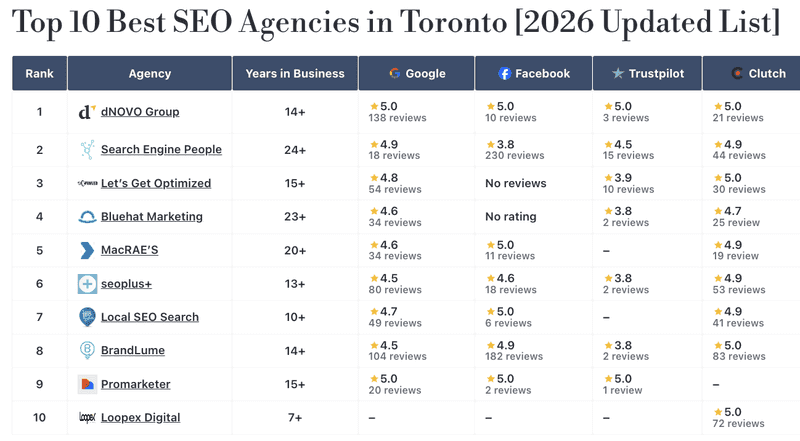
For example, dNovo’s Toronto roundup names ten agencies including dNovo Group, Search Engine People, Let’s Get Optimized, BlueHat Marketing, MacRAE’s, SEOplus+, Local SEO Search, BrandLume, Pro Marketer, and Loopex Digital. That gives businesses a starting shortlist, but not necessarily the right final answer for every business model.
A smarter way to evaluate agencies is to ask which one fits your business stage, growth goals, competition level, and market.
What Businesses Should Ask Before Hiring an SEO Agency
Most agency sales calls sound polished.
The questions you ask are what reveal whether the agency actually has depth.
Useful questions include:
- How do you decide what to prioritize in the first 90 days?
- How do you approach technical SEO versus content versus links?
- How do you measure lead quality, not just traffic?
- What kind of businesses do you usually get the best results for?
- How do you handle local SEO in a market like Toronto?
- What do your reports actually show?
- How do you adapt when rankings move but leads do not?
The goal is not to catch the agency out. It is to understand how strategic they really are.
An experienced agency should be able to explain its thinking clearly, not hide behind vague process language.
What Metrics Actually Matter
This is where a lot of SEO relationships go wrong.
The agency reports on rankings and impressions. The client cares about leads and revenue. Neither side is technically wrong, but they are not measuring success in the same way.
The metrics that matter most usually include:
- qualified organic traffic
- non-branded keyword visibility
- local pack visibility
- phone calls and form submissions
- conversion rate
- cost per lead compared to paid channels
- revenue contribution from organic search
Rankings still matter, of course. But they are only useful when they connect back to business performance.
This is exactly why platforms like Ranktracker are useful in the agency evaluation process. Businesses can monitor keyword movement, compare competitors, track local visibility trends, and see whether SEO momentum is actually building around the terms that matter most.
That makes agency reporting easier to validate and much harder to inflate with vanity numbers.
Why Case Studies Matter More Than Claims
Most agencies say they get results.
Case studies are where that claim becomes real.
A useful case study should show more than a before-and-after screenshot. It should explain:
- what the business challenge was
- what the agency changed
- what the ranking or traffic impact looked like
- how that translated into leads or growth
That is one reason agency list pages often mention case studies, retention, and reporting as evaluation criteria. dNovo’s own Toronto SEO roundup says it ranks agencies using factors such as case studies and real results, which is a more useful approach than relying on branding alone.
Businesses should always look for evidence that an agency can handle situations similar to their own.
Red Flags to Watch For
Not every SEO agency is a good one.
Some warning signs are easy to miss at first because they are wrapped in confident language.
Common red flags include:
- guaranteed #1 rankings
- vague explanations of link building
- no real discussion of conversion or lead quality
- overemphasis on traffic without business context
- generic audits with no prioritization
- no meaningful case studies
- unclear ownership of content, assets, or reporting
Good SEO takes time, testing, and iteration. Agencies that promise instant domination usually leave out the hard part.
How to Use a “Best SEO Agencies in Toronto” List Properly
A roundup article is useful when treated as a shortlist, not a final answer.
The best way to use one is to:
- identify a handful of agencies that seem relevant
- compare their strengths and positioning
- review their case studies and industry fit
- check whether their process matches your needs
- look at how clearly they talk about results
That gives you a much better chance of finding an agency that actually fits your business instead of simply choosing the loudest brand.
Final Thoughts
Finding the best SEO agencies in Toronto is less about discovering one perfect company and more about finding the right strategic fit.
Toronto is competitive, the SEO landscape is crowded, and agencies vary widely in how they approach growth. Some are better for local businesses. Some are stronger in technical SEO. Some work best for regulated industries. Some shine when SEO needs to support a broader digital strategy.
The All-in-One Platform for Effective SEO
Behind every successful business is a strong SEO campaign. But with countless optimization tools and techniques out there to choose from, it can be hard to know where to start. Well, fear no more, cause I've got just the thing to help. Presenting the Ranktracker all-in-one platform for effective SEO
We have finally opened registration to Ranktracker absolutely free!
Create a free accountOr Sign in using your credentials
dNovo Group’s Toronto roundup is one example of how agencies are being compared in 2026, and it reflects a wider reality: businesses have plenty of choice, but that makes careful evaluation even more important.
The strongest decision usually comes from looking past the headline claims and asking a more useful question:
Can this agency build a search strategy that improves visibility, attracts the right audience, and turns that attention into actual business growth?
That is the standard worth using.