Intro

When demos go wrong, they don’t just waste 30 minutes of Zoom time—they stall deals, burn out solution engineers, and leave buyers wondering whether your product can actually solve their problem.
Enter a new breed of “AI-first” demo platforms. These tools automate everything from storyboarding to stakeholder analytics so you can showcase value on demand—often before anyone from sales even hits “Join meeting.”
Below is a research-backed guide to the category, the evaluation criteria that matter, and an impartial rundown of the five best options on the market.
Why AI-Led Demos Are Exploding
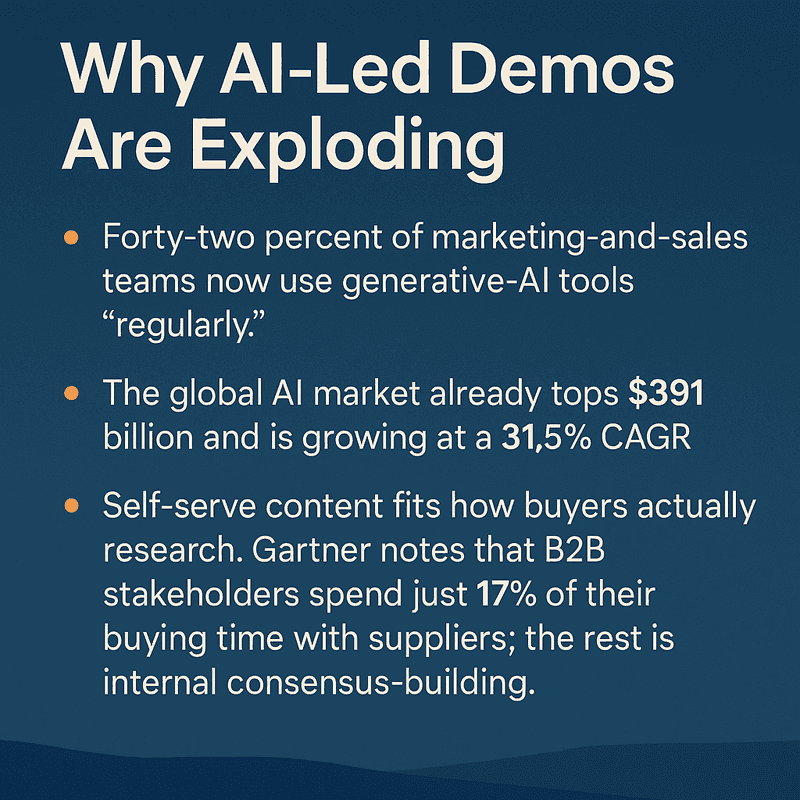
Forty-two percent of marketing-and-sales teams now use generative-AI tools “regularly.” The global AI market already tops $391 billion and is growing at a 31.5% CAGR.
Self-serve content fits how buyers actually research. Gartner notes that B2B stakeholders spend just 17% of their buying time with suppliers; the rest is internal consensus-building.
The All-in-One Platform for Effective SEO
Behind every successful business is a strong SEO campaign. But with countless optimization tools and techniques out there to choose from, it can be hard to know where to start. Well, fear no more, cause I've got just the thing to help. Presenting the Ranktracker all-in-one platform for effective SEO
We have finally opened registration to Ranktracker absolutely free!
Create a free accountOr Sign in using your credentials
AI demo platforms let you control that 83% by giving every champion a link they can forward instead of begging for a time slot.
The Core Problems AI Demo Platforms Solve
- Repetitive live demos. When presales teams deliver the same “101” walk-through five times a day, fatigue (and payroll) skyrockets.
- Self-education gap. Prospects comparison-shop long before talking to sales. If you aren’t feeding them tailored product experiences, a competitor will.
- Data blindness. Traditional video hosting shows views, not which features each stakeholder cares about. Navattic’s top 1% of demos now enjoy 54% CTR and 61.6% completion rates—numbers that fuel targeted follow-up.
Evaluation Framework: Seven Questions to Ask Every Vendor
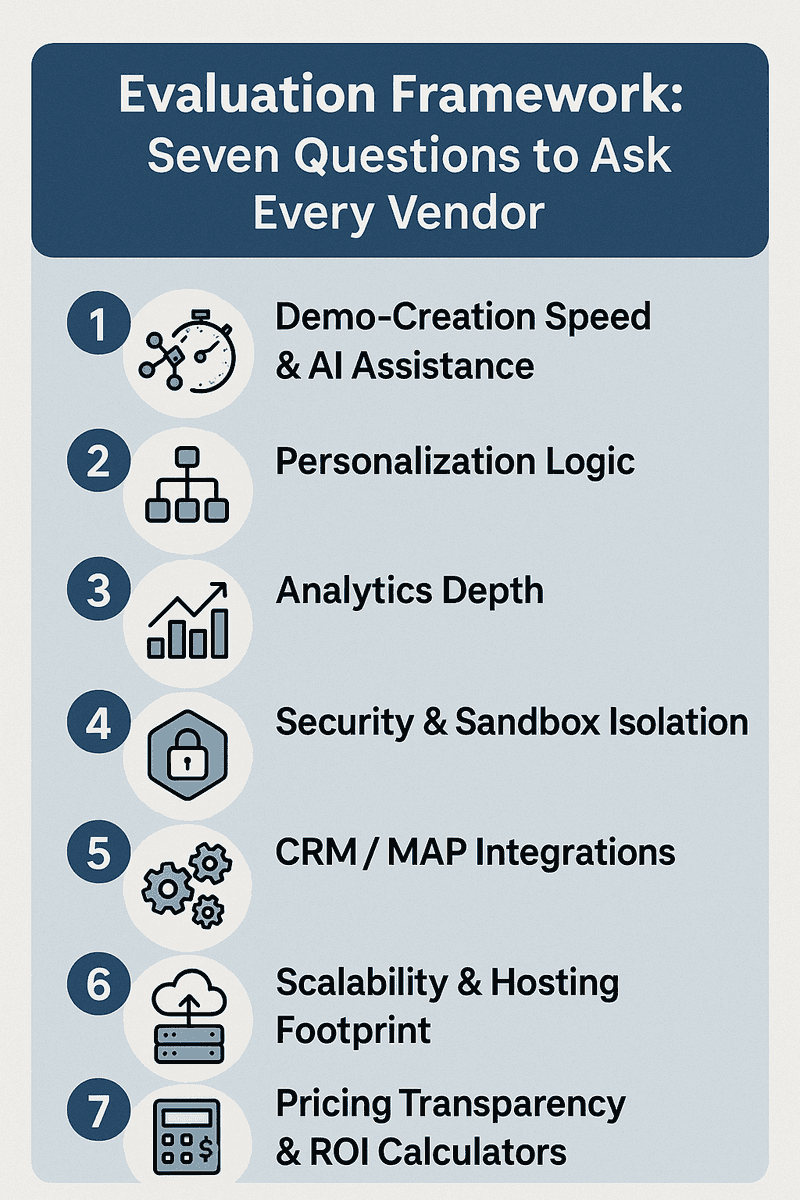
1. Demo-Creation Speed & AI Assistance
- Does the platform auto-generate storyboards, voice-overs, or translations?
- How many hours does it take to ship a finished tour?
2. Personalization Logic
- Can prospects select their role or use case and branch automatically?
- Is demo content dynamic (text replacements, localized copy) or static?
3. Analytics Depth
- Do you get heat maps, screen-level drop-offs, and time-in-view?
- Can data pipe into HubSpot, Marketo, or your CDP?
4. Security & Sandbox Isolation
- SOC 2 or ISO 27001 certified?
- Can sensitive data be masked or replaced with synthetic sets?
5. CRM / MAP Integrations
- Native connectors to Salesforce, Outreach, or Slack alerts?
- Webhooks and REST API for custom stacks?
6. Scalability & Hosting Footprint
- Will hundreds of concurrent demo sessions throttle performance?
- Any limit on monthly views or storage?
7. Pricing Transparency & ROI Calculators
- Seat-based, usage-based, or flat SaaS?
- Does the vendor publish an ROI model (for example, Consensus’ Demo Automation ROI Calculator)?
The Shortlist: Five Best AI Demo Platforms for 2026
1. Consensus – The Category Creator
Why it leads
Consensus uses AI to turn raw screen captures into guided tours—complete with autogenerated scripts and multilingual voice-overs.
Its trademark Demolytics® engine tracks which stakeholders engage with each demo and can surface ‘hidden influences’ in the buying committee.
Consensus offers a native Salesforce integration that can pass buyer-engagement data to CRM records.
Ideal for
Enterprise SaaS teams are juggling complex buying committees across sales, presales, marketing, and channel.
Watch-outs
Storyboards require some upfront strategy for the optimum automated results; be careful not to feed messy feature dumps at the tool.
2. Navattic – The Self-Serve Powerhouse
Navattic shines at speed: drag-and-drop hotspots, form gates, and checklists mean marketing can ship a tour in a single sprint.
Its new GA4 integration sends anonymous usage events straight to your analytics stack, making it simple to compare demo engagement with other demand-gen channels.
Best for PLG and growth-team experiments where rapid iteration trumps deep enterprise governance.
3. Reprise – Sandbox Maestro
Reprise differentiates with “full-fidelity sandboxes.” Instead of static screens, users click around a cloned, data-safe copy of your application.
Built-in blur rules strip PII while preserving realism, so you can hand prospects the keyboard without legal nightmares.
The All-in-One Platform for Effective SEO
Behind every successful business is a strong SEO campaign. But with countless optimization tools and techniques out there to choose from, it can be hard to know where to start. Well, fear no more, cause I've got just the thing to help. Presenting the Ranktracker all-in-one platform for effective SEO
We have finally opened registration to Ranktracker absolutely free!
Create a free accountOr Sign in using your credentials
Expect heavier implementation but unrivaled authenticity for technical audiences.
4. Walnut – Sales-Led Storytelling
Walnut courts AEs with a Chrome extension that records flows on the fly. Toggle Guided or Live modes during calls, reuse the same asset post-call, and push metrics to the Walnut AI Coach for personalized pitch feedback.
Think Gong, but for demos.
5. Storylane – SMB-Friendly On-Ramp
Storylane targets lean teams that need polished tours without enterprise price tags. AI voice-overs, one-click “mini-demo” GIF exports for LinkedIn, and shared templates keep content fresh.
Lacks the advanced stakeholder analytics of Consensus or Reprise, but total cost of ownership is hard to beat for early-stage startups.
Feature-by-Feature Glance
- Storyboard AI: Consensus, Navattic, Storylane
- Data-safe sandboxing: Reprise (full), Consensus (simulation mode)
- Buyer-level analytics: Consensus (Demolytics®), Walnut (pitch coach), Navattic (GA4)
- Role-based branching: Consensus, Walnut
- Native Salesforce integration: Consensus, Reprise, Walnut
- Free tier: Navattic (limited), Storylane (trial only)
Hidden Costs & Gotchas
- Content upkeep. Your app UI will change; factor quarterly tour refreshes into scope.
- Privacy reviews. Sandboxing still means screenshots—legal may require DPA or redaction workflows.
- Voice-over localization. AI voices are cheap, but professional QA for 10 languages isn’t.
Implementation Roadmap: 90 Days to ROI
Phase 1 – Pilot (Weeks 1-3)
- Pick one high-impact flow (e.g., onboarding dashboard).
- Build v1 tour, gate with email, push events to CRM.
- Define success: demo-sourced meetings or pipeline $.
Phase 2 – Roll-Out to SDRs & AEs (Weeks 4-8)
- Train reps to attach demos in first-touch emails.
- Share demo links and engagement summaries (Consensus integrates with Slack, making for seamless communication).
- Iterate scripts based on drop-off heat maps.
Phase 3 – Full-Funnel Integration (Weeks 9-12)
- Embed demos on pricing, comparison, and blog pages.
- Trigger nurture sequences when prospects hit “Finish Tour.”
- Report lift: Ramp attributes 15% of total inbound leads to its interactive tour—proof that AI demos convert cold traffic into pipeline.
Caveats & Counterpoints
- Hallucination risk. Generative scripts can invent features; always human-review voice-overs.
- Vanity metrics. High completion rates look great but track “meetings booked per 100 views” for real impact.
- Live demos still matter. Complex security deep-dives or bespoke integrations need human nuance; AI tours should complement, not replace, engineering calls.
Conclusion: Choose a Platform That Scales With You
AI demo software isn’t magic—it just lets your best pitch run 24/7. Start small, measure pipeline lift, then expand once you’ve proven value.
Whether you favour Consensus for enterprise analytics, Reprise for sandbox authenticity, or Navattic for growth agility, the right tool will free your experts to focus on strategic conversations and move prospects from click to close—fast.